Custom software development pricing in 2026 defies simple benchmarks. Rates, team models, and technology choices interact in ways that can shift a project’s total investment by 30x or more — and most of that variance is invisible at the quoting stage. What follows breaks down the real pricing drivers, from market rates and engagement models to hidden charges and estimation strategy.
Pricing Trends and Market Rates
The market in 2026 is wildly fragmented. The gap between the cheapest and most expensive options now spans over 30x — driven by regional wage differences, vendor tier stratification, and the rising price of specialized talent. On a mid-size project, that spread can mean $100,000 or more in budget variance. Picking the right vendor has never mattered more.
Rates by Region
Regional hourly rate averages in 2026 range from $28 in Asia Pacific to $66 in Western Europe, with North America at $55, Latin America at $50, Eastern Europe at $37, and Africa at $31. Market salary trends in software development keep shifting as businesses reassess software development pricing against global competition and evolving skill demands. Median developer compensation keeps rising in specialized domains — AI, cloud-native architecture, and cybersecurity — while generalist salaries are plateauing as the global talent pool expands. Companies that don’t track these salary movements risk overpaying for commodity skills or losing critical talent to competitors offering market-rate pricing structures.
Pricing by Vendor Size
Hourly software development rates in 2026 are split into pricing tiers based on vendor size, and those tiers are diverging. Rates range from $40 to $150+ per hour. With software development projects easily hitting thousands of hours, even a small rate difference compounds into a five- or six-figure budget impact.
Enterprise-class firms charge $400+/hour, some exceeding $900. Big business-class firms charge $250–$350, mid-market firms $120–$250. A local development company in North America or Western Europe typically bills $100–$250/hour — the premium option for companies that prioritize communication clarity and legal simplicity. An outsourcing agency charges $25–$85/hour, depending on geography and seniority, compared to $100–$250+ for a local development company.
Project size further shapes the pricing trend. Smaller engagements ($20,000–$500,000) are seeing per-hour rates rise as vendors add minimum-commitment clauses and onboarding surcharges. Mid-range projects ($150,000–$5 million) remain the pricing sweet spot — quoted rates are trending down 5–8% year-over-year as vendor competition in this segment intensifies.
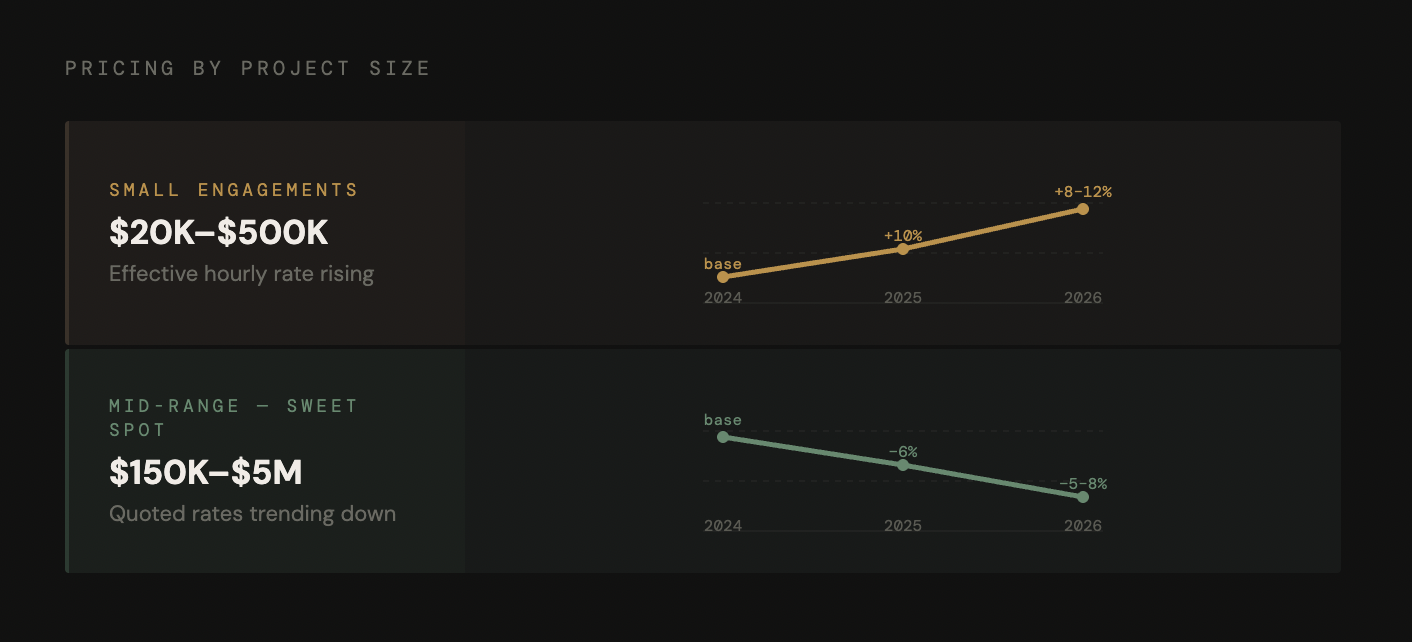
Project size determines negotiating power. Mid-range budgets hit the sweet spot between vendor competition and delivery efficiency.
Rates and Pricing by Seniority
Junior developers typically charge $25–$50 per hour, mid-level professionals $45–$85, and senior specialists $75–$150 or more. Freelancers on platforms like Upwork and Arc report average rates of $81–$100 per hour, though the range stretches from $10 to $300 depending on geography and track record.
Team size and experience are driving a visible pricing split in 2026. Rates for compact senior teams (3–5 engineers) have risen 10–15% year over year as demand outpaces supply. Rates for larger junior-heavy teams remain flat or declining.
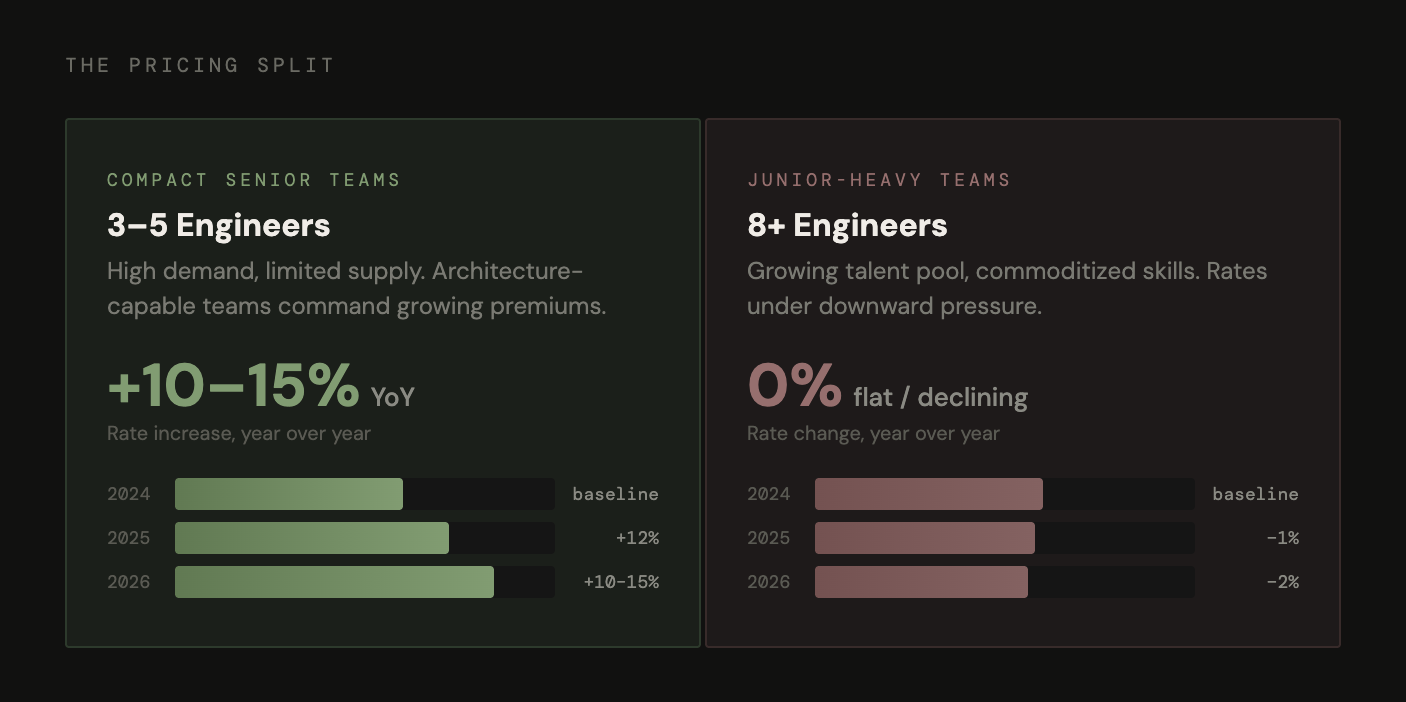
Demand for senior talent outpaces supply while AI tooling commoditizes junior output, compressing rates at the lower end.
Vendors now quote AI/ML engagements at a 30–50% premium over equivalent-complexity projects on standard stacks — a pricing gap that has widened steadily since 2024 and shows no sign of closing.
Offshore Rates
Offshore development rates range from $27 to $55 an hour, depending on region, seniority, and technology stack. By region: Asia: $20–$50 per hour; Africa: $20–$45; Eastern Europe: $30–$58; Latin America: $25–$55. According to Clutch’s February 2026 data, the majority of listed software development companies charge $24–$49 per hour — a baseline that reflects the dominance of mid-size offshore and nearshore firms in the global marketplace.
Sprint-based billing is replacing fixed-bid contracts on mid-size projects, driving 10–15% reductions in total engagement pricing. Outcome-tied structures are emerging in which vendors discount their hourly rates in exchange for performance bonuses tied to delivery milestones. Blended-rate teams — mixing senior and mid-level developers under a single averaged hourly figure — are becoming the default, letting clients lock in predictable budgets without negotiating individual rates per seat.
Nearshore Rates
Nearshore software development rates range from $44 to $82 an hour — a clear premium over the $27–$55 offshore band. Latin American rates hit $70–$75 per hour for senior roles, with North American companies paying that premium for shared time zones and cultural proximity. Eastern European pricing is lower: mid-level developers bill $35–$55 per hour, and senior specialists bill $60–$85 per hour.
Hybrid agile methodologies have driven a measurable rate correction in the nearshore segment — sprint-billed engagements now price 10–20% below the fixed-bid market average, narrowing the pricing gap between nearshore and offshore. In an agile environment, time-and-material pricing aligns naturally with sprint-based delivery. Each sprint delivers a working increment, and the client retains the option to adjust priorities or pause.
Total Engagement Investment
The headline hourly rate is just the starting line. Some companies are shifting to value-based pricing models that tie compensation to delivered outcomes — such as working features, performance benchmarks, or business KPIs — rather than hours logged. Time-and-materials pricing suits projects where requirements evolve: R&D, early-stage products, or builds where discovery and development run in parallel. Above $5 million, rates include built-in premiums for project management, security audits, and SLA guarantees — pushing the effective price 20–30% above the listed base rate.
Compliance with data privacy laws and industry standards is becoming a measurable line item in software development pricing. The gap between a $35/hour vendor without compliance certifications and a $45/hour vendor with them narrows once the client factors in the expense of independently closing those gaps. In regulated sectors — healthcare, finance, government — choosing a pre-certified vendor at a higher hourly rate is often the more financially sound option.
The companies extracting the most value from outsourcing in 2026 are those that evaluate the total investment rather than the hourly rate alone, factoring in time zone alignment, retention rates, code quality metrics, and management overhead. When two vendors quote $180,000 and $320,000 for the same project brief, the gap rarely reflects a proportional difference in quality — it reflects different assumptions about scope, staffing models, risk premiums, and levels of post-delivery support included in the price. Pricing benchmarking against industry data — regional rate averages, project-type baselines from platforms like Clutch or GoodFirms, and historical data from comparable internal projects — provides an independent reference point that prevents both overpaying for standard work and underestimating the true investment required for complex builds.
Factors Influencing Custom Software Pricing
Estimating the pricing of custom software development is inherently complex — no two projects share the same scope, architecture, or business constraints. Custom software demands a higher initial investment — typically $50,000 to $500,000 for small-to-mid-scale projects — but eliminates recurring license fees, removes SaaS vendor lock-in, and delivers a product shaped to the organization’s exact workflows.
Pricing varies widely based on technical complexity, feature depth, team composition, location strategy, infrastructure decisions, and delivery model. A realistic software development budget estimate must account for how these variables interact — not just individually, but systemically — including the structural pricing drivers that compound over time.
Features and Custom Design
The depth and variety of features and functionalities are among the most direct factors influencing custom software pricing — the number of features and functions affects the amount of work, and the sophistication of user roles and underlying logic dictates the development hours required. Front-end pricing depends on the number of screens, interaction complexity, supported platforms (web, iOS, Android), and the level of custom visual design. In complex enterprise environments, the aggregate price of licensing, customizing, and integrating multiple SaaS tools often exceeds the investment in a unified, custom solution — a reality more common than generally appreciated.
Team, Location, and Seniority
The pricing of custom software is inseparable from the team that builds it. Developer seniority is one of the most misunderstood pricing variables — experience directly affects project outcomes, and rates vary significantly with the experience level of the team involved. The custom software development hourly rate reflects that difference: more complicated software doesn’t just take longer to build — it requires more experienced engineers, more careful architecture planning, and more rigorous testing.
Team location shapes the effective pricing through team quality, management overhead, and how well-defined your requirements are before engagement begins.
The same product scope can vary by 2–5× in price depending on whether it is built by an in-house team, a freelancer, a local development company, an outsourcing agency, or by outsourcing dedicated teams to an offshore or nearshore partner. Project size, team size and experience level, and vendor size all determine throughput capacity, communication complexity, and the depth of oversight required.
Execution Risk and Governance
Communication overhead, time zone differences, cultural differences, and potential quality variances all influence how smoothly the project runs and the level of management effort required. A team split across three time zones needs more structured handoffs, more documentation, and more synchronous checkpoints — all of which add overhead without adding features.
The project size, team size, experience level, and vendor size all affect throughput and governance complexity. Larger teams don’t scale linearly — a 20-person team requires dedicated project managers, formalized sprint processes, and layered QA that a 5-person team handles informally.
The seniority of developers on the team determines how much oversight, architectural guidance, and rework the project requires. Junior-heavy teams ship more bugs, need more code review cycles, and demand more hands-on technical leadership — lowering the hourly rate but raising the total investment.
Complexity, Integrations, and Tech Stack
Small shifts in software complexity can multiply the total price — together, these variables can shift the pricing of custom software development by an order of magnitude.
Technology requirements determine how deeply third-party integrations affect the build. Connecting a custom build to existing systems — ERP platforms, legacy databases, SaaS products, and partner APIs — requires integration work that is notoriously difficult to estimate accurately. Custom software rarely operates in isolation — it connects to payment gateways, CRM platforms, email services, analytics tools, mapping APIs, and industry-specific data providers through third-party connectors.
The cloud provider you choose and how well you understand its pricing models can have a significant impact on both development and operational expenditure. AWS, Azure, and Google Cloud pricing structures are complex, with rates varying by compute instance type, storage tier, data transfer volume, region, and commitment term.
The choice of programming language, framework, database engine, and deployment environment determines which specialists are needed, how long core development takes, and how much flexibility the system retains as it scales. Vendor lock-in occurs when the software is built on proprietary platforms, frameworks, or cloud services that make switching providers technically difficult and financially expensive. Lock-in with cloud services providers, low-code platforms, or proprietary database engines can create switching fees that exceed the original development investment.
How Pricing Drivers Compound
The pricing factors above don’t move independently — they compound. Project size, team size, experience level, and vendor size interact to shape both throughput and governance complexity. A complex AI feature built by a junior offshore team with unclear project scope doesn’t add three separate pricing premiums — it multiplies them. Project constraints shape every estimation decision: a hard budget ceiling may force a reduction in scope, a fixed deadline may require a larger team that increases the total investment, and a technology mandate may limit the pool of available vendors.
The pricing of custom software development has changed significantly over the last two years — talent competition, infrastructure expenditure, and contract structures have all evolved. Software development budgets are often estimated based on complexity alone, but they also compound over time. A team of five senior developers will command significantly higher rates than a team of eight junior and mid-level developers. Each factor carries a different weight depending on the specific build, and understanding which ones dominate your project is the first step toward an accurate software development budget estimate.
From Budget Estimation to Pricing Model
Before writing a line of code, smart teams invest in requirement gathering and business analysis to define what they’re actually building. This isn’t overhead — it’s insurance. A structured feasibility study catches misaligned assumptions early, when changes take hours instead of months. ROI estimates built on real project data — not gut feelings — give stakeholders the confidence to commit budget.
Then comes budget forecasting. A software development pricing calculator can generate useful ballpark figures, but no tool replaces the judgment of someone who’s shipped similar software before. The difference between a project that finishes on budget and one that overruns by 50% is almost never the development itself — it is the quality of the estimation and planning that happened before a single line of code was written.
The pricing model you select determines who bears the risk. A fixed price model protects the client’s budget but limits flexibility — vendors price in uncertainty, so you pay a premium for predictability. Time-and-materials pricing lets you adjust project scope as you learn, but requires disciplined project constraints to prevent budget drift. The more precisely you can specify features and integrations, the more options you have.
No budget estimate — regardless of method or rigor — accounts for every variable that will surface during a custom software build. A vendor quote is not an estimate — it is a commercial proposal shaped by the vendor’s pricing strategy, capacity utilization, and competitive positioning. Evaluating vendor quotes effectively requires decomposing them into comparable components: hourly rates by role, estimated hours by phase, infrastructure fees, licensing charges, and post-launch support terms.
How AI Is Reshaping Pricing
AI and low-code platforms are fundamentally altering how software is built — and what it costs to build it. To understand where the pricing moves, you need to examine both sides of the equation: the new expenditure these technologies introduce and the efficiencies they generate in return.
AI Integrations and the Shifting Price
Capabilities like chatbots, recommendation engines, natural language processing, and predictive analytics carry a meaningful price premium — but they deliver proportional value. Training or fine-tuning models, building data pipelines, managing inference infrastructure, and handling edge cases in AI behavior all demand specialists whose hourly rates run 20–40% above those of standard software engineers. Cloud-based infrastructure with high-performance GPUs for model training and testing adds another layer of recurring expenditure — typically $2,000–$15,000 per month or more, depending on workload and provider.
The upfront investment in AI features is higher than for conventional functionality, but the long-term returns — in automation, personalization, and operational efficiency — can be transformative. Organizations should budget not just for the build, but for ongoing model monitoring, periodic retraining, and the dedicated infrastructure that sustains production AI systems over time.
AI-Powered Development Tools
On the other side of the equation, AI is making certain categories of development meaningfully less expensive. Tools like GitHub Copilot and ChatGPT Code Interpreter have become standard fixtures in professional engineering workflows — accelerating unit test generation, shortening debugging cycles, and lowering the barrier to navigating unfamiliar codebases. Industry data consistently points to 20–35% productivity gains on routine coding tasks, translating into real budget savings on large-scale projects.
These tools do not eliminate the need for skilled engineers. AI-generated code still requires human review for accuracy, security posture, and architectural fit. The net effect is not fewer developers — it is shorter development cycles. In pricing terms, that means reduced total hours and compressed timelines rather than lower hourly rates.
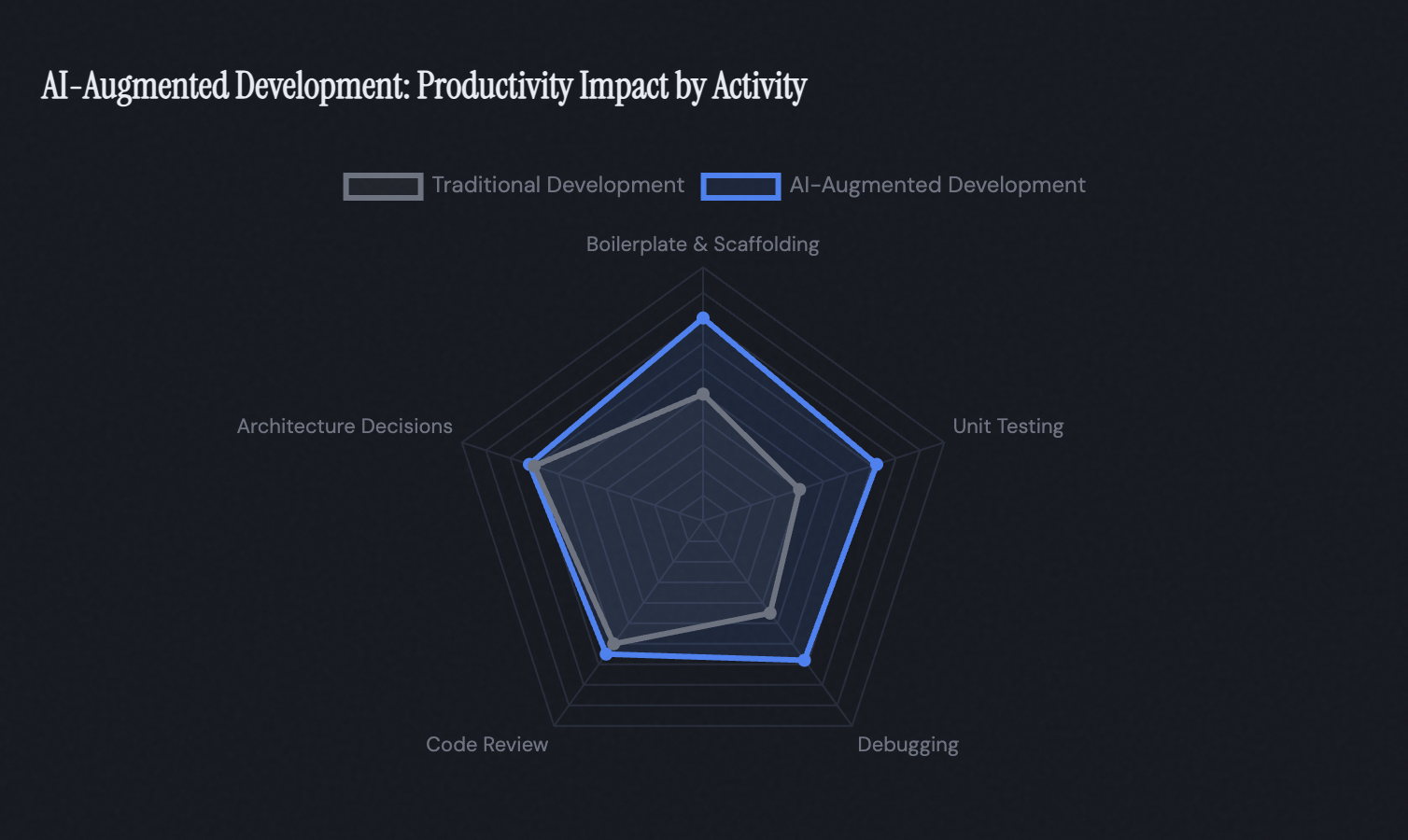
AI-Augmented Development: Productivity Impact by Activity — traditional vs. AI-augmented development compared across key engineering tasks
Low-Code and No-Code Platforms
Low-code platforms like Retool, Bubble, and Microsoft Power Apps occupy a distinct pricing tier. For internal tools, simple workflows, and MVPs, they can reduce development investment by up to 80% compared to building from scratch. The emergence of low-code AI platforms — combining visual development with built-in capabilities like automated document processing and predictive analytics — has extended these gains further, enabling non-engineers to deliver functional software without writing significant custom code.
The trade-off is long-term flexibility. Projects that begin on low-code platforms often face re-architecture when business needs outgrow the platform’s constraints — and that transition carries its own price. Many organizations encounter this same inflection point when they migrate from Excel to custom software. The early savings can be partly offset by migration expenditure later, so the most important question is whether a given platform can genuinely support the product’s growth trajectory.
The Hybrid Approach
In 2025–2026, the most financially efficient delivery strategy is typically a deliberate combination of methods: low-code tooling for admin panels and internal dashboards, AI-assisted development environments to accelerate custom code, and fully bespoke engineering reserved for the core features that define competitive differentiation. By matching the right technology layer to each component of the product, teams avoid over-engineering the ordinary and under-investing in the extraordinary — achieving the strongest possible pricing efficiency across the entire build.
Software Development Teams
The way you hire and manage your development team has as much of an effect on the total investment as the software itself. Team structure and engagement model selection is a strategic choice — not an administrative one.
The pricing of custom software is inseparable from the team that builds it. Software with complex functionality and a highly animated interface, developed in the agile environment of a fast-moving product company, demands a very different team structure than a straightforward internal tool with stable requirements. Organizations pursuing custom software face a broad spectrum of delivery options: in-house software development, freelancers, a local development company, offshore/nearshore software development companies, a dedicated outsourcing agency, or enterprise-class custom software development companies capable of full-cycle development — from discovery through deployment and long-term support.
Each model carries distinct pricing profiles, risk characteristics, and operational constraints. The optimal choice depends on project complexity, required velocity, budget parameters, and whether the organization needs to retain full intellectual ownership or can delegate execution to an external partner. Below, we evaluate every major team structure and contract model to provide the analytical framework needed to match engagement type to project requirements.
In-House Software Development
In-house software development offers maximum organizational alignment, institutional knowledge accumulation, and direct management control. When your product is the business — a SaaS platform, a marketplace, a data-intensive application — in-house software development is typically the only model that provides the strategic depth required. Teams embedded within the organization understand the competitive landscape, customer pain points, and long-term product vision in a way that external partners cannot replicate.
The investment, however, is substantial. A mid-sized US-based in-house team — product manager, designer, four engineers, QA engineer — carries an annual fully-loaded budget of $800,000–$1.2 million including compensation, benefits, facilities, equipment, recruiting, onboarding, and professional development. In-house software development is justified when the software is a core business asset requiring continuous, long-term development and deep organizational context. It is essential in an agile environment where rapid iteration, institutional memory, and cross-functional collaboration are critical to delivery velocity.
Freelancers
Freelance developers offer maximum pricing flexibility and minimal commitment overhead. Hourly rates for freelancers on platforms like Upwork, Toptal, and Arc range from $30 to $200+, depending on geography, specialization, and platform vetting tier. For well-specified, self-contained deliverables — a specific API integration, a UI component library, a data migration script — freelancers represent the most agile procurement option.
The limitations emerge at scale. Coordinating multiple freelancers on a complex project introduces significant management overhead, creates knowledge fragmentation, and exposes the organization to continuity risk when individual contributors disengage. Freelancers are rarely appropriate as the primary delivery vehicle for core product development, but they excel as targeted supplements to in-house or agency teams.
Local Development Company
A local development company in North America or Western Europe offers proximity advantages — shared time zones, cultural alignment, legal simplicity, and in-person collaboration — at a pricing premium that reflects those benefits. Hourly rates typically range from $100 to $250. For organizations where communication clarity, IP sensitivity, or regulatory requirements make offshore engagement impractical, a local development company is the appropriate default.
The value proposition is strongest for mid-scale projects ($100,000–$500,000) where management overhead from geographic and cultural distance would meaningfully erode the savings offered by offshore alternatives.
Offshore and Nearshore Agencies
Offshore and nearshore software development companies offer the most compelling pricing-to-capability ratio for organizations willing to invest in clear communication infrastructure and disciplined project governance. Hourly rates range from $25 to $85 offshore and $44 to $82 nearshore, enabling teams to access senior-level engineering talent at a fraction of the North American or Western European market rate.
The nearshore model — leveraging teams in compatible time zones — has gained significant adoption as organizations discovered that the productivity benefits of real-time collaboration more than offset the modest pricing premium over pure offshore engagements. Eastern Europe and Latin America represent the two dominant nearshore markets for North American and Western European buyers.
Dedicated Team Model
The dedicated team model sits at the intersection of outsourcing economics and in-house operational characteristics. Rather than purchasing project-based deliverables, the client engages a pre-formed team — engineers, QA specialists, a project manager — on a time-and-materials basis, with the team operating as a functional extension of the client’s organization. This model is optimally suited for long-running product development programs where continuity, institutional knowledge accumulation, and adaptive capacity are valued over fixed-scope delivery.
Enterprise-class custom software development companies frequently offer the dedicated team model as their flagship engagement structure, combining the pricing efficiency of offshore/nearshore software development companies with enterprise-grade project governance, security protocols, and delivery assurance. For complex programs requiring full-cycle development across multiple phases, enterprise-class custom software development companies provide the process maturity, risk management frameworks, and scaling capacity that smaller agencies cannot match. Understanding what a software development company does across the full delivery lifecycle helps set accurate expectations before engagement.
Pricing Comparison: Team Models Side by Side
In the table below, we compare the pricing of four team configurations: a local US company, an in-house team in the US, freelance developers, and an outsourcing development agency from Ukraine — one of the most established offshore destinations for software engineering.
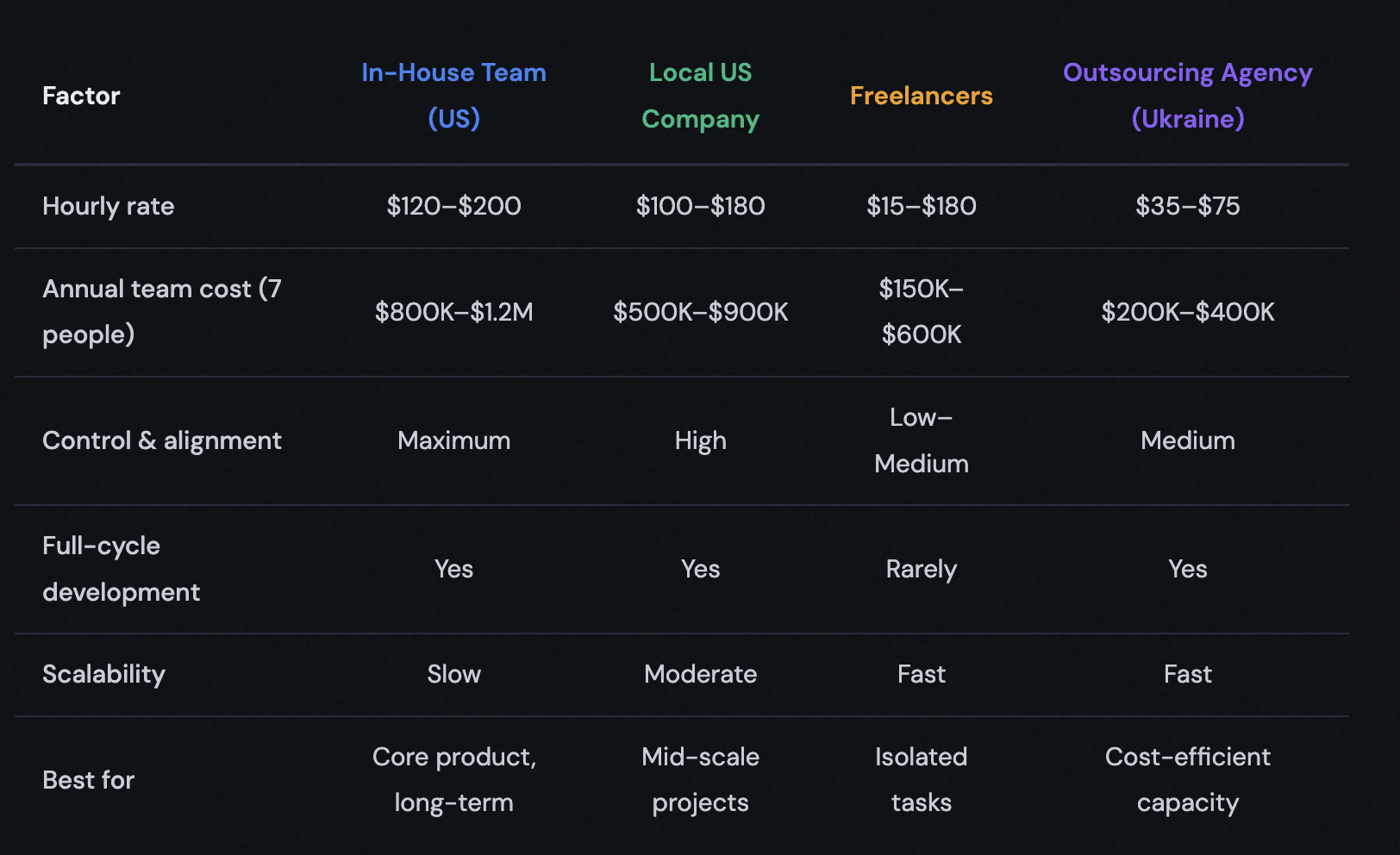
Software development team pricing comparison: In-House, Local US Company, Freelancers, and Outsourcing Agency across key factors
The comparison illustrates a central principle: there is no universally optimal model. The right choice depends on the intersection of budget constraints, project duration, required expertise, and the organization’s tolerance for management overhead. For projects requiring full-cycle development with tight budgets, an outsourcing agency or the dedicated team model from offshore/nearshore software development companies typically delivers the strongest pricing-to-capability ratio.
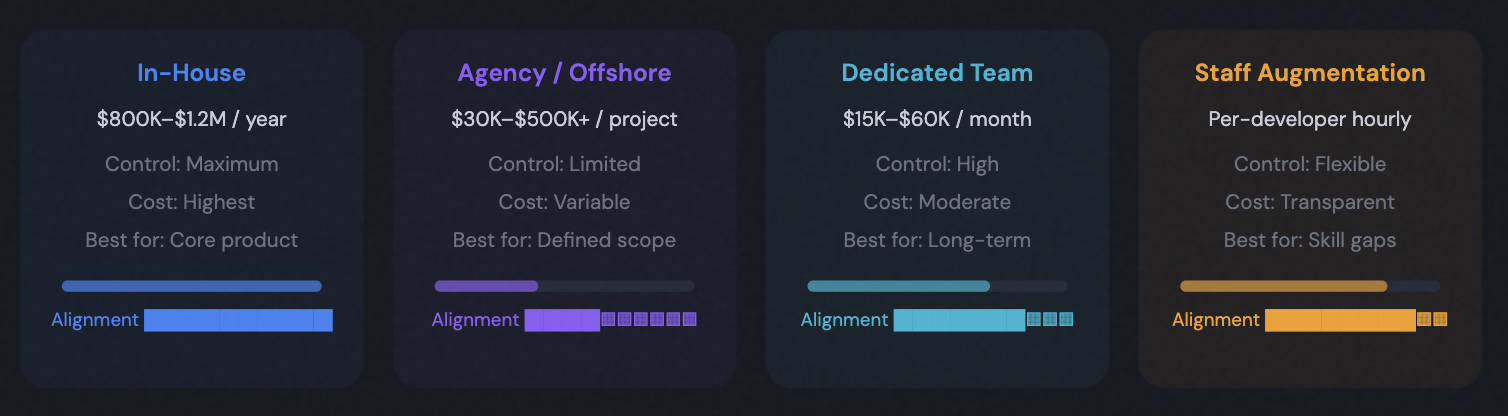
Software development team models compared: In-House, Agency/Offshore, Dedicated Team, and Staff Augmentation — pricing, control, and alignment at a glance
Contract Structures: Fixed-Price, Time and Material Model, and Hybrid Approaches
The contract structure determines how risk is distributed between client and vendor, and directly shapes budget predictability, scope flexibility, and delivery incentives.
Fixed-price contracts provide budget certainty but require exhaustive upfront specification. They are appropriate for small, well-defined engagements — particularly initial discovery phases or standalone deliverables where the scope can be fully articulated before work begins. Fixed-price works well when you go for an MVP (minimal viable product) where the feature set is deliberately constrained and the goal is speed to market rather than long-term scalability. Scope changes trigger renegotiation, and vendors routinely embed risk premiums of 15–30% in fixed-price estimates to absorb specification ambiguity.
The time and material model is ideal for medium to large projects with evolving requirements. Under a time and material model, clients pay for actual hours worked, gaining flexibility to reprioritize features, adjust team composition, and respond to market signals mid-engagement. But if your project is likely to evolve, a time and material model gives you more flexibility to adjust features, design, and priorities as needed — which is precisely why the time and material model has become the dominant contract structure for complex custom development programs operating in an agile environment.
Most enterprise-class custom software development companies offer the time and material model as the default for engagements exceeding $100,000 or six months in duration. The trade-off is that time and material model contracts require active budget governance. Without disciplined oversight — regular budget reviews, explicit change-order processes, and transparent reporting — time and material model engagements are susceptible to budget drift. Organizations operating in an agile environment should pair the time and material model with velocity tracking, burn-down reporting, and sprint-level budget checkpoints to maintain financial control.
In practice, high-performing engagements frequently employ a hybrid structure: fixed-price for discovery, requirements engineering, and architecture phases where scope can be rigorously defined, transitioning to a time and material model for iterative development and delivery where flexibility creates value. This hybrid approach combines the budget predictability that stakeholders require during planning with the adaptive capacity that engineering teams need during execution.
Engagement Model Selection Framework
Match team structure to strategic priority. Choose in-house software development for core IP and long-term product ownership; request expert support from specialists when needed. Engage freelancers for well-specified, isolated tasks. Partner with a local development company for mid-scale projects requiring proximity. Scale through offshore/nearshore software development companies or an outsourcing agency for pricing-efficient capacity. Select the dedicated team model when you need outsourcing of dedicated teams — hire a ready-to-go dev team with in-house-level continuity. Use the time and material model in an agile environment; fixed-price when scope is fixed. Go for an MVP (minimal viable product) first to validate before committing to full-cycle development with enterprise-class custom software development companies.
Off-the-Shelf vs Custom Solutions
Not every business need warrants custom development. The build-vs-buy decision should be driven by economic analysis and strategic necessity, not organizational ego.
For standard business functions, off-the-shelf SaaS products are almost always more economical in the short term. Replicating the feature set of Salesforce, Jira, or QuickBooks through custom development would require investment orders of magnitude greater than licensing fees. Low-code platforms further extend the buy-side option, enabling rapid construction of internal tools, dashboards, and workflow automation without full custom engineering investment.
Custom development is economically justified in four scenarios. First, when the software is the revenue-generating product itself — a platform, marketplace, or SaaS application. Second, when truly unique business processes require deep API customization or legacy system integration that commercial products cannot support. Third, when the aggregate price of licensing, customizing, and integrating multiple SaaS tools exceeds the investment in a unified custom solution — a condition more common in complex enterprise environments than is generally appreciated. Fourth, when the product requires AI models trained on proprietary data, where off-the-shelf AI services cannot match the accuracy or differentiation of domain-specific models.
Architectural considerations further strengthen the custom case. Cloud-native applications — designed for containerized, microservices-based deployment — achieve scalability and resilience characteristics that off-the-shelf products cannot replicate. Modular custom architectures enable independent component replacement and upgrade, reducing long-term maintenance overhead and eliminating vendor lock-in. In regulated industries — healthcare, financial services, government — custom solutions ensure compliance requirements are embedded in the architecture from inception rather than retrofitted into commercial products not designed for those constraints.
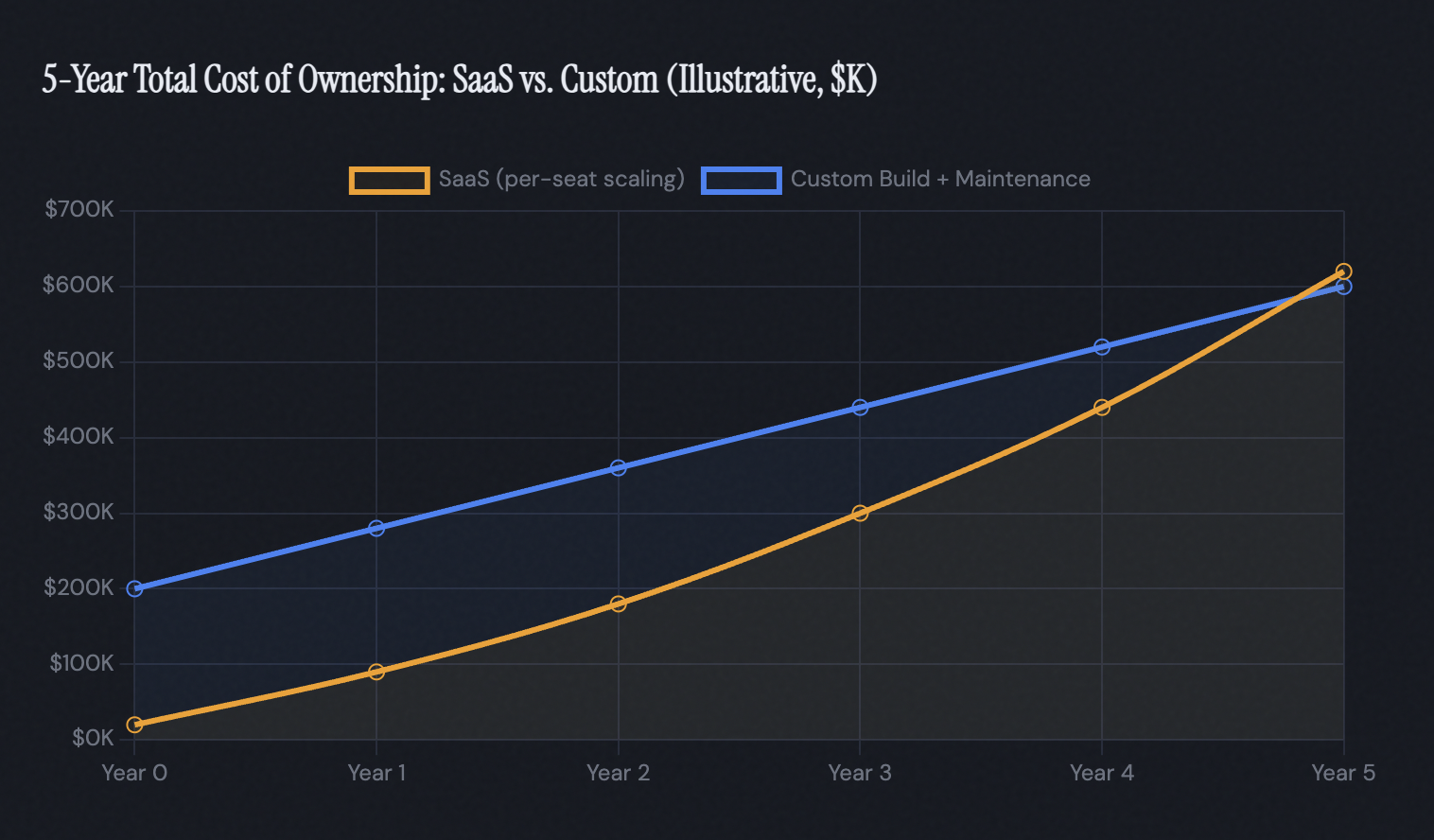
5-Year Total Cost of Ownership: SaaS (per-seat scaling) vs. Custom Build + Maintenance — illustrative pricing comparison over time
Strategic Recommendation
Default to off-the-shelf for commodity functions. Validate that workflows genuinely require custom capability. When custom is justified, begin with an MVP that proves the concept before committing to full-scale build investment.
Pricing Breakdown and Components
Understanding where capital is allocated within a software project enables informed trade-off decisions and exposes optimization opportunities that aggregate estimates obscure.
Every custom software project follows a lifecycle — from project planning and requirements engineering through architecture and UI design, software coding, quality assurance, software deployment, and ongoing maintenance. Each phase consumes a predictable share of the total budget. Knowing these proportions allows you to spot misallocations early, negotiate vendor proposals with confidence, and protect the phases that generate the highest return on investment. Below, we break down each component, its typical budget share, and the factors that push pricing up or down.
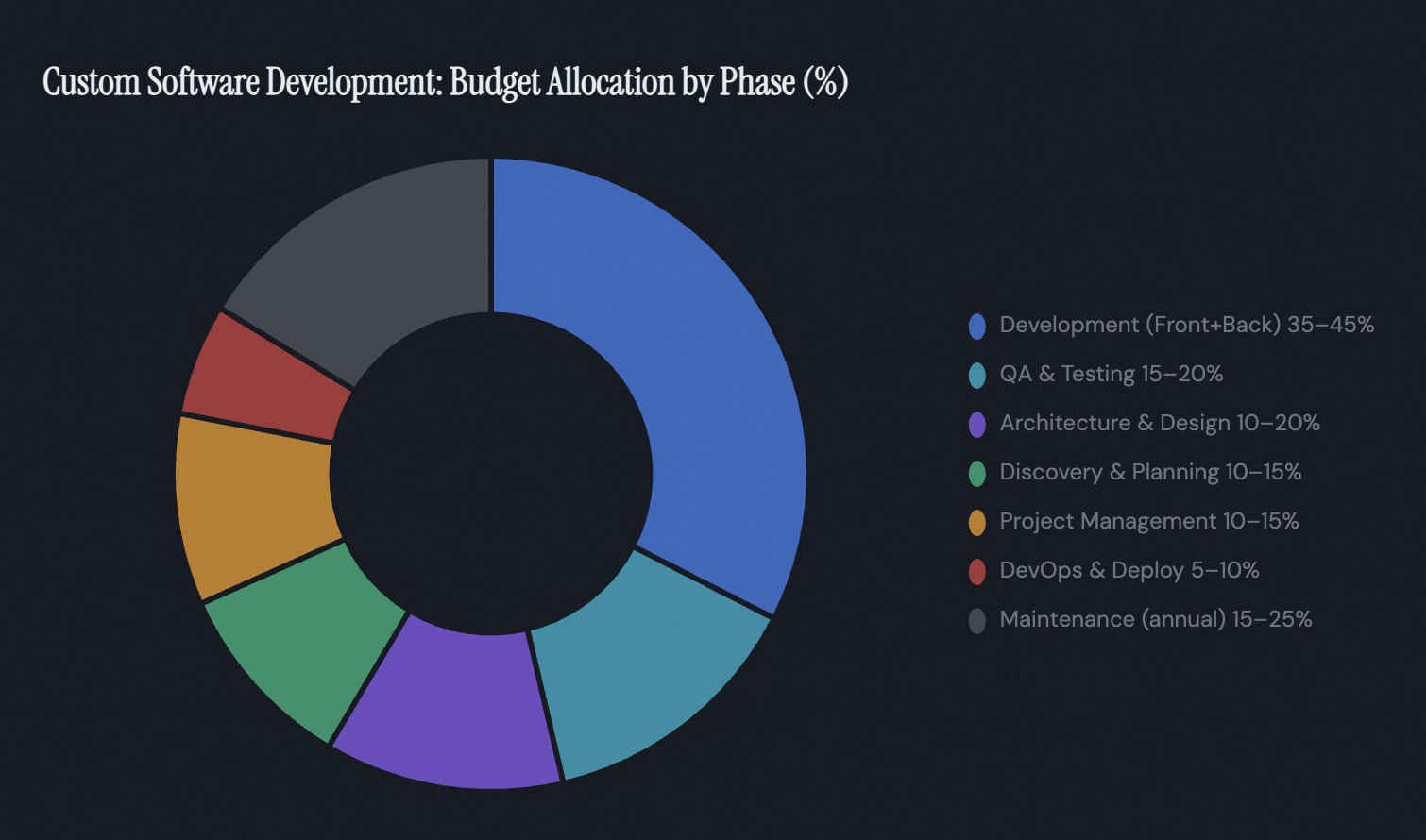
Custom Software Development: Budget Allocation by Phase (%) — typical pricing distribution across the full project lifecycle
Discovery, Requirements Engineering, and Project Planning — 10–15%
This phase encompasses stakeholder interviews, requirements workshops, market and technology research, tech stack evaluation, architecture planning, and project roadmap development. Requirements engineering — the disciplined process of defining what the system must do — is the foundation upon which every subsequent phase depends. Underinvestment in requirements engineering is the single most reliable predictor of downstream budget overruns. Deficient requirements engineering and ambiguous project planning are the primary root causes of expensive rework later in the lifecycle.
Project planning runs in parallel with requirements engineering: defining milestones, resource allocation, risk registers, and communication cadences. Good project planning sets realistic timelines based on validated requirements, while poor project planning forces teams into reactive mode — firefighting instead of building. For mid-sized projects, expect to allocate $10,000–$30,000 to the combined discovery, requirements engineering, and project planning phase. Organizations that compress this phase consistently spend 2–3x more on rework during development and quality assurance.
Architecture and UI Design — 10–20%
Architecture and UI design is a dual-track effort. System architecture defines component structure, service boundaries, data flow patterns, and tech stack selection — decisions that establish long-term constraints on performance, scalability, and system evolvability. The tech stack chosen at this stage — languages, frameworks, databases, cloud services — materially affects both initial development velocity and long-term operational expenditure. Choosing the wrong tech stack creates compounding overhead across every subsequent phase: more expensive development, harder quality assurance, more complex deployment, and higher maintenance burden.
UX design — the second track within architecture and UI design — encompasses user research, wireframing, prototyping, visual design, and design system creation. Effective UX design reduces front-end development rework and directly influences user adoption and satisfaction metrics. Architecture and UI design pricing ranges from $10,000 for straightforward applications to $50,000+ for complex, multi-platform products. Investing in thorough architecture and UI design upfront prevents expensive redesigns during development and post-launch front-end rework.
Front-End and Back-End Development — 35–45%
Development constitutes the largest single budget component, divided between front-end and back-end work. Front-end development includes responsive interface construction, client-side logic, accessibility compliance, animation, and cross-browser/cross-device compatibility. The quality of front-end development directly depends on the UX design decisions made during the architecture phase — poorly specified designs result in rework that can consume 20–40% of the original front-end budget.
Back-end development covers server-side logic, database architecture, API design, authentication infrastructure, business rule implementation, and data processing pipelines. Back-end development is where the tech stack decision has the most impact: choosing between Node.js, Python, Java, or .NET shapes everything from development patterns to scalability ceilings to the talent pool available for hiring. Complex back-end work — real-time data processing, event-driven architectures, multi-tenant systems — requires senior engineers and careful planning during the requirements engineering phase.
Integration fees deserve separate attention within the development phase. For projects with extensive external dependencies — payment processors, CRMs, ERPs, analytics platforms — integration work can consume an additional 10–20% of the development budget. These fees are notoriously hard to estimate because they depend on the quality of third-party APIs, which you don’t control. Budget for integrations explicitly: simple webhook connections at $2,000–$5,000 each, complex bidirectional data syncs at $10,000–$30,000 each. Mid-range custom applications typically fall within a $50,000–$250,000 range for the combined front-end, back-end, and integration pricing of this phase.
Quality Assurance and Testing — 15–20%
Quality assurance should represent 15–20% of total budget but is disproportionately targeted when budgets are constrained. This is a false economy. Comprehensive quality assurance — manual testing, automated test suite development, performance testing, security testing, regression testing, and user acceptance testing — catches defects at a fraction of their production remediation price. Industry data consistently shows that production defects carry a remediation price 5–10x higher than defects identified during quality assurance.
Quality assurance is not just about finding bugs — it validates that requirements engineering was done correctly, that front-end development matches UX design specifications, that back-end development handles edge cases properly, and that the system meets its scalability targets. Automated quality assurance testing is especially important for products with continuous delivery pipelines: it ensures that new code doesn’t break existing functionality. Cutting corners on quality assurance to reduce upfront spend guarantees higher maintenance expenditure and deployment risk later.
DevOps, Infrastructure, and Software Deployment — 5–10% Initial + 5–10% Monthly
Software deployment encompasses CI/CD pipeline configuration, containerization, environment provisioning, cloud hosting, monitoring and alerting systems, and deployment automation. Reliable deployment pipelines reduce release risk and enable faster iteration cycles. Without automated deployment, every release becomes a manual, error-prone event that consumes engineering time and introduces scalability risk.
Monthly infrastructure fees for production applications range from $500–$5,000+, depending on architecture and scalability requirements. Scalability — the system’s ability to handle growing user loads without degradation — must be designed into the architecture from the start, not bolted on after launch. Systems that ignore scalability during project planning face expensive re-engineering when user bases expand: migrating from monolithic to distributed architectures, adding caching layers, implementing database sharding, and upgrading hosting tiers. The tech stack and cloud provider decisions made during architecture directly determine deployment complexity and long-term infrastructure expenditure.
Project Management — 10–15%
Sprint planning, stakeholder communication, risk management, and delivery coordination — whether performed by an internal product owner or an external project manager. Effective project management ensures that the outputs of requirements engineering translate into delivered features on schedule and within budget. Planning at this level is operational: tracking velocity, managing scope changes, coordinating between front-end and back-end teams, and ensuring quality assurance keeps pace with development output.
Post-Launch Support and Maintenance — 15–25% Annually
Post-launch expenditure is the most consistently omitted line item in initial budgets. Industry benchmarks recommend allocating 15–25% of the initial development investment annually for maintenance: bug remediation, security patching, dependency updates, scalability improvements, performance optimization, and incremental feature development. Software that does not receive sustained maintenance investment degrades in security posture, compatibility, and functional relevance. Post-launch maintenance involves ongoing development — fixing bugs, updating integrations, patching vulnerabilities — as well as periodic deployment of updates and regression testing to ensure stability.
How Pricing Components Compound
These budget components are not independent — they interact in ways that amplify or attenuate total spend. Deficient requirements engineering inflates development expenditure through rework. Poor UX design decisions during architecture generate expensive front-end redesigns post-launch. Incorrect tech stack selection compounds back-end development and long-term maintenance overhead. Insufficient quality assurance investment allows defects to reach production, where remediation carries a price an order of magnitude higher. Rushed project planning leads to unrealistic timelines that increase integration fees and deployment risk. Ignoring scalability during architecture forces costly re-engineering after launch. The central insight is that front-loading investment in planning, requirements engineering, and architecture generates compounding returns across every downstream phase — from development through quality assurance, deployment, and long-term maintenance.
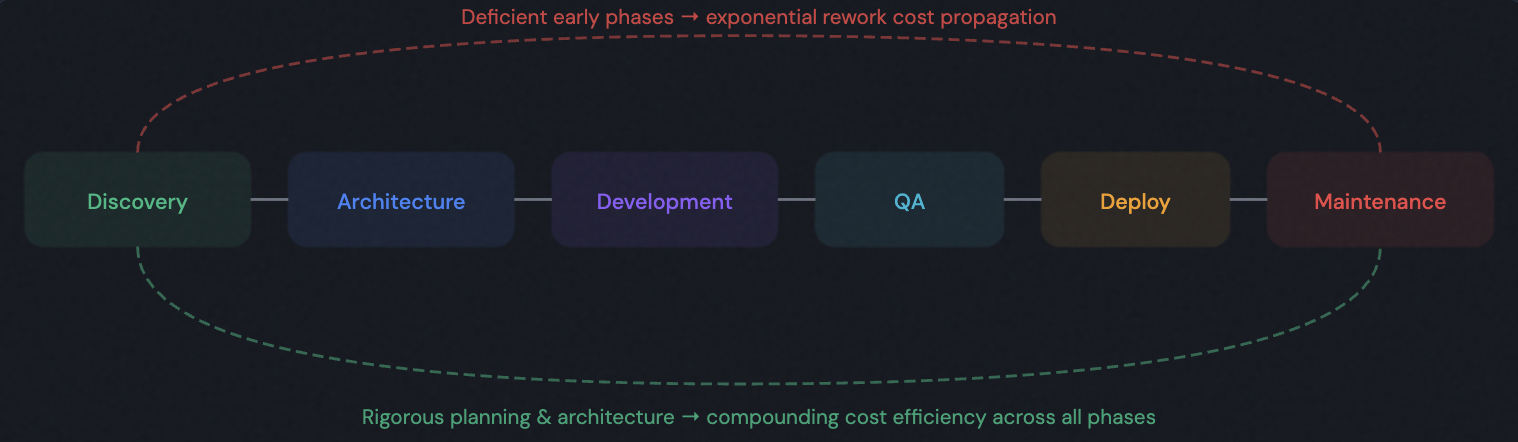
How early-phase investment propagates across the software development lifecycle: deficient planning drives exponential rework expenditure, while rigorous architecture compounds efficiency
Hidden Charges and Overlooked Expenses
The most damaging expenditure in software development is what’s absent from the initial estimate. Experienced sponsors budget for it explicitly; inexperienced ones encounter it in production.
Technical debt
When engineers take shortcuts — whether due to timeline pressure, budget constraints, or suboptimal design decisions — the result is technical debt: code that is progressively harder to modify, features that take longer to build, and defects that become more difficult to isolate. Left unaddressed, technical debt consumes 20–40% of engineering capacity over time, creating a compounding drag on delivery velocity.
Compliance audits
For regulated organizations, compliance audits are a recurring budget baseline. SOC 2, HIPAA, GDPR, and PCI DSS audit cycles carry fees of $10,000–$50,000 each. Remediation work arising from audit findings can demand substantially higher investment.
Security hardening
Penetration testing ($5,000–$30,000 per engagement), vulnerability scanning infrastructure, security monitoring services, and incident response planning represent ongoing investment requirements frequently absent from initial project estimates.
Infrastructure scaling
Organizations that did not architect for growth face material re-engineering expenditure when user bases expand. Migration from monolithic to distributed architectures, introduction of caching layers, database sharding, and hosting tier upgrades can require substantial unplanned investment.
Third-party licenses and API fees
Payment processing fees, mapping API consumption, email delivery services, SMS notification platforms, analytics tools, and monitoring services all carry usage-based or subscription charges that scale with your user base. These recurring operational fees are frequently underestimated in initial planning.
Ongoing maintenance
Framework and library updates — particularly across major version boundaries — operating system and runtime upgrades, SSL certificate management, database optimization, and third-party API migration represent continuous maintenance obligations. Software deprived of sustained maintenance investment progressively deteriorates in security posture, compatibility, and operational reliability.
Risk Advisory
Model hidden charges explicitly. Construct a separate budget category for technical debt remediation, compliance, security, scaling, and third-party operational fees. Projects that treat these as contingencies rather than certainties consistently exceed budget.
Budget Estimation and Pricing Strategy
Accurate budget estimation in software development is inherently challenging. These strategies do not eliminate uncertainty — they contain it within manageable bounds.
Every software project begins with the same question: what will it require? The answer depends on how rigorously you approach pricing estimation, how honestly you account for project constraints, and how disciplined your budgeting process is from day one. The strategies below — from feasibility studies and ROI estimates to pricing calculators and phased delivery — provide a practical framework for containing uncertainty while making informed investment decisions.
Feasibility Study and Business Analysis
Before committing capital, conduct a feasibility study. A feasibility study evaluates whether the proposed project is technically viable, financially justified, and operationally achievable within the organization’s project constraints — budget limits, timeline requirements, team availability, and regulatory obligations. A thorough feasibility study answers three questions: Can we build this? Should we build this? And can we afford to build it right?
Business analysis complements the feasibility study by translating strategic objectives into concrete requirements. Business analysis identifies which features drive revenue, which reduce operational overhead, and which serve primarily internal convenience. This distinction is critical for budgeting because it determines which components justify premium investment and which can be deferred or simplified. Organizations that skip business analysis and feasibility studies before committing to a project consistently underestimate their total budget by 30–60%.
Requirement Gathering and Project Scope Definition
Requirement gathering is the foundation of accurate pricing estimation. Without detailed, validated requirements, every estimate is speculation. Requirement gathering should produce a clear, prioritized list of functional and non-functional requirements — what the system must do, how it must perform, and what project constraints it must operate within. The more thorough the requirement gathering, the more precise the pricing estimation.
Project scope defines the boundaries of what will and will not be built. A well-defined project scope protects budgets by creating explicit agreement between stakeholders on deliverables, timelines, and acceptance criteria. When project scope is ambiguous, scope creep is inevitable — and scope creep is the most common reason software projects exceed their budgets. Every addition to the project scope after requirement gathering is complete adds to the budget: not just development hours, but testing, documentation, deployment, and maintenance overhead.
The MVP-First Approach and Rapid Prototyping
The most effective risk reduction strategy available. Rather than estimating and committing to a full product vision, identify the minimum viable product that delivers core value, build and launch it, then iterate based on validated user feedback. MVPs typically represent 20–30% of a full product’s total investment. This approach converts a large, uncertain commitment into a series of smaller, progressively informed decisions.
Rapid prototyping accelerates this process further. By building interactive prototypes early — before committing to full-scale development — teams can validate assumptions, test user flows, and surface project constraints that would otherwise emerge late in the build cycle when changes carry a steep price. Rapid prototyping is especially valuable for consumer-facing products where UI/UX assumptions need market validation. A rapid prototyping phase typically adds 5–10% to the initial budget but reduces total project investment by 15–25% through early course correction.
Pricing Model and Fixed Price Model Selection
The pricing model you choose directly affects budget predictability and risk distribution. As discussed in Section 4, the two dominant pricing models are fixed-price and time-and-materials, with hybrid approaches gaining ground. Choosing the right pricing model depends on how well-defined your project scope is and how much flexibility you need during development.
A fixed price model provides maximum budget certainty: you agree on a price upfront, and the vendor delivers the defined scope for that amount. The fixed price model works best for projects with a thoroughly completed requirement gathering phase, a well-bounded project scope, and limited anticipated changes. However, a fixed price model also carries concealed expenses — vendors embed 15–30% risk premiums in fixed price model estimates, meaning you pay for certainty whether or not scope changes materialize.
Time-and-materials pricing models offer flexibility but require active budgeting discipline. Regardless of which pricing model you select, pair it with explicit project constraints — budget caps, phase gates, and change-order protocols — to prevent uncontrolled expenditure escalation.
ROI Estimates and Investment Framing
Reframe the question from “How much does this require?” to “What is this worth?” ROI estimates transform budget forecasting from an accounting exercise into a strategic investment analysis. Each feature or project increment should be evaluated against its projected business value — revenue generation, operational savings, efficiency gain, or risk reduction — relative to its development price. A feature requiring $50,000 investment that generates $200,000 annually has a clear economic mandate regardless of the hourly rate charged.
Build ROI estimates into every phase of the budgeting process. During business analysis, assign projected value to each capability. During requirement gathering, prioritize features by ROI. During development, track actual spend against ROI estimates to validate investment decisions. Organizations that integrate ROI estimates into their budgeting process consistently make better trade-off decisions and achieve higher return on software investment.
Pricing Calculators and Estimation Tools
A software development pricing calculator is a practical tool for generating initial budget estimates based on project parameters — team size, hourly rates, project duration, feature complexity, and geographic distribution. While no pricing calculator can replace detailed requirement gathering and business analysis, it provides a useful starting point for budgeting conversations and vendor comparisons. Many agencies and enterprise-class custom software development companies offer proprietary pricing calculators as part of their client engagement process.
When using a pricing calculator, input realistic assumptions about project scope, project constraints, and team composition. Overly optimistic inputs produce misleadingly low figures. For the most accurate results, use a pricing calculator after completing at least a preliminary feasibility study and requirement gathering phase — this ensures the inputs reflect actual project parameters rather than aspirational targets.
Phased Delivery and Contingency Reserves
Extending the MVP principle across the product lifecycle. Structuring the project as a sequence of phases — each with defined objectives, dedicated budget, and explicit success criteria — creates natural decision points for progress evaluation, priority adjustment, and budget reallocation. Phased delivery improves both pricing estimation accuracy and cash flow management by distributing capital expenditure across the engagement timeline rather than committing the full amount upfront.
No material software project should proceed without contingency reserves. Industry best practice prescribes 15–25% above the base budget estimate. This is not padding — it is a realistic acknowledgment that project constraints evolve and software development operates under persistent uncertainty. Integration complications, evolving requirements, and emergent technical constraints are standard occurrences, not exceptional events.
Total Cost of Ownership (TCO) Analysis
Initial build pricing is a misleading proxy for total investment. A project priced at $200,000 to build and $80,000 annually to operate and maintain carries a five-year TCO of $600,000. Comparing alternatives — SaaS subscriptions, licensed platforms, different architectural approaches — on a TCO basis frequently reveals that the cheapest option to build is not the cheapest option to own. Include ROI estimates in your TCO analysis to evaluate not just what you spend, but what each option returns.
Transparency as a Pricing Discipline
Regardless of pricing model or contract structure, the single most important budget management practice is visibility. Regular budget reviews, formalized change-order processes, and open communication between stakeholders and delivery teams convert small overruns into managed adjustments rather than uncontrolled escalations. The projects that dramatically exceed budget are not those where stakeholders were watching the numbers — they are the ones where no one looked until it was too late.
FAQ
What is the average pricing for custom software development?+
Pricing varies significantly based on project complexity, team location, and scope. Simple applications typically range from $30,000 to $80,000, mid-complexity projects fall between $80,000 and $250,000, and enterprise-grade systems can exceed $500,000. These figures include discovery, design, development, quality assurance, and deployment — but not ongoing maintenance, which adds 15–25% of the initial investment annually.
Should I choose a fixed price model or time-and-materials?+
It depends on how well-defined your requirements are. A fixed price model works best when project scope is thoroughly documented, changes are unlikely, and you need budget certainty. Time-and-materials pricing is better suited for projects with evolving requirements or exploratory phases. Keep in mind that fixed price contracts typically include a 15–30% risk premium — you pay for certainty regardless of whether scope changes occur.
What is the biggest hidden charge in software development?+
Technical debt. When engineers take shortcuts due to timeline pressure or budget constraints, the resulting code becomes progressively harder and more expensive to modify. Left unaddressed, technical debt consumes 20–40% of engineering capacity over time. Other frequently underestimated expenses include compliance audits ($10,000–$50,000 per cycle), security hardening, infrastructure scaling, and third-party API fees that grow with your user base.
Is offshore development genuinely more affordable?+
Offshore teams offer lower hourly rates — typically $25–$60 per hour compared to $100–$200+ in North America. However, lower rates do not always translate to lower total investment. Communication overhead, time zone gaps, cultural differences, and potential quality issues can increase project duration and rework expenditure. The effective pricing depends on team quality, management overhead, and how well-defined your requirements are before engagement begins.
How does an MVP reduce software development investment?+
An MVP (minimum viable product) typically represents 20–30% of a full product’s total investment. Instead of committing your entire budget upfront based on assumptions, you build only the core functionality, launch it, and iterate based on real user feedback. This converts one large uncertain investment into a series of smaller, informed decisions — eliminating features users don’t need and focusing resources on what actually delivers value.
When should I choose custom software over off-the-shelf solutions?+
Choose custom software when your business processes are genuinely unique, when off-the-shelf tools require extensive workarounds, or when the software itself is your competitive advantage. For commodity functions — accounting, email, CRM — off-the-shelf solutions are almost always more economical. Evaluate on a total cost of ownership basis over 3–5 years: a $200,000 custom build with $80,000 annual maintenance may carry a higher five-year price than a SaaS subscription covering the same functionality.
How much contingency budget should I set aside?+
Industry best practice recommends 15–25% above the base budget estimate. This is not padding — it accounts for the reality that integration complications, evolving requirements, and emergent technical constraints are standard occurrences in software development. Projects without contingency reserves are the ones most likely to face painful scope cuts or budget overruns when inevitable surprises arise.
Conclusion
Custom software development is a capital investment, not an expense. Start with a feasibility study and business analysis. Invest in thorough requirement gathering to define project scope. Use a software development pricing calculator for preliminary budget estimation, then refine with detailed planning. Select the right pricing model — whether a fixed price model for well-defined scope or time-and-materials for evolving requirements. Build ROI estimates into every decision. Apply rapid prototyping to validate before you commit. Respect project constraints, and maintain contingency reserves. Approached with this rigor, software investment delivers durable competitive advantage. Approached without it, it delivers budget overruns and technical debt. The methodology matters more than the budget.