In today’s rapidly evolving technology landscape, organizations face growing pressure to deliver high-quality software products faster and with greater adaptability. Sprints — short, fixed-duration development cycles rooted in Agile methodology — have become the standard operating model for high-performing engineering teams worldwide. This article provides a comprehensive practitioner’s guide to sprint-based delivery, drawing on extensive experience advising Fortune 500 clients on Agile transformation and technology strategy.
Benefits of Sprints
Sprint-based delivery offers a structured yet flexible approach that addresses many of the chronic challenges in traditional software development. Our goal in this section is to add practical depth — drawing on the experience of practitioners who live this work every day — to help organizations make an informed choice between traditional development and agile methods. For teams evaluating delivery partners to support sprint-based work, our guide on how to choose a software development company provides a structured evaluation framework.
Enhanced Project Planning and Project Visibility
Sprints create natural checkpoints that provide stakeholders with regular progress updates. Effective project planning within each sprint ensures that resources are allocated efficiently, dependencies are identified early, and teams enter every iteration with clarity and confidence. When project planning and project visibility operate together, leadership gains the transparency needed to steer programs proactively rather than reactively. Progress updates at the end of every sprint cycle replace guesswork with data, giving portfolio managers the project visibility they need to make informed trade-off decisions in real time.
Adaptability to Changing Requirements
The ability to respond to changing requirements without derailing the entire project is one of the most significant advantages sprints offer over rigid, plan-driven approaches. Scrum development replaces this rigidity with iterations, enabling teams to absorb feedback and shift direction at the end of every sprint cycle rather than discovering misalignment months into the project. Sprints help teams follow the agile principle of delivering working software frequently, and they operationalize the agile value of responding to change over following a plan. The Scrum values of transparency, inspection, and adaptation are complementary to these agile principles and central to the concept of sprints. Sprints are the time-boxed iterations that form the heartbeat of Scrum development, and understanding this hierarchy matters: an organization can adopt agile methods without using Scrum, and it can run Scrum ceremonies without fully embracing the agile principles behind them. Client requirements evolve continuously, and sprint cadences allow teams to incorporate feedback loops and reprioritize work at regular intervals, reducing the risk of delivering a product that no longer meets market needs. Organizations looking to replace rigid legacy tools with adaptable solutions can explore our guide on how to migrate from Excel to custom software using sprint-based delivery. While adaptability to changing requirements is a core benefit of Agile, the sprint itself must remain a protected container — changes are welcomed between sprint cycles, not during them. By welcoming changing requirements between sprints rather than resisting them, organizations turn volatility into a competitive advantage.
Incremental Product Delivery and Continuous Testing
By delivering working software at the end of each sprint, organizations reduce the compounding risk associated with large-batch releases. Iterations are the mechanism through which agile software development manages risk. Scrum development surfaces these risks early by delivering a testable increment at the end of every iteration. Through short iterations, Scrum development delivers working software incrementally, allowing teams to gather feedback and adjust course at the end of each iteration. The concept of iterations is central to agile software development, and this iterative approach fundamentally changes the risk profile of software projects: instead of discovering problems at the end of a long traditional development cycle, teams surface issues early and often through short, focused iterations. Incremental product delivery means stakeholders see tangible progress updates at the end of every sprint cycle, not just at project milestones. Continuous testing within each sprint cycle catches defects early, lowering the total cost of quality. Continuous integration reinforces this discipline by ensuring that code contributions from every team member are merged and validated throughout the sprint, preventing technical debt from undermining delivery outcomes. For a detailed breakdown of how these iterative practices affect project budgets, see our analysis of custom software development pricing. Traditional development retains relevance in narrowly defined contexts — regulatory compliance systems, safety-critical embedded software, or projects with truly fixed requirements — but for most modern software initiatives, agile methods built around sprint-based iterations deliver superior outcomes.
Improved Client Involvement Through Feedback Loops
These built-in feedback loops provide a regular cadence of input that significantly reduces misalignment and costly rework. The sprint review at the end of each iteration gives stakeholders a window into progress that traditional development simply cannot provide. Development teams, product managers, and marketers may each experience the sprint review differently, but the shared outcome is the same: decisions are grounded in real software rather than slide decks. Each sprint review reinforces this advantage by giving stakeholders a concrete checkpoint to evaluate progress and course-correct early. Collaborative teamwork thrives when team dynamics are openly discussed, when team feedback is welcomed rather than feared, and when retrospectives produce tracked actions that carry over into the next sprint cycle. Effective retrospectives invite honest team feedback on process, collaboration, and tooling, creating a safe space where team dynamics can be discussed openly. The sprint retrospective further strengthens this cycle by turning team feedback into concrete process improvements for the next iteration, closing the loop between what stakeholders need and what the team delivers. The team feedback loop — from sprint retrospective to Jira templates to next sprint cycle — becomes the heartbeat of continuous improvement.
Sprint Duration: Maximizing the Benefits
Each iteration — each sprint — produces a potentially shippable product increment that stakeholders evaluate during the sprint review. The sprint review makes this tangible — stakeholders see working software at the end of every iteration rather than waiting for a final delivery gate. Early-stage products with high uncertainty benefit from shorter sprints (one week) to enable rapid experimentation. Newer Agile teams often benefit from shorter sprints that provide more frequent feedback loops and learning opportunities. As team synchronization strengthens and velocity stabilizes, longer sprints may reduce ceremony overhead while still preserving project visibility.
In regulated industries such as healthcare and financial services, longer sprints may be necessary to accommodate compliance reviews and documentation requirements — but even in these contexts, continuous testing and incremental product delivery within each sprint cycle ensure that project planning remains grounded in reality.
Consistency enables reliable velocity measurement, simplifies capacity planning, and creates a predictable rhythm for the entire organization. Understanding where sprints fit within the broader landscape of software development methodologies is essential for making informed organizational decisions. Kanban, Extreme Programming (XP), and the Scaled Agile Framework (SAFe) each offer distinct advantages depending on organizational context, and SAFe extends agile methods to enterprise scale and coordinates delivery of custom web applications, managing multiple Scrum teams across a portfolio — though it introduces complexity that smaller organizations rarely need.
Why These Benefits Compound Over Time
The true power of sprints emerges when project planning, project visibility, team synchronization, accountability, feedback loops, changing requirements adaptation, incremental product delivery, continuous testing, continuous integration, client involvement, and sprint retrospective all operate as an integrated system. Progress updates accumulate into a rich dataset that sharpens project planning and improves project visibility with every cycle. The sprint review becomes the proving ground where leadership sees the tangible advantages of agile software development over the traditional development approach they are leaving behind. Teams that embrace Scrum values during this transition adapt faster because the shared principles guide decision-making even when the process is still unfamiliar.
Well-configured Jira templates reduce administrative overhead, ensure process consistency across sprint cycles, and free the team to focus on collaborative teamwork rather than tooling overhead. The best scrum productivity tools empower teams to focus on building software rather than managing process overhead. Key capabilities include a customizable agile board in Jira for visualizing sprint progress, sprint backlog management, epics in Jira for organizing work into larger strategic themes, burndown charts, velocity tracking, and robust reporting. Teams that configure their agile board in Jira to reflect their actual workflow — with columns for Backlog, In Progress, In Review, and Done — gain real-time transparency into sprint health. Organizing work through epics in Jira allows teams to group related user stories under strategic objectives, making it easier to track progress at both the sprint and portfolio level. For smaller teams, Hubstaff Tasks offers a streamlined alternative — lighter configuration overhead while still providing an agile board, velocity tracking, and the ability to escalate overdue issues through built-in alerts.
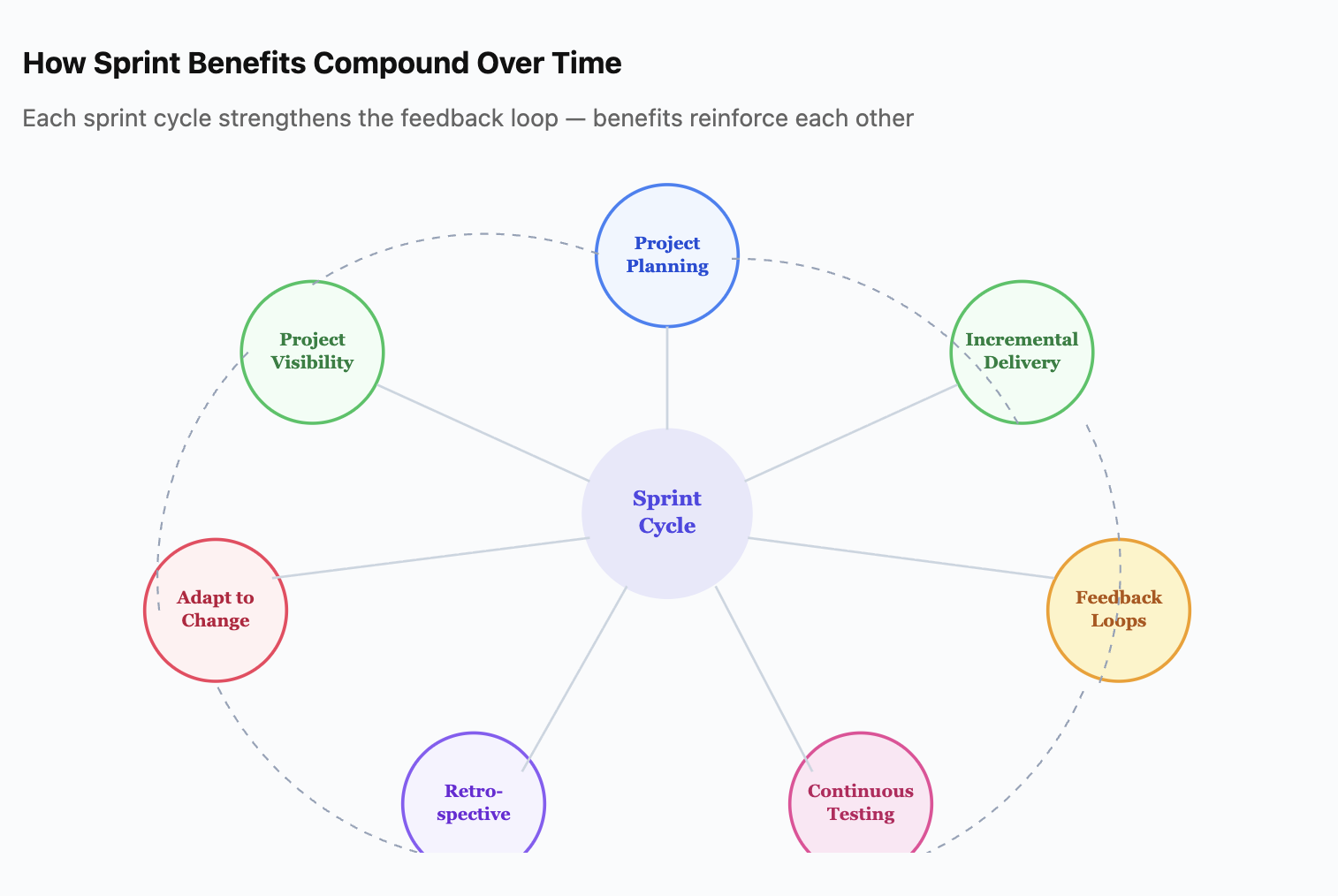
How sprint benefits compound over time: each sprint cycle strengthens the feedback loop as project planning, visibility, delivery, and retrospectives reinforce each other
Comparison with Other Development Methods
The debate around Scrum vs. Waterfall remains one of the most consequential conversations in agile software development, and choosing the right approach can determine whether a product succeeds or fails. The Scrum Guide lays the theoretical groundwork for this discussion by defining the ceremonies, roles, and artifacts that distinguish Scrum development from other agile methods and from the Waterfall model alike. Our goal is to add some color to the topic by uncovering best practices from people who do this work every single day. Scrum is a framework within agile development methodology, and understanding how it compares to traditional development is essential for any organization considering the shift.
Scrum vs. Waterfall: A Fundamental Divide
The Waterfall model is the classic approach to software delivery, where a project advances through sequential phases — requirements, design, implementation, testing, deployment — and each phase depends on the completion of the one before it. The Scrum framework takes the opposite stance: rather than locking requirements upfront, Scrum development breaks large, complex projects into a series of short iterations called sprints, each producing working software that can be inspected and adapted. This core tension between Scrum vs. Waterfall reflects two fundamentally different philosophies about how software should be built.
In the Waterfall model, traditional development assumes that the full scope can be understood before a single line of code is written — an assumption that rarely holds in today’s volatile business environment. With Scrum, a product is built in a series of iterations called sprints that break down big, complex projects into bite-sized pieces. There is little room for course correction during the Waterfall model’s sequential phases, and revisiting earlier decisions is costly and disruptive.
Agile, Scrum, and Sprints — Related but Distinct
Many practitioners associate sprints so closely with agile software development that Scrum and Agile are often treated as synonyms. They are not. Agile is a set of principles — a philosophy captured in the Agile Manifesto — while Scrum is a specific framework for putting those agile principles into practice. The big difference is that a sprint is a time-boxed iteration, while Scrum is a comprehensive agile framework incorporating sprints as a core component of its structure. The many similarities between agile values and Scrum processes lead to a fair association — sprints help teams follow the agile principle of delivering working software frequently, and the Scrum values of transparency, inspection, and adaptation are complementary to these agile principles and central to the concept of sprints.
Benefits of Scrum Sprints over Traditional Development
Agile methods like Scrum are widely adopted because they deliver products faster, with higher quality, and with greater customer satisfaction compared to the Waterfall model. Each sprint review makes this tangible — stakeholders interact with a working product increment instead of reviewing slide decks and status reports.
The shift from traditional development to Scrum development is not merely procedural — it is cultural. The Waterfall model conditions teams to think in sequential phases and hand-offs, while Scrum development requires thinking in iterations, shared ownership, and continuous improvement. However, there is a vast change in the development methodology from traditional development to Scrum development, and development teams might approach the sprint review differently than marketers — yet the shared outcome is decisions grounded in real software rather than assumptions.
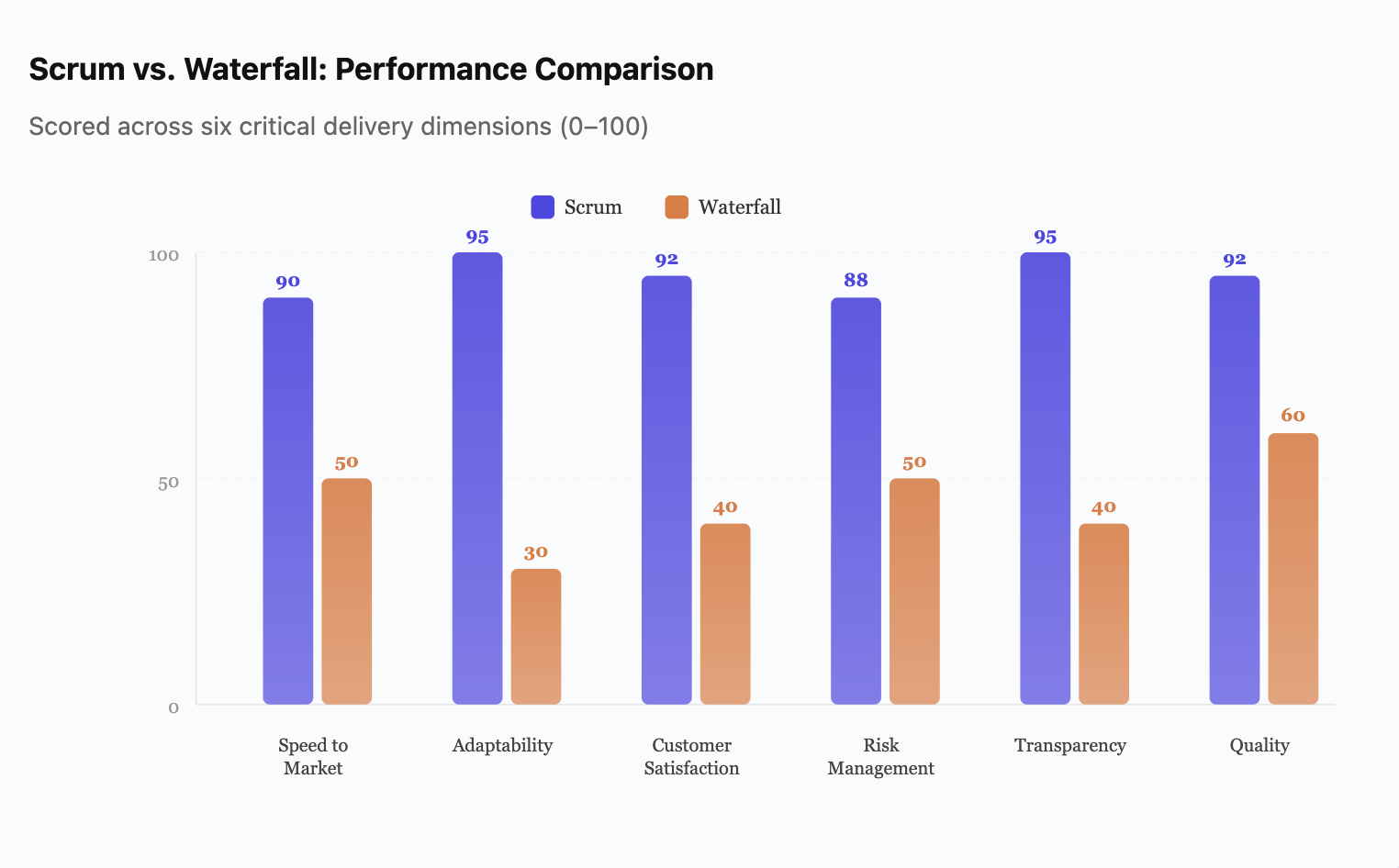
Scrum vs. Waterfall performance comparison scored across six critical delivery dimensions: speed to market, adaptability, customer satisfaction, risk management, transparency, and quality
Why Iterations Matter in Agile Software Development
In the Waterfall model, stakeholders may not see a working product until months or years after traditional development began — and by then, market conditions, user needs, or competitive dynamics may have shifted dramatically. Iterations are the mechanism through which agile software development manages risk. Scrum development surfaces these risks early by delivering a testable increment at the end of every iteration.
For organizations evaluating Scrum vs. Waterfall, the evidence strongly favors agile software development for projects with evolving requirements, complex stakeholder landscapes, or competitive pressure to deliver value quickly.
Making the Transition from Traditional Development to Scrum
Organizations moving from the Waterfall model to Scrum development often underestimate the cultural shift required. The Waterfall model conditions teams to think in sequential phases, while Scrum development requires thinking in iterations. However, the change from traditional development to Scrum development is significant, and success depends on leadership commitment, structured coaching, embracing Scrum values, and a willingness to inspect and adapt the process itself. Teams that embrace Scrum values during this transition adapt faster because the shared principles guide decision-making even when the process is still unfamiliar. The Scrum Guide provides the structural blueprint for this shift, but lasting adoption depends on internalizing the Scrum values that underpin every ceremony and interaction.
Key Differences at a Glance
When comparing Scrum vs. Waterfall, the differences span every dimension of software delivery. In the Waterfall model, requirements are fixed at the start; in Scrum development, they evolve through iterations. Traditional development treats testing as a late-stage phase; agile software development integrates continuous testing within each iteration. The Waterfall model relies on comprehensive upfront documentation; the Scrum Guide emphasizes working software as the primary measure of progress — an agile principle that fundamentally redefines what “done” looks like.
From a governance perspective, traditional development uses milestone-based gates, while Scrum development uses the sprint review as the primary checkpoint for progress and alignment. Scrum values of openness and transparency make this possible — in contrast to the Waterfall model, where problems often remain hidden until integration testing reveals them late in the cycle. To understand the full scope of services that sprint-based delivery teams provide, see our overview of what a software development company does.
For organizations still debating Scrum vs. Waterfall, the core question is whether their environment demands the adaptability of iterations or the perceived control of traditional development. In nearly every case where requirements evolve, agile software development through Scrum development delivers better results than the Waterfall model. Sprint and Scrum are distinct concepts within agile software development — and while they are related, conflating them leads to shallow adoption that misses the deeper benefits of each. Organizations that recognize this distinction and commit to the full framework, not just the cadence, position themselves for sustained competitive advantage.
Sprint Roles and Ceremonies
Effective Scrum ceremonies depend on clearly defined roles and disciplined execution. Understanding how each role contributes to the sprint — and how each ceremony reinforces Scrum principles and values — is essential for building a high-performing delivery engine. At its core, the Scrum Guide is built upon the agile principles outlined in the Agile Manifesto, which prioritize individuals and interactions, working software, customer collaboration, and responding to change. Scrum values — commitment, courage, focus, openness, and respect — underpin every aspect of Scrum development. These Scrum values are not abstract ideals; they directly influence how teams plan iterations, conduct sprint reviews, and collaborate daily. The Scrum Guide provides a clear starting framework, but teams must internalize the agile principles behind it — not just follow the Scrum ceremonies mechanically. Among agile methods, Scrum stands apart because of its prescriptive ceremony structure and clear role definitions, while other approaches like Kanban and XP offer flexibility in areas where Scrum development is deliberately opinionated. Organizations that recognize this cultural dimension and invest in education on the Scrum Guide and Scrum values navigate the transition far more successfully than those that simply rename their milestones as sprints. The Scrum values of commitment, courage, focus, openness, and respect are what separate teams that merely follow the process from those that truly embody it.
Key Roles: Product Owner, Scrum Master, and Scrum Team Members
The Product Owner owns and prioritizes the product backlog, defines user stories, establishes acceptance criteria, and serves as the primary liaison between Scrum team members and business stakeholders. A strong Product Owner has deep domain expertise, decision-making authority, and is available to Scrum team members throughout the sprint. For a deeper framework on evaluating and assembling the right team for sprint-based delivery, see our guide on how to hire software developers. The Product Owner must arrive at sprint planning with a prioritized backlog and well-defined acceptance criteria, and during backlog refinement the Product Owner collaborates with Scrum team members on sprint estimation tasks by providing context and confirming scope.
The Scrum Master serves as a servant leader, responsible for ensuring that all Scrum team members adhere to Scrum principles and values while removing impediments that hinder progress. They facilitate all Scrum ceremonies — from sprint planning and daily stand-up meetings through sprint review and sprint retrospective — and coach the team on Agile practices. The Scrum Master shields Scrum team members from external disruptions and ensures that the timebox for each ceremony is respected. The Scrum Master plays a critical role in protecting the team’s focus, and changing requirements should flow through the Product Owner and be deferred to the next sprint planning session.
The development team is a cross-functional, self-organizing group of Scrum team members who deliver a potentially releasable product increment each sprint. Team size typically ranges from five to nine Scrum team members. In daily stand-up meetings, Scrum team members synchronize progress. In the sprint review, Scrum team members demonstrate what was built. In the sprint retrospective, they reflect on Scrum principles and values and propose improvements for future Scrum ceremonies.
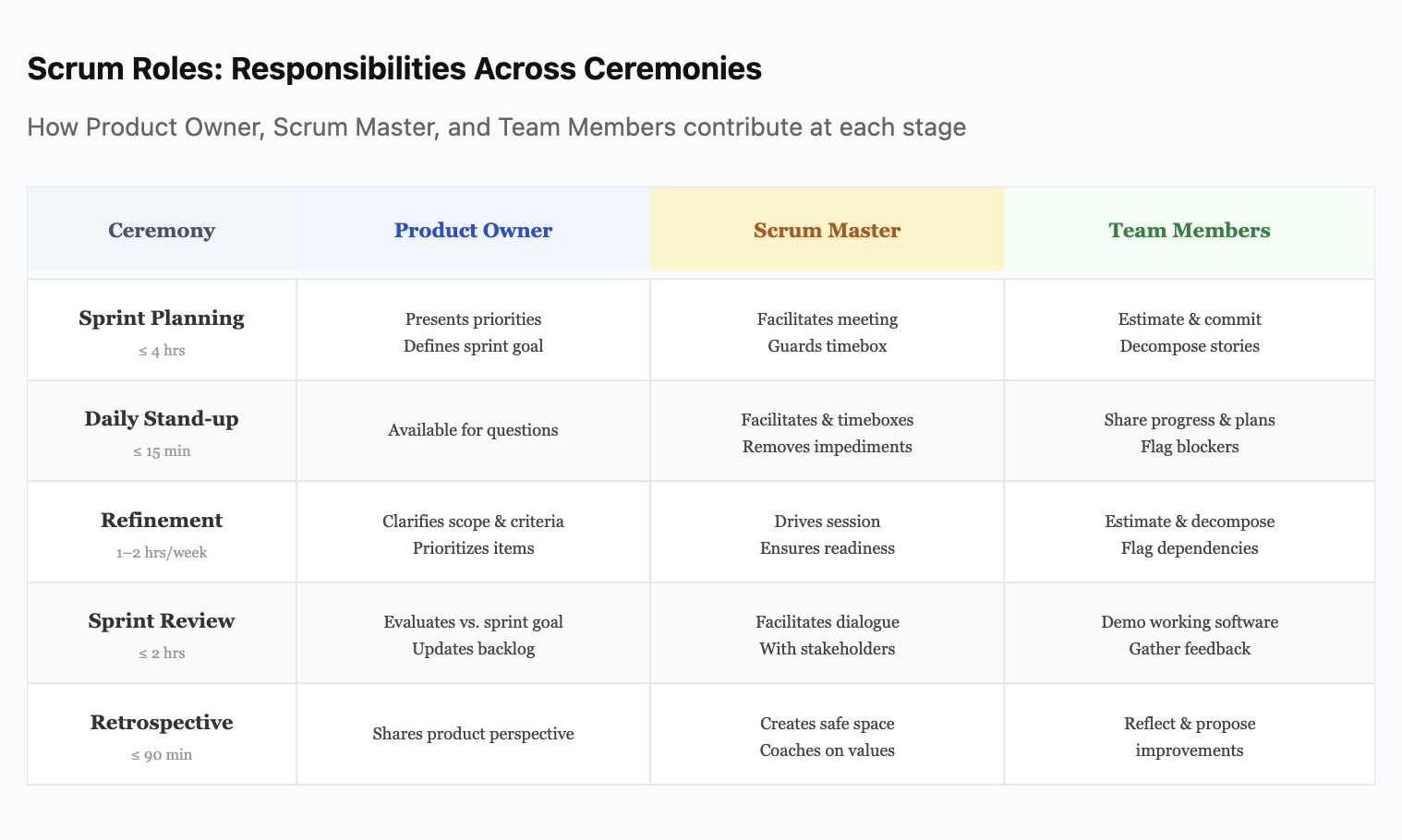
Scrum roles and responsibilities across ceremonies: how the Product Owner, Scrum Master, and Team Members contribute at each stage from sprint planning through retrospective
Daily Stand-Up Meetings and Sprint Execution
Daily stand-up meetings are timeboxed to fifteen minutes and provide a brief synchronization point where each Scrum team member shares progress, plans, and blockers. The Scrum Master facilitates the daily stand-up meetings and ensures the timebox is respected, keeping the conversation focused on what matters most. During sprint execution, the Scrum Master guards against scope creep — new requests are captured in the product backlog but not added to the active sprint.
Sprint Review
At the end of the sprint, Scrum team members demonstrate the completed product increment to stakeholders. The sprint review ceremony is where the value of iterations becomes most visible. Sprint reviews create a structured forum for client involvement and stakeholder engagement, ensuring that the development trajectory remains aligned with business objectives. The sprint review is not merely a demo — it is a feedback-driven Scrum ceremony where stakeholders evaluate what was built, provide input, and help shape backlog prioritization for subsequent sprints. The sprint review is one of the most critical Scrum ceremonies for maintaining alignment between the team and the business, and every sprint review should be timeboxed, prepared, and attended by real stakeholders.
Sprint Retrospective and Scrum Principles and Values
Concrete improvement actions are tracked and reviewed in future Scrum ceremonies, creating a continuous improvement cycle. The effectiveness of every Scrum ceremony depends on the team’s genuine commitment to Scrum principles and values. When Scrum principles and values are embedded in how Scrum team members interact — during daily stand-up meetings, sprint review, sprint retrospective, and backlog refinement alike — the Scrum ceremonies become more than rituals. Accountability flows naturally from this structure: each ceremony creates a visible checkpoint where Scrum team members own their commitments, and client involvement during sprint reviews ensures that the team’s work remains aligned with stakeholder expectations.
Common Anti-Patterns in Roles and Ceremonies
When the Product Owner is unavailable during sprint planning or backlog refinement, Scrum team members are forced to make assumptions about priority and scope. The fix: the Product Owner must treat all Scrum ceremonies as non-negotiable, and the Scrum Master should escalate availability issues immediately.
When the Scrum Master overrides sprint estimation tasks or controls daily stand-up meetings as status reports, self-organization erodes. The fix: the Scrum Master must trust Scrum team members, respect the timebox as a guardrail rather than a weapon, and coach on Scrum principles and values.
The Product Owner and Backlog Management
The Product Owner oversees the backlog and regularly reviews and prioritizes it — a practice known as backlog refinement. Items at the top of the backlog should carry the most detail and be ready to move into the next sprint. Before each sprint planning session, the Product Owner outlines the goal for that sprint and identifies which backlog items might help accomplish it. The Product Owner is responsible for detailing the highest-priority backlog items so that Scrum team members can perform sprint estimation tasks with confidence. The entire Scrum team participates in backlog refinement — the Scrum Master, Product Owner, and Scrum team members can all surface risks, flag dependencies, and contribute technical perspective to keep the backlog healthy.
The Scrum Master as Coach and Facilitator
The Scrum Master acts as a coach who guides the development team through every Scrum ceremony. The Scrum Master focuses on Scrum principles and values and coaches Scrum team members in every sprint activity — from sprint planning through the sprint review and sprint retrospective. It is a common misconception that the Scrum Master merely observes Scrum ceremonies without actively shaping them; in practice, the Scrum Master is responsible for ensuring that each ceremony achieves its purpose within its timebox. The Scrum Master is also responsible for helping people outside the Scrum team understand which interactions with Scrum team members are helpful and which are disruptive. During daily stand-up meetings, the Scrum Master keeps the conversation within its timebox and follows up on impediments raised by Scrum team members.
Scrum Ceremonies as Time-Boxed Events
Scrum ceremonies — also known as Scrum events — are time-boxed by design, which makes them easier to respect while preserving flexibility within that timebox. Scrum team members take key sprint responsibilities within these ceremonies, including sprint estimation tasks during sprint planning and backlog refinement. When the Scrum ceremonies are respected as time-boxed events grounded in Scrum principles and values, the team develops a sustainable rhythm that supports consistent delivery.
Sprint Process and Stages
A sprint follows a well-defined lifecycle consisting of four primary stages, each serving a distinct purpose within the iterative delivery model. Sprint planning sets the direction, daily stand-up meetings maintain alignment, backlog refinement prepares the pipeline, the sprint review validates the outcome, and the sprint retrospective drives improvement. Each ceremony has a defined timebox: sprint planning is limited to four hours for a two-week sprint, daily stand-up meetings to fifteen minutes, the sprint review to two hours, and the sprint retrospective to ninety minutes. Client involvement is woven into the sprint lifecycle through structured feedback loops.
Stage 1: Sprint Planning
In the first half of sprint planning, the Product Owner presents the highest-priority items from the product backlog, articulated as user stories with clear acceptance criteria. During the planning meeting, a sprint backlog is created — a subset of items from the product backlog that the team aims to achieve and develop in the current sprint. Inputs include the refined product backlog, team capacity, and the previous sprint’s velocity. The output is a committed sprint backlog with clearly defined acceptance criteria for each item. Backlog refinement is an ongoing activity, typically consuming one to two hours per week, and feeds directly into the planning stage. Effective backlog refinement means the Product Owner has already clarified scope, resolved ambiguities, and confirmed acceptance criteria well before the sprint planning timebox begins. Sprint reviews and sprint planning require stakeholder participation, so the cadence must align with stakeholder schedules to maintain client involvement.
Stage 2: Sprint Execution (Daily Work)
The development team works collaboratively to deliver the sprint backlog items. Progress updates flow naturally from each sprint cycle, and each sprint retrospective refines the process.
Stage 3: Sprint Review
At the end of the sprint, the team demonstrates the completed product increment to stakeholders. Unlike the sprint retrospective, the primary goal of the sprint review is to celebrate completed work and determine what is “done.” To be considered complete, a task must meet the acceptance criteria that the Product Owner outlined before the start of the sprint. Where traditional development defers stakeholder visibility to late-stage milestones, every sprint review in Scrum development provides a working increment that stakeholders can evaluate, critique, and redirect. During each sprint review, stakeholders see working software, provide feedback, and help shape the direction of the next iteration. The sprint review is also an opportunity to discuss what is coming up next, based on what was completed in this sprint. The sprint review is not merely a demo — it is a feedback session that informs backlog prioritization for subsequent sprints. In the sprint review, the Product Owner evaluates the increment against the sprint goal and updates the backlog. The Scrum Guide mandates that every sprint concludes with a sprint review, ensuring stakeholder visibility is built into the process rather than bolted on afterward. Client involvement is not a one-time checkpoint but a continuous thread woven through every sprint. When the sprint review is treated as optional, stakeholder feedback vanishes and the backlog loses alignment with business needs.
Stage 4: Sprint Retrospective
The retrospective is the team’s opportunity for introspection and continuous improvement. The sprint retrospective examines team dynamics, process effectiveness, and adherence to Scrum principles and values. Every sprint cycle should end with a retrospective that generates specific areas of improvement — not vague intentions. The turnaround began with the sprint retrospective. Jira templates were updated to include a “retrospective action” issue type, ensuring every areas of improvement item from each sprint retrospective was tracked as a first-class backlog item.
Scrum Artifacts: Product Backlog, Sprint Backlog, and Product Increment
There are three core artifacts in Scrum: the product backlog, the sprint backlog, and the product increment. The product backlog is a living, prioritized list of everything the product might need — features, enhancements, bug fixes, and technical debt. The Product Owner owns the product backlog and regularly reviews and prioritizes it through backlog refinement. Before that, ideas often sit in an icebox — a holding area for items that the team might work on at some point but that are not yet refined or prioritized for a sprint. The Product Owner can move items from the icebox into the product backlog and adjust their priority before the sprint planning session.
At the start of each sprint, the team selects items from the top of the product backlog and moves them into the sprint backlog — the set of items committed to for that sprint cycle. The sprint backlog should remain open to change within the boundaries of the sprint goal: new requirements can be incorporated as long as they align with the objective and do not compromise quality or timelines. The product increment is the sum of all completed sprint backlog items that meet the definition of done. Each increment builds on those that came before, and by the end of the sprint it must be in a usable condition regardless of whether the Product Owner decides to release it.
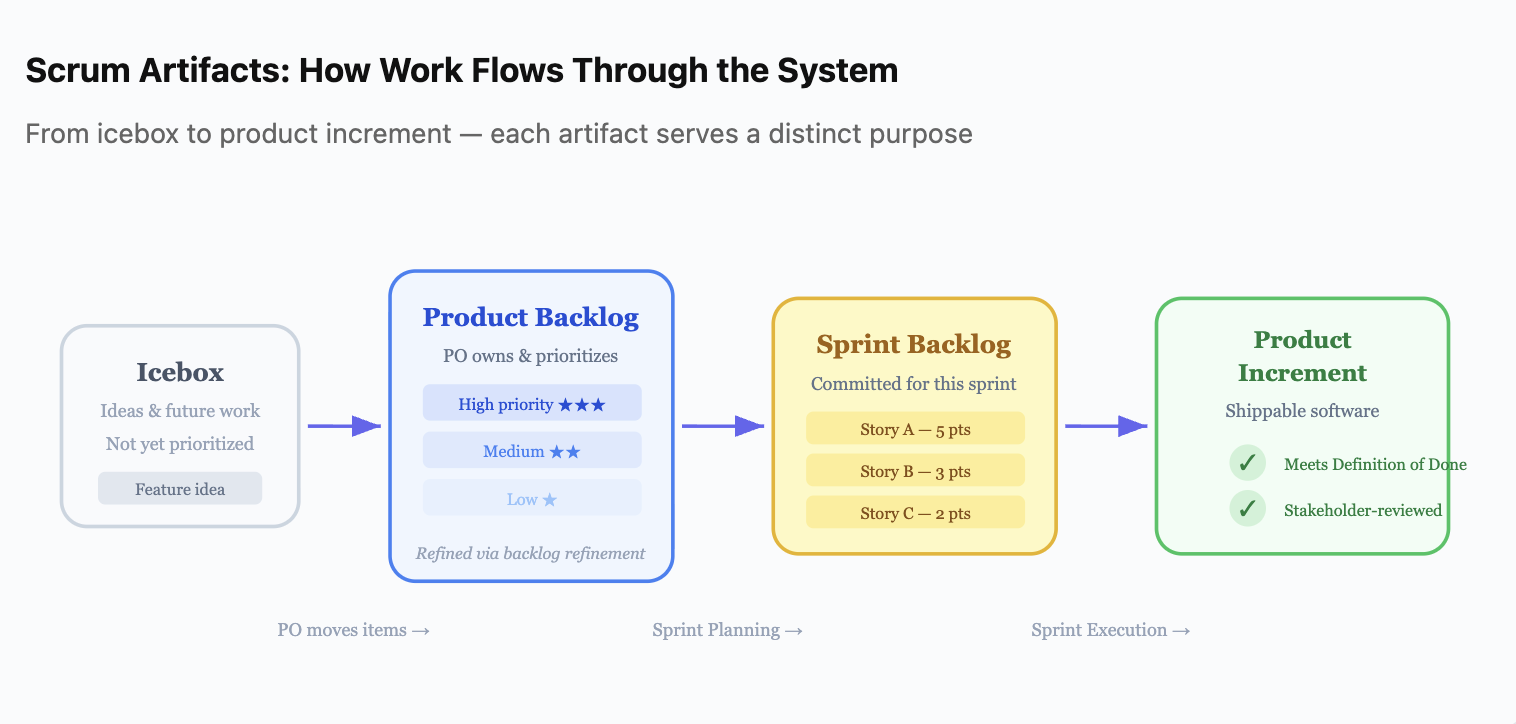
Scrum artifacts: how work flows through the system from icebox to product backlog, sprint backlog, and product increment — each artifact serves a distinct purpose
The Scrum Sprint Cycle: How the Stages Connect
All the stages and activities described above function together and are collectively known as the Scrum sprint cycle. There are six main phases when working in sprints: icebox, backlog refinement, sprint planning, sprint execution, sprint review, and sprint retrospective. Each sprint, lasting from one to four weeks, begins with sprint planning, includes daily stand-up meetings for progress updates, and ends with a sprint review and retrospective. The sprint cycle creates a repeatable rhythm that allows teams to plan with increasing accuracy, deliver with increasing quality, and improve with increasing speed. When every phase of the sprint cycle is respected — from the discipline of backlog refinement through the honesty of the sprint retrospective — the result is a delivery engine that compounds its own effectiveness over time.
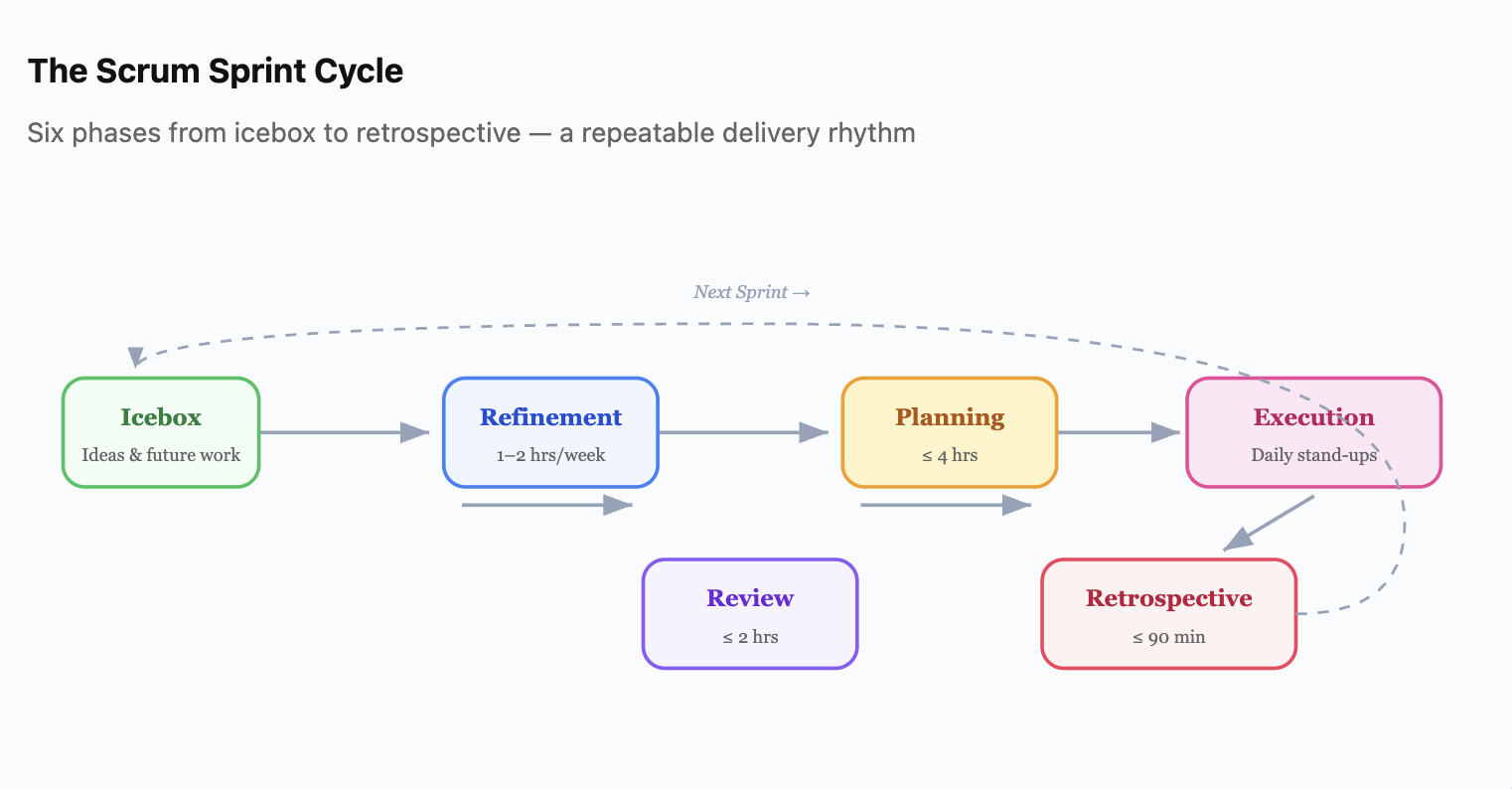
The Scrum sprint cycle: six phases from icebox to retrospective — a repeatable delivery rhythm that compounds team effectiveness over time
Sprint Planning and Execution
Sprint planning is the foundational ceremony that sets the direction for each iteration. A well-executed planning session aligns the team around a clear sprint goal and a realistic sprint backlog.
Planning Phase
Planning establishes the sprint goal and backlog. The sprint planning meeting typically involves two parts. In the first half, the Product Owner presents the highest-priority items from the product backlog, articulated as user stories with clear acceptance criteria. During sprint planning, the Product Owner presents the highest-priority backlog items and collaborates with the team on sprint estimation tasks to ensure the selected scope is achievable within the timebox. In the second half, Scrum team members perform sprint estimation tasks, decompose selected stories into tasks, estimate effort, and commit to a sprint backlog that is achievable within the timebox.
Sprint goal definition is critical. The sprint goal provides a unifying objective that guides decision-making throughout the sprint. It should be specific enough to be measurable yet flexible enough to allow Scrum team members to determine the best approach to achieving it. Effective sprint planning depends on a well-refined backlog and accurate sprint estimation tasks completed during prior backlog refinement sessions. Sprint reviews and sprint planning both require stakeholder participation, so the cadence must align with stakeholder availability to maintain momentum. Understanding software development cost per hour helps organizations plan sprint budgets and allocate resources effectively across iterations.
The team collectively owns the sprint backlog and is jointly accountable for meeting the sprint goal. When accountability is embedded in the process rather than imposed from outside, teams develop stronger ownership of outcomes. During backlog refinement, Scrum team members collaborate on sprint estimation tasks — decomposing stories, estimating effort, and identifying technical dependencies — so that sprint planning runs efficiently within its timebox. Team synchronization happens naturally through these ceremonies — each team member understands their contribution to the sprint goal, creating shared accountability that drives higher engagement and performance. This rhythm of team synchronization ensures that no one operates in isolation and that impediments are surfaced before they compound. Epics in Jira bridge the gap between high-level roadmap planning and day-to-day sprint execution, giving teams the structural visibility needed to align sprint-level work with strategic objectives.
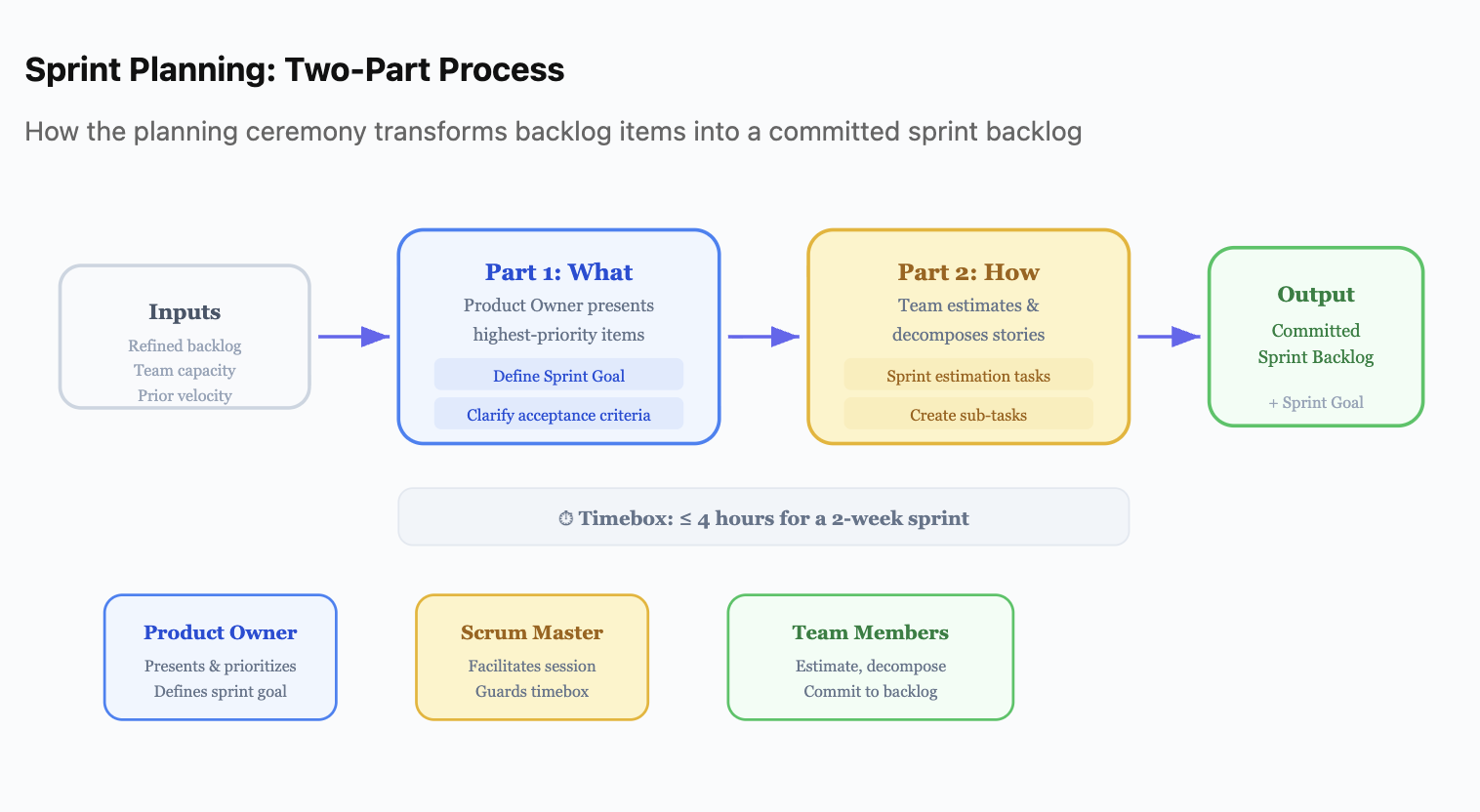
Sprint planning: two-part process showing how the planning ceremony transforms backlog items into a committed sprint backlog with a clear sprint goal
Refinement and Estimation
During sprint planning, the Product Owner presents the highest-priority backlog items while Scrum team members perform sprint estimation tasks — sizing stories, decomposing work, and committing to a sprint backlog within the timebox. Accurate sprint estimation tasks depend on thorough backlog refinement, where Scrum team members collaborate with the Product Owner to clarify, estimate, and decompose upcoming backlog items — an ongoing activity where healthy teams invest one to two hours per week.
Breaking down stories into small, actionable units is the foundation of effective sprint execution. Teams that master the discipline of breaking down stories consistently deliver more predictable results and avoid carrying unfinished work across sprint boundaries. Refinement is where breaking down stories, clarifying acceptance criteria, and preliminary story estimation happen — the team discusses each story to ensure shared understanding and identifies any dependencies or risks before the sprint begins. During backlog refinement, Scrum team members contribute technical perspective to sprint estimation tasks, ensuring that upcoming work is well-understood before it enters the sprint. Backlog refinement is where sprint estimation tasks are prepared for future sprint planning sessions, ensuring stories are right-sized and ready. Without consistent backlog refinement, sprint planning becomes chaotic and sprint estimation tasks take far longer than necessary.
Accurate story estimation is the engine of reliable sprint planning. When story estimation is treated as a team skill to be developed — not a bureaucratic exercise — it becomes one of the most powerful tools for sprint cycle predictability. Story estimation accuracy improves only through deliberate practice: reviewing estimates against actuals, adjusting for changing requirements, and refining the team’s shared understanding of what “done” means. Use historical velocity data and honest team feedback during retrospectives to set realistic sprint commitments that the team can deliver with quality. Without consistent backlog refinement, sprint estimation tasks take three times longer because Scrum team members must clarify requirements in real-time during sprint planning. The sprint planning timebox is consumed by work that should have happened during backlog refinement.
Execution Phase
During execution, the team focuses on completing the committed sprint backlog items. Key execution principles include:
Prioritize by business value. Scrum team members prioritize backlog items by business value, working on the highest-value items first to maximize the increment’s impact, even if the sprint is not fully completed.
Guard against scope creep. New requests are captured in the product backlog but not added to the active sprint. Teams that fail to shield the sprint cycle from ad hoc changing requirements create a chaotic environment where velocity becomes meaningless and collaborative teamwork suffers. The agile principle of responding to change over following a plan is operationalized most clearly through Scrum’s sprint-based iterations — each iteration represents a bounded experiment where the team can adjust direction based on real feedback.
Ensure continuous integration and testing. Each story should meet its definition of done, including testing and code review, before being considered complete.
Sprint Retrospective as an Execution Lever
The sprint retrospective is the team’s primary mechanism for identifying areas of improvement and turning team feedback into actionable change. Scrum team members reflect on the sprint and identify improvements. The team reflects on what went well, what could be improved, and agrees on specific actions for the next sprint. The team committed to three concrete areas of improvement: enforce rigorous breaking down stories during refinement; protect the sprint cycle from changing requirements by routing all new requests through the Product Owner; and restructure the sprint retrospective to prioritize anonymous team feedback on team dynamics before discussing process topics.
In sprint planning, the Scrum Master ensures the timebox is respected and that sprint estimation tasks are thorough. Scrum team members own execution — during sprint planning, they perform sprint estimation tasks and commit to the sprint backlog within the timebox. Create Jira templates for recurring ceremonies — sprint planning agendas, retrospective action items, and definition-of-done checklists — so that the team spends its energy on delivery, not setup.
Automation in Sprint Planning and Execution
Through Jira automation rules, teams can auto-create sub-tasks from sprint planning templates, automatically assign issues based on component ownership or team rotation, and escalate overdue issues to the Scrum Master when items remain blocked beyond defined thresholds. Configure rules to automatically assign issues to the appropriate team member when new sub-tasks are created, reducing manual triage overhead. Implement three high-impact Jira automation rules: auto-create sub-tasks when stories enter the sprint, automatically assign issues to reviewers when sub-tasks move to “In Review,” and escalate overdue issues via Slack when items stall for more than two days.
Sprint Duration and Cadence
Selecting the right sprint duration is a critical design decision that influences team productivity, stakeholder engagement, and delivery predictability. While the Scrum Guide does not prescribe a specific duration beyond a maximum of one month, industry practice has converged around two-week sprints as the most common cadence.
Factors Influencing Sprint Length
Product complexity and maturity. Mature products with well-understood domains may operate effectively with two- to three-week sprints.
Team experience and velocity stability. As velocity stabilizes, longer sprints may reduce ceremony overhead.
Stakeholder availability. The cadence must align with stakeholder schedules and decision-making rhythms.
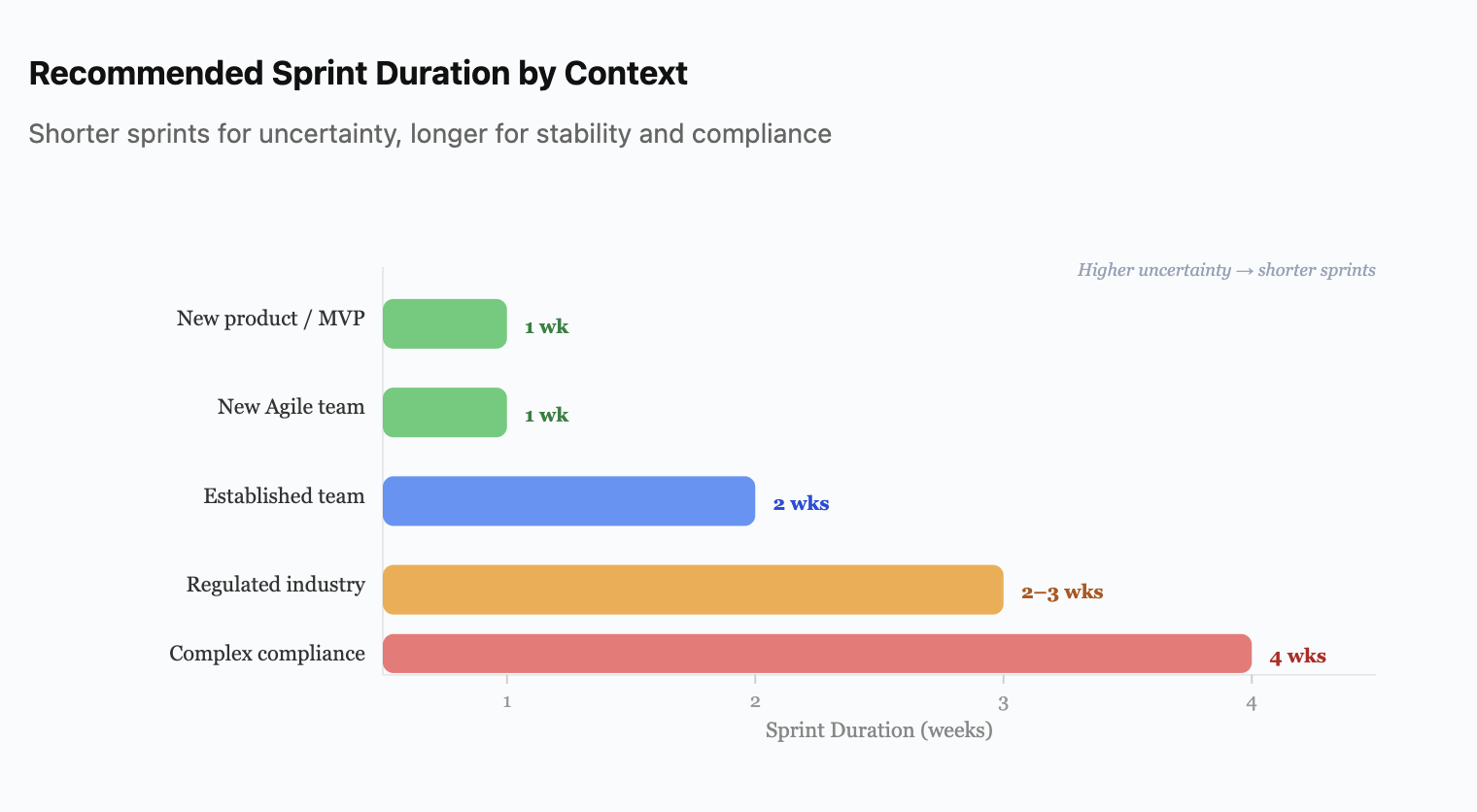
Recommended sprint duration by context: shorter sprints for high uncertainty and new teams, longer sprints for stability and complex compliance requirements
The Importance of Consistency
Maintaining a fixed duration across sprints is essential. Changing sprint length mid-stream should be treated as a significant process decision — not a casual adjustment — and should only occur after thorough retrospective analysis identifies persistent bottlenecks tied to cadence.
Cadence, Estimation, and Refinement
Industry practice has converged around two-week sprints as the most common cadence, though mature products with well-understood domains may operate effectively with two- to three-week sprints. Maintaining a fixed sprint duration is essential for reliable velocity measurement and consistent iteration rhythms. Kanban, while highly flexible, lacks the time-boxed iterations that sprints provide, which can make it harder to establish predictable delivery rhythms and structured sprint review ceremonies.
Whether using story points, t-shirt sizes, or planning poker, consistent story estimation practices improve velocity predictability and strengthen sprint planning accuracy over time. Stories should be small enough to complete within a single sprint cycle — a useful heuristic is that if a story cannot be estimated with confidence by the full team, it likely needs further decomposition. Teams should track their velocity across multiple sprint cycles to establish a baseline and refine their story estimation calibration continuously. Skipping refinement undermines the entire sprint cycle and forces the team to do refinement work during sprint planning, consuming valuable time. Sustainable pace is not optional — it is foundational to long-term Agile success.
The Retrospective as a Cadence Lever
The difference between good and great sprint teams lies in how seriously they treat the sprint retrospective as a vehicle for change. Sprints require collaborative teamwork, and team dynamics play a decisive role in sprint success. Within three sprint cycles of disciplined retrospective practice, teams typically see velocity stabilize and predictability improve.
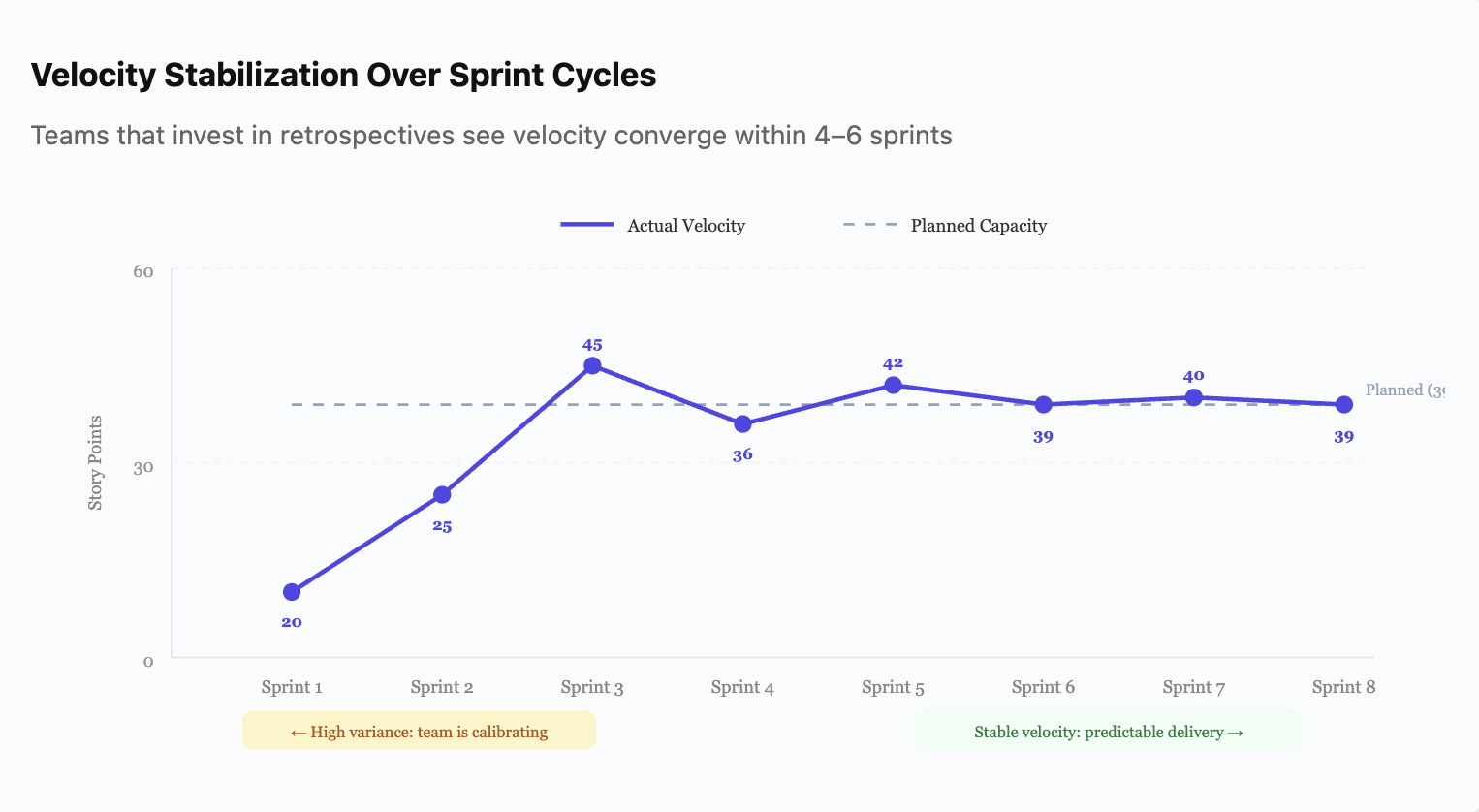
Velocity stabilization over sprint cycles: teams that invest in retrospectives see velocity converge within 4–6 sprints, enabling predictable delivery
Sprint Tools and Automation
Selecting the right agile project management tool — and pairing it with smart automation — is a force multiplier for sprint-based delivery. Whether your organization is beginning its Agile journey or seeking to optimize an existing sprint-based delivery model, the right tooling ecosystem offers actionable improvements grounded in real-world efficiency gains. Understanding the strengths and limitations of each of these agile methods and their supporting tools helps leaders choose the right framework for their context.
Jira as the Leading Agile Project Management Tool
Standardize sprint workflows using Jira templates and automation rules to auto-create sub-tasks, assign issues, and escalate overdue items. Kanban boards and burndown charts provide real-time transparency into sprint progress, enabling the team to self-organize and address impediments proactively. Kanban boards and burndown charts also enable Scrum team members to monitor sprint health at a glance, ensuring that teams can address impediments proactively rather than reactively. Instead of relying on manual status updates, velocity should serve as a guide for sprint planning and capacity forecasting — nothing more — and automated dashboards make this effortless. Effective retrospectives examine team dynamics, process efficiency, and tooling effectiveness, and the right tool configuration ensures that retrospective outputs are tracked and acted upon.
Jira Automation for Sprint Efficiency
Jira automation is one of the most impactful scrum productivity tools available within the platform.
Advanced Jira automation workflows can trigger Slack notifications when items move across the agile board in Jira, auto-close stale tickets after a configurable period, and generate sprint summary reports at the end of each iteration. Jira automation transforms the agile board in Jira from a passive display into an active management engine that keeps the sprint on track.
Alternative Scrum Productivity Tools
While Jira leads the market, alternative agile project management tool options such as Azure DevOps, Monday.com, Hubstaff Tasks, and Linear each offer distinct advantages depending on the organization’s technology stack, team size, and integration requirements. Hubstaff Tasks provides a lightweight agile board with built-in time tracking — a useful scrum productivity tool for distributed teams that need effort visibility alongside sprint progress.
When evaluating any agile project management tool, consider factors such as agile board customization, the ability to manage epics in Jira or equivalent hierarchy, Jira automation or comparable rules engines, support for burndown charts and velocity reporting, and integration with CI/CD pipelines.
Workflow Automation
Use Jira automation or equivalent scrum productivity tools to auto-transition issues through workflow states (e.g., move to “In Review” when a pull request is opened), trigger notifications for blocked items on the agile board in Jira, and auto-close stale items after defined thresholds. The goal of workflow automation is to ensure the agile board in Jira always reflects reality without requiring manual updates.
Reporting Automation
Generate burndown charts, velocity reports, and sprint summaries automatically at the end of each sprint. Automated burndown charts remove human error from progress tracking and give stakeholders a reliable view of sprint health. Velocity trends over time — easily visualized through Jira automation dashboards — help teams calibrate sprint planning and identify capacity patterns. When burndown charts update in real-time, the team can course-correct mid-sprint rather than discovering slippage at the sprint review.
Integration Automation
Connect your agile project management tool with CI/CD pipelines, code repositories, and communication platforms (e.g., Slack) to create a unified delivery ecosystem. When the agile board in Jira reflects real-time build and deployment status, teams can respond to integration failures within minutes rather than discovering them at the next daily stand-up.
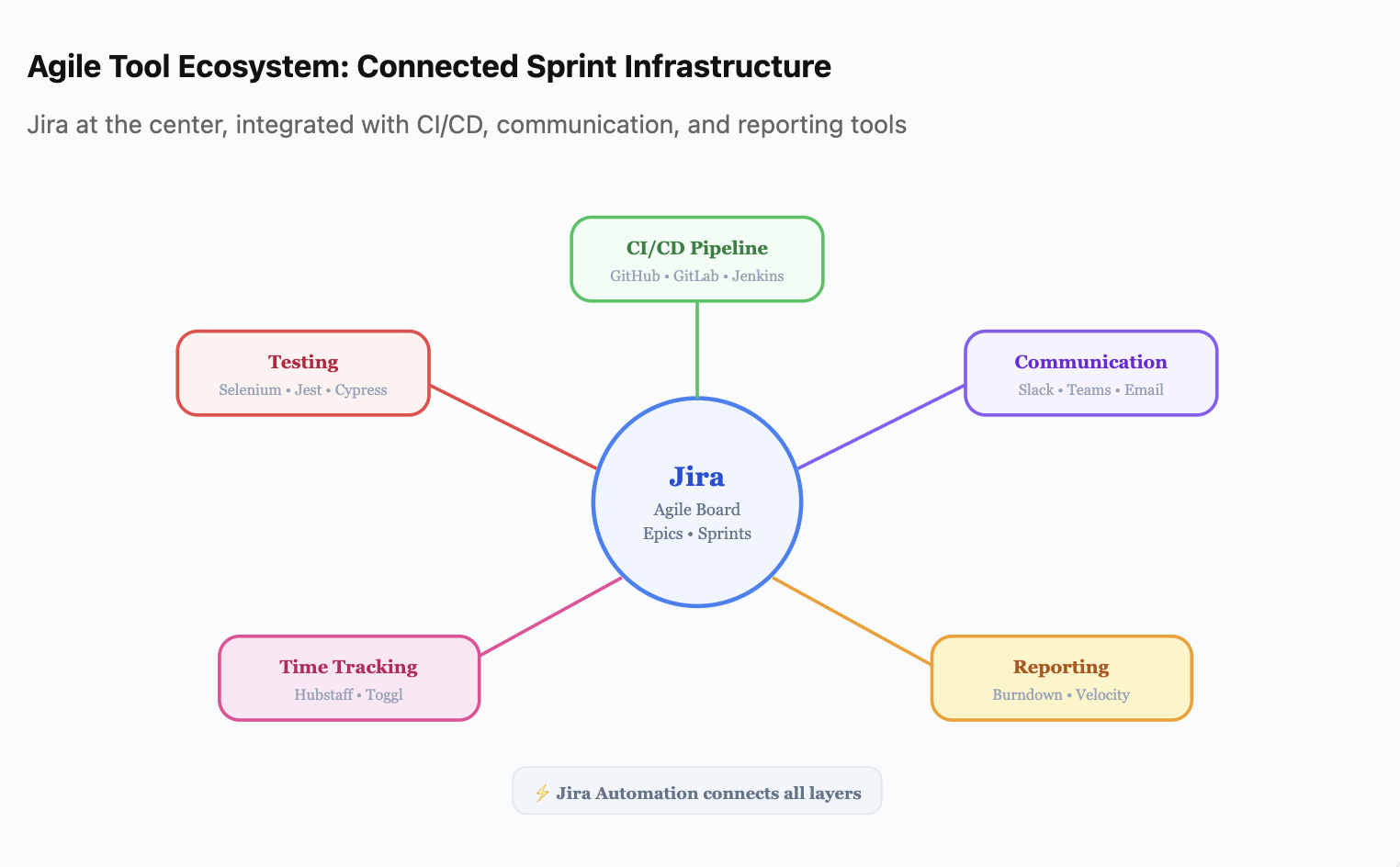
Agile tool ecosystem: connected sprint infrastructure with Jira at the center, integrated with CI/CD pipelines, communication, time tracking, and reporting tools
Choosing the Right Agile Project Management Tool
The ideal agile project management tool should support a fully customizable agile board in Jira or equivalent visual workflow, native management of epics in Jira or hierarchical work item structures, robust Jira automation to auto-create sub-tasks, automatically assign issues, and escalate overdue issues without manual intervention, real-time burndown charts and velocity dashboards, and seamless integration with your development stack.
For enterprise teams, Jira remains the benchmark among scrum productivity tools. Key Jira automation patterns to implement immediately include: auto-create sub-tasks when a story enters the sprint backlog, automatically assign issues to the component owner, escalate overdue issues by notifying the Scrum Master when items exceed their time estimate, and auto-generate burndown charts and velocity reports at sprint close.
Regardless of which agile project management tool you select, the key is ensuring it functions as a true scrum productivity tool that makes the agile board in Jira (or equivalent) the single source of truth.
Implementation Playbook: Setting Up Jira for Sprint Success
Week one: Board and structure. Create an agile board in Jira with columns mapped to your workflow. Configure epics in Jira for quarterly objectives and nest stories under the appropriate epics in Jira for strategic roll-up visibility.
Week two: Jira automation setup.
Week three: Reporting and velocity. Configure automated burndown charts on the agile board in Jira. Set up velocity widgets on the team dashboard. Create a recurring Jira automation rule to generate sprint summaries at iteration close.
Week four: Full ecosystem. Integrate Hubstaff Tasks or equivalent time-tracking scrum productivity tools alongside Jira. The combination of the agile board in Jira for workflow, epics in Jira for strategy, Jira automation to auto-create sub-tasks, automatically assign issues, and escalate overdue issues, plus burndown charts and velocity dashboards, creates a tooling foundation that scales. The goal of every agile project management tool configuration is the same: make the right thing easy and the wrong thing visible.
Best Practices and Common Pitfalls
Drawing from hundreds of Agile coaching engagements, we have identified the following best practices and common pitfalls that consistently differentiate high-performing sprint teams from those that struggle.
Breaking Down Stories Rigorously
Rigorous breaking down stories also makes story estimation more accurate, since smaller items are inherently easier to size.
Conducting Meaningful Retrospectives Focused on Areas of Improvement
Track areas of improvement across sprints to ensure follow-through and continuous team growth.
Common Pitfall: Treating Velocity as a Performance Metric
Velocity is a planning tool, not a measure of team productivity. Using velocity to compare teams or pressure individuals undermines trust and distorts story estimation accuracy.
Common Pitfall: Neglecting Team Dynamics
Ignoring interpersonal friction or failing to address communication breakdowns during sprint retrospectives erodes team effectiveness over successive sprint cycles. Healthy team dynamics must be actively cultivated through intentional retrospective discussions, one-on-one check-ins, and a culture where team feedback is valued rather than penalized.
Common Pitfall: Skipping Refinement Sessions
Without regular backlog refinement, teams enter sprint planning with poorly defined stories, leading to mid-sprint confusion, scope creep, and missed commitments. The team discusses each story to ensure shared understanding and identifies any dependencies or risks.
Common Pitfall: Over-Committing Capacity
Teams that consistently overload their sprint backlog create a cycle of incomplete work and declining morale.
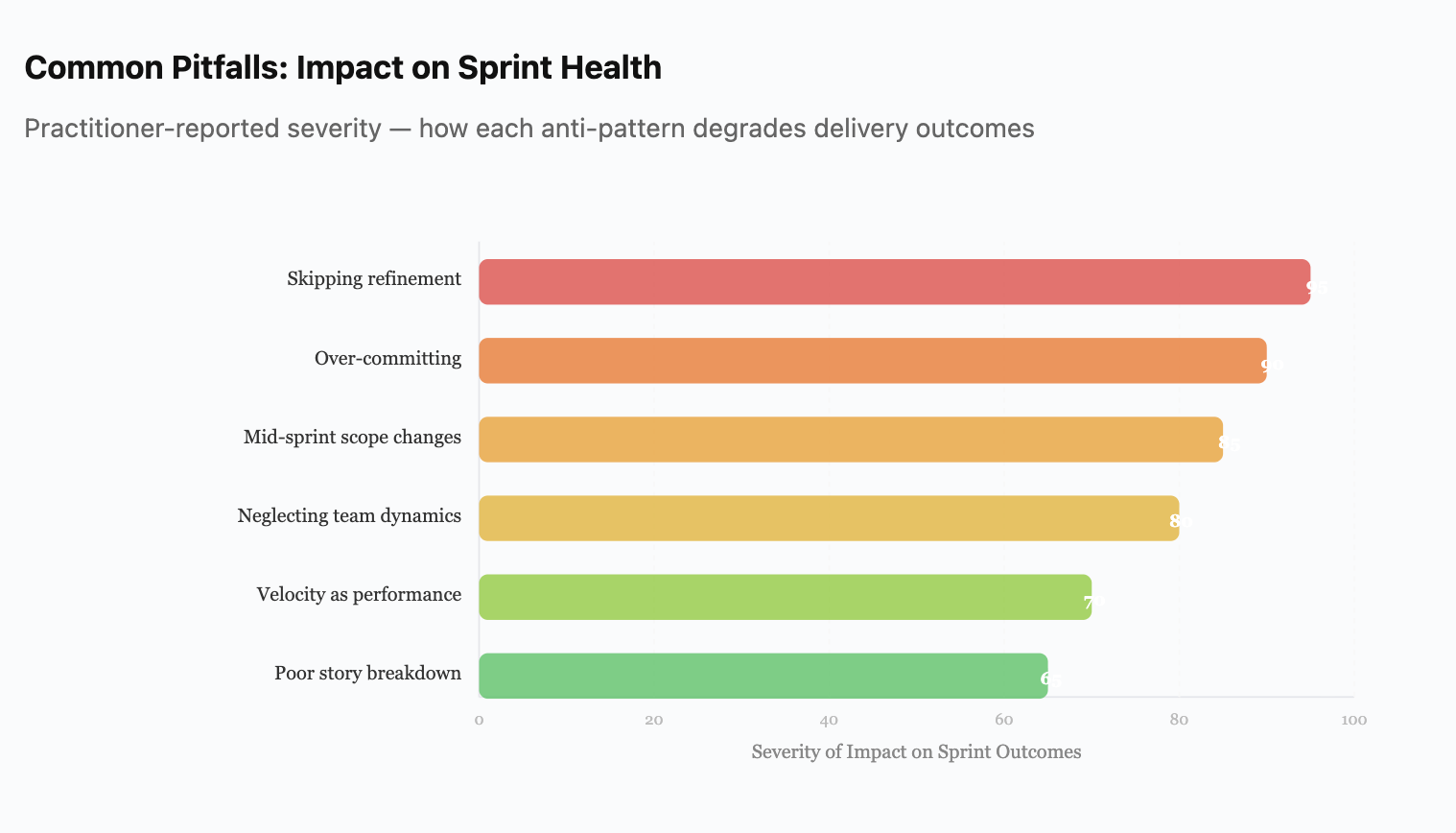
Common pitfalls and their impact on sprint health: practitioner-reported severity showing how each anti-pattern degrades delivery outcomes
Building a Culture of Continuous Improvement
The practices outlined in this guide provide a foundation for that journey — and Jira templates can codify these retrospective outputs into recurring backlog items, ensuring that areas of improvement become part of the team’s working rhythm rather than forgotten notes.
Real-World Scenario: Turning a Struggling Team Around
Consider a mid-sized fintech team running two-week sprint cycles with persistent issues: stories regularly spilling across sprints, low morale, and stakeholders losing confidence. Diagnosis revealed three root causes. First, inadequate breaking down stories — epics were entering sprints as monolithic items, making accurate story estimation impossible. Second, team dynamics had deteriorated because retrospectives were treated as a formality rather than a genuine forum for team feedback. Third, changing requirements were being injected mid-sprint, destroying focus.
Story estimation accuracy improved by 40% as the team gained confidence from consistently completing well-sized stories. Collaborative teamwork strengthened because team dynamics issues were being surfaced and resolved in retrospectives rather than festering.
Frequently Asked Questions
What is a sprint in software development?+
A sprint is a short, fixed-duration iteration — typically one to four weeks — during which a cross-functional Scrum team commits to delivering a potentially shippable product increment. Sprints are the core building block of Scrum development and provide a structured rhythm of planning, execution, review, and retrospective that enables teams to deliver working software incrementally.
How long should a sprint last?+
Most teams use two-week sprints as the industry standard, though sprint duration can range from one to four weeks. Shorter sprints suit early-stage products with high uncertainty and newer Agile teams, while longer sprints may benefit mature products or regulated industries. The key is maintaining a consistent duration to enable reliable velocity measurement and predictable delivery rhythms.
What is the difference between a sprint and Scrum?+
A sprint is a time-boxed iteration, while Scrum is a comprehensive agile framework that incorporates sprints as a core component. Scrum defines the roles (Product Owner, Scrum Master, development team), ceremonies (sprint planning, daily stand-ups, sprint review, sprint retrospective), and artifacts (product backlog, sprint backlog, product increment) that structure how sprints are planned and executed.
What are the key ceremonies in a sprint?+
The four key Scrum ceremonies are sprint planning (setting the sprint goal and selecting backlog items), daily stand-up meetings (fifteen-minute synchronization), sprint review (demonstrating the completed increment to stakeholders), and sprint retrospective (reflecting on process improvements). Each ceremony is time-boxed and serves a distinct purpose in maintaining team alignment and continuous improvement.
How does sprint planning work?+
Sprint planning is a time-boxed ceremony (up to four hours for a two-week sprint) where the Product Owner presents prioritized backlog items and the team collaborates on estimation and task decomposition. The output is a committed sprint backlog with a clear sprint goal. Effective sprint planning depends on thorough backlog refinement conducted in advance, so stories are well-defined and properly sized before the session begins.
What is the difference between Scrum and Waterfall?+
The Waterfall model follows sequential phases where requirements are fixed upfront and testing occurs late in the cycle. Scrum development breaks projects into iterative sprints, delivering working software at the end of each iteration and welcoming changing requirements between sprint cycles. For most modern software projects with evolving requirements, Scrum delivers superior outcomes through faster feedback loops, reduced risk, and greater stakeholder visibility.
What tools are best for managing sprints?+
Jira is the leading agile project management tool, offering customizable boards, sprint backlog management, epics for strategic planning, burndown charts, velocity tracking, and powerful automation rules. Alternatives include Azure DevOps, Monday.com, Hubstaff Tasks, and Linear. The best tool for your team depends on your technology stack, team size, integration requirements, and the level of automation needed to support your sprint workflow.
Conclusion
Sprints are far more than a project management technique — they represent a fundamental shift in how organizations conceptualize and deliver value through technology. When implemented with discipline, supported by the right tools, and governed by clear roles and ceremonies, sprint-based delivery drives measurable improvements in speed, quality, and stakeholder satisfaction.
From years of hands-on consulting, we have seen firsthand how organizations that invest in Agile maturity — not just Agile adoption — achieve sustainable competitive advantage. We encourage leaders to view sprints not as a methodology to be imposed, but as a capability to be cultivated through continuous learning, experimentation, and improvement. For organizations beginning this journey, understanding what a software development company does provides essential context for selecting the right delivery partner.