A software development company is responsible for every step of the software development lifecycle, from ideation and planning through implementation and long-term post-release support. As technology has become more complex, these companies have developed software that scales, remains secure, and continues to evolve to meet business needs. Whether it involves custom software development, legacy system modernization, or cloud development, these firms deliver end-to-end application services tailored to each client’s goals.
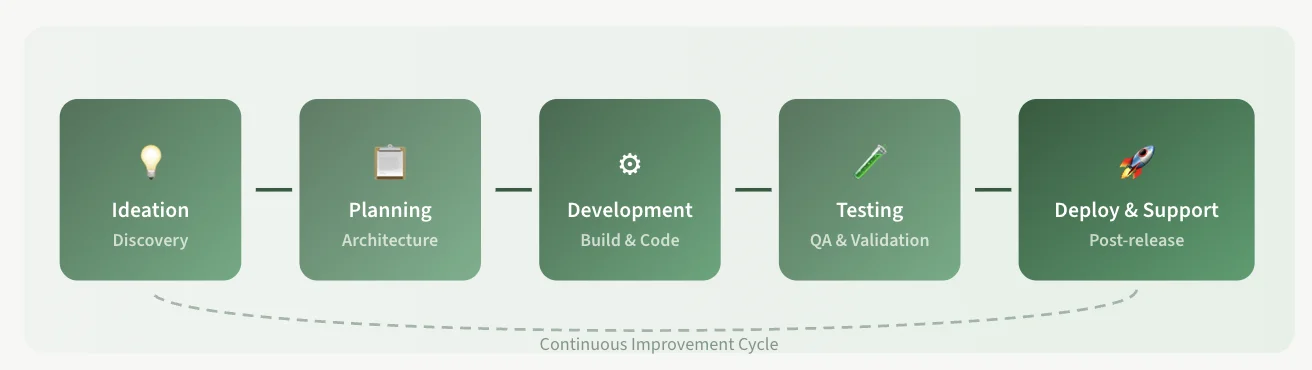
The five core phases of the software development lifecycle, connected by a continuous improvement cycle
Most software development companies today use agile methods such as Scrum, Kanban, or Waterfall — or a hybrid composition of these approaches. These methods let them release new versions frequently, adapt based on stakeholder feedback, and ensure continuous workflow automation across the entire delivery pipeline.
Approach and Methodology
Successful software delivery depends on choosing the right approach and methodology. The most common frameworks for software development companies to integrate development, QA, and DevOps into a single delivery workflow are Agile, Scrum, Kanban, Waterfall, or a hybrid composition of these methodologies.
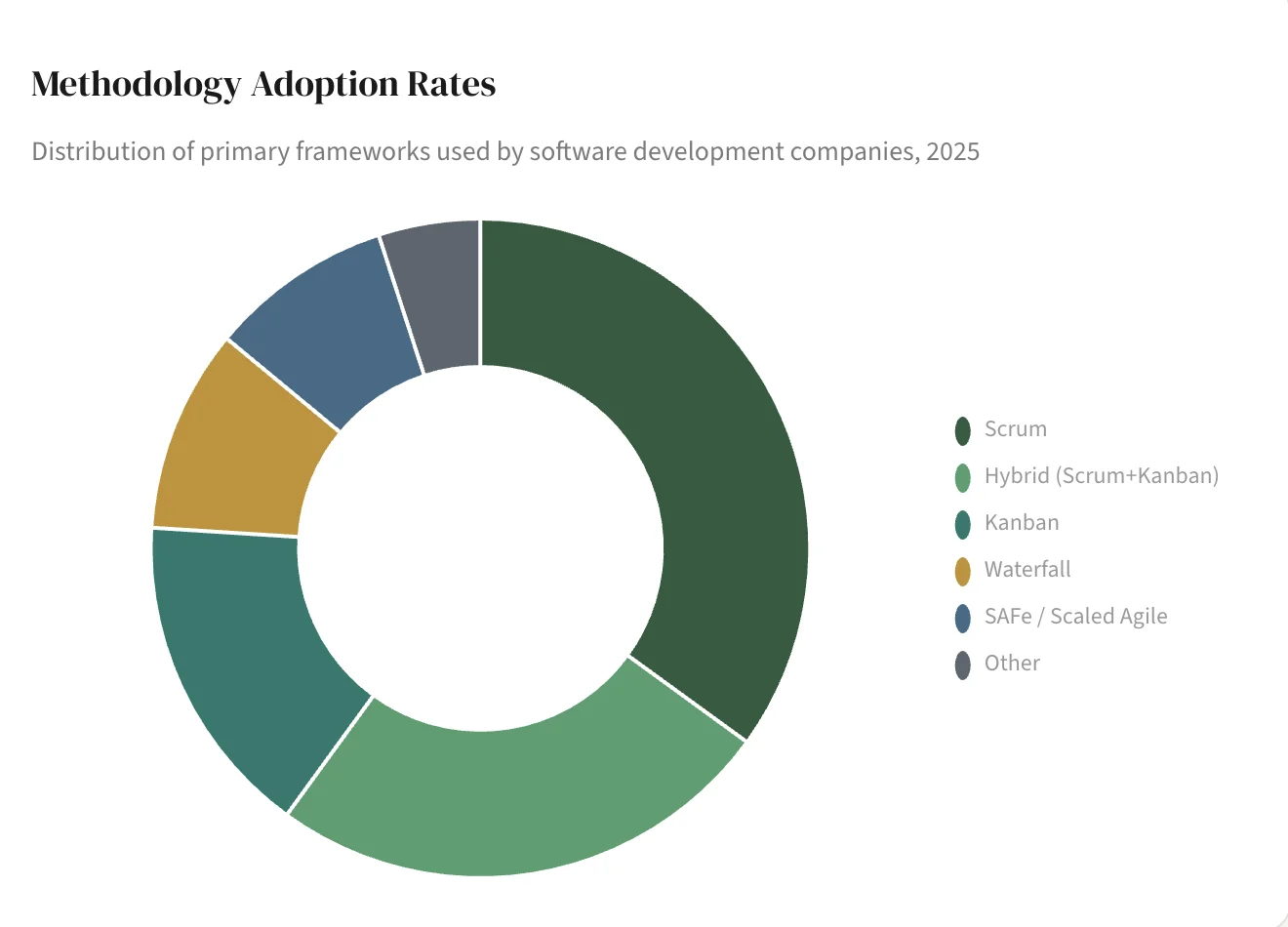
Distribution of primary frameworks used by software development companies, 2025
Scrum, Kanban, and Waterfall in Practice
Scrum organizes work into fixed-length sprints with daily standups, sprint reviews, and retrospectives, giving teams a predictable cadence for planning and delivery. Kanban focuses on continuous flow, using visual boards and work-in-progress limits to optimize throughput and reduce bottlenecks. Waterfall follows a sequential phase-gate approach — requirements, design, development, testing, deployment — and works well for projects with clearly defined scope. Many companies adopt a hybrid composition, combining the structured cadence of Scrum with Kanban’s flow-based prioritization or using Waterfall for planning phases and Agile for execution.
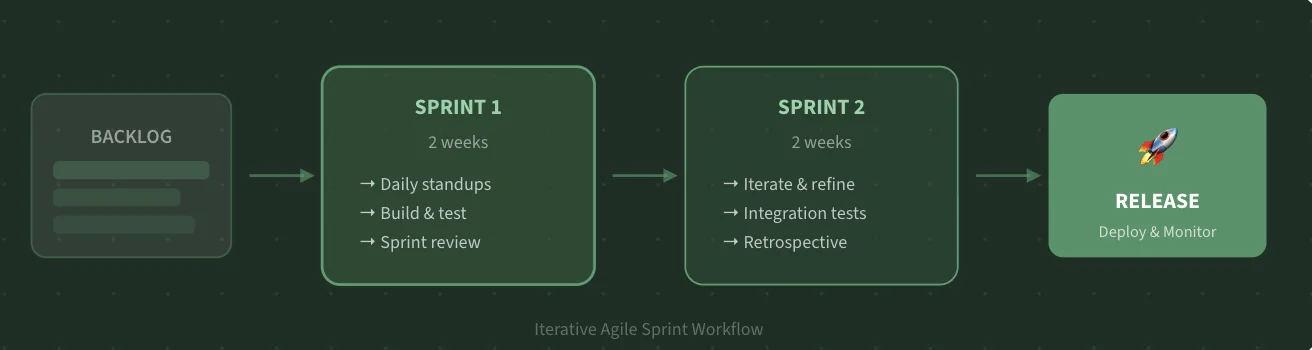
Iterative Agile Sprint Workflow: from backlog through sprints to release
Workflow Automation and Coding Standards
Workflow automation is central to modern software delivery. Automated CI/CD pipelines build, test, and deploy code with minimal manual intervention, reducing human error and accelerating releases. Teams enforce consistent coding standards through automated linters, static analysis tools, and mandatory code reviews, ensuring every commit meets quality and security benchmarks before it enters the main branch.
Shift-Left Approach to QA and Risk Management
A shift-left approach to QA means integrating testing and quality assurance as early as possible in the development cycle rather than treating it as a final gate. This includes writing unit tests during development, running continuous testing frameworks on every commit, and performing early security scans. Combined with structured risk management — identifying, assessing, and mitigating risks at every phase — this approach reduces the cost of defects and prevents surprises later in the delivery lifecycle.
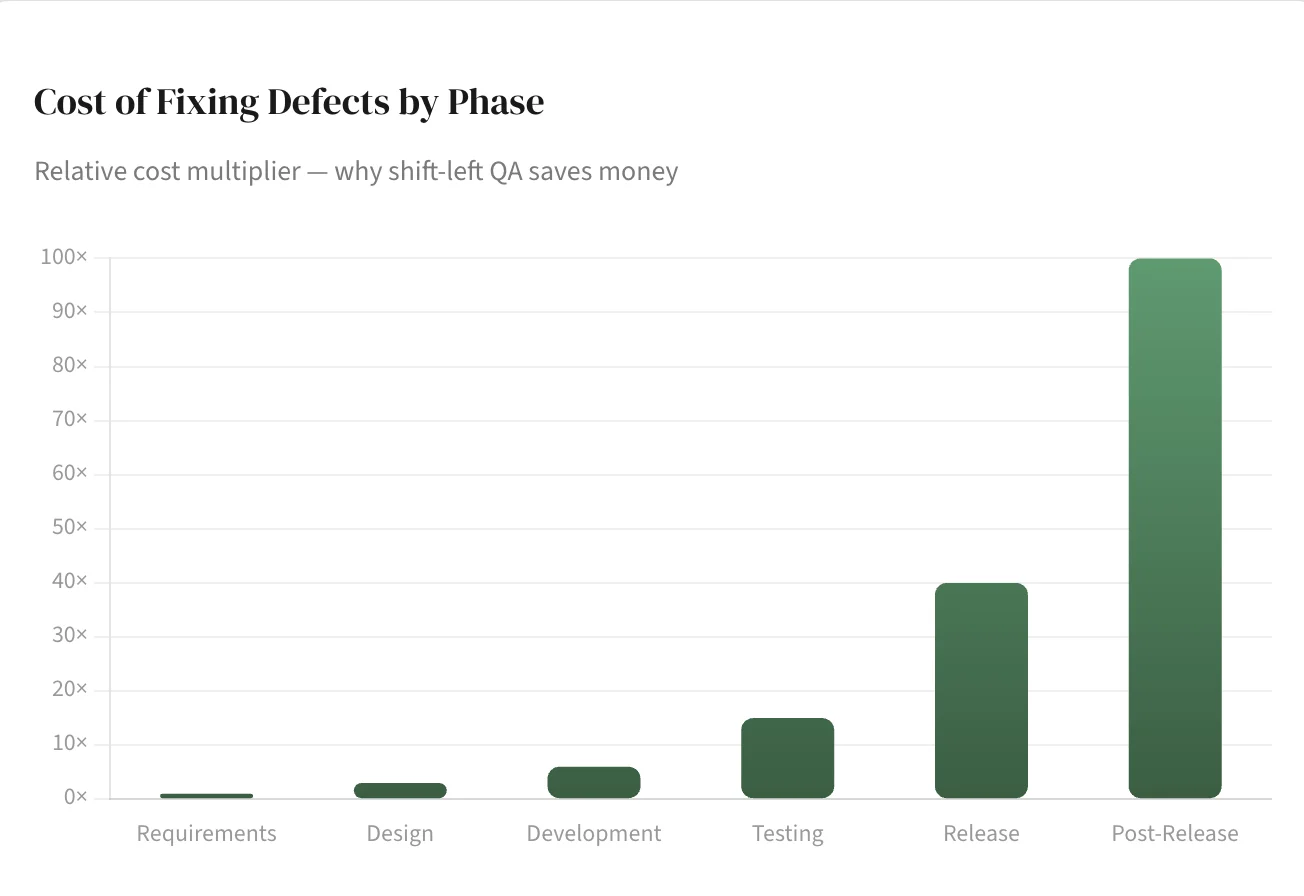
Cost of fixing defects by phase: why shift-left QA saves money
Change Management and Application Modernization
Change management practices ensure that evolving requirements, scope adjustments, and new priorities are handled without disrupting delivery. Each change request goes through impact analysis, approval workflows, and reprioritization within the task management system. For clients with aging infrastructure, application modernization and migration of legacy databases are handled through a disciplined methodology — assessing technical debt, planning incremental upgrades, and validating each migration step before cutover.
Project Management Practices and Quality Management System
Mature software development companies follow established project management practices that include sprint planning, milestone tracking, dependency mapping, and resource planning. A certified quality management system — often aligned with ISO 9001 — provides the framework for continuous improvement, regular audits, process documentation, and corrective actions. This ensures every project meets defined standards from kickoff through post-release support.
These methodologies and practices make it possible to:
Consistently integrate components and conduct tests through CI/CD tools, workflow automation, and continuous testing frameworks.
Build and test the MVP faster through MVP development practices and a shift-left approach to QA.
Calculate project cost accurately using cost estimation models and project cost calculation frameworks, giving a clear view of software development costs.
Provide reliable post-release support including monitoring, bug fixes, security updates, and performance improvements.
Manage risk using structured risk management and change management processes at every stage.
Maintain delivery quality through a certified quality management system aligned with project management practices and established coding standards.
Handle application modernization and migration of legacy databases through disciplined Scrum, Kanban, or Waterfall workflows with full workflow automation.
Team Models and Staff Augmentation
Along with full-cycle delivery, software development companies offer flexible team models to match each project’s needs:
Dedicated developers and QA engineers operating under a clear statement of work.
Dedicated teams with defined roles, goals, and resource planning aligned to delivery milestones.
A hybrid composition of internal and external specialists, combining domain knowledge with technical skill.
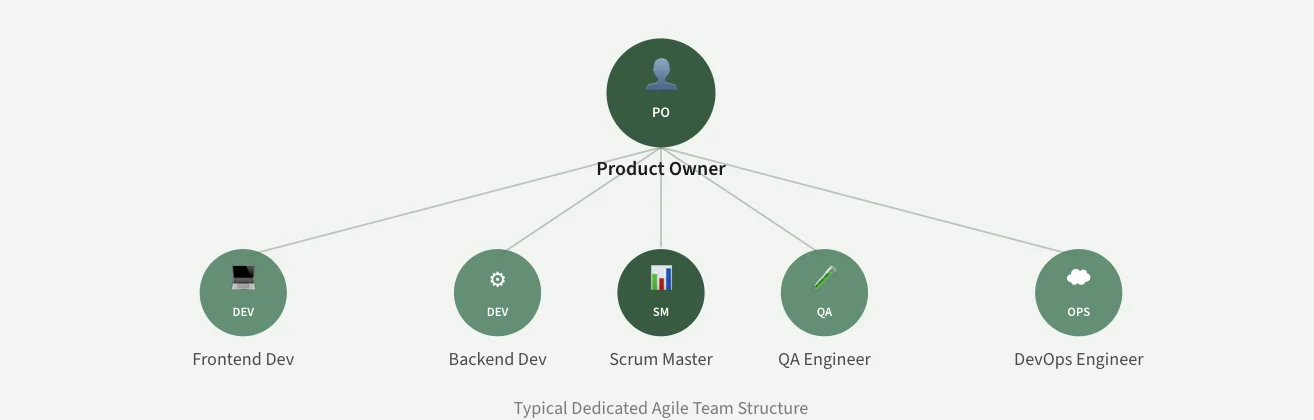
Typical Dedicated Agile Team Structure with key roles
Staff augmentation models let projects easily add or remove resources as priorities change. These models use a task management system to track progress, improve delivery predictability, and make resource planning transparent.
Services a Software Development Company Can Provide
Most of the time, a software development company offers a broad range of service offerings:
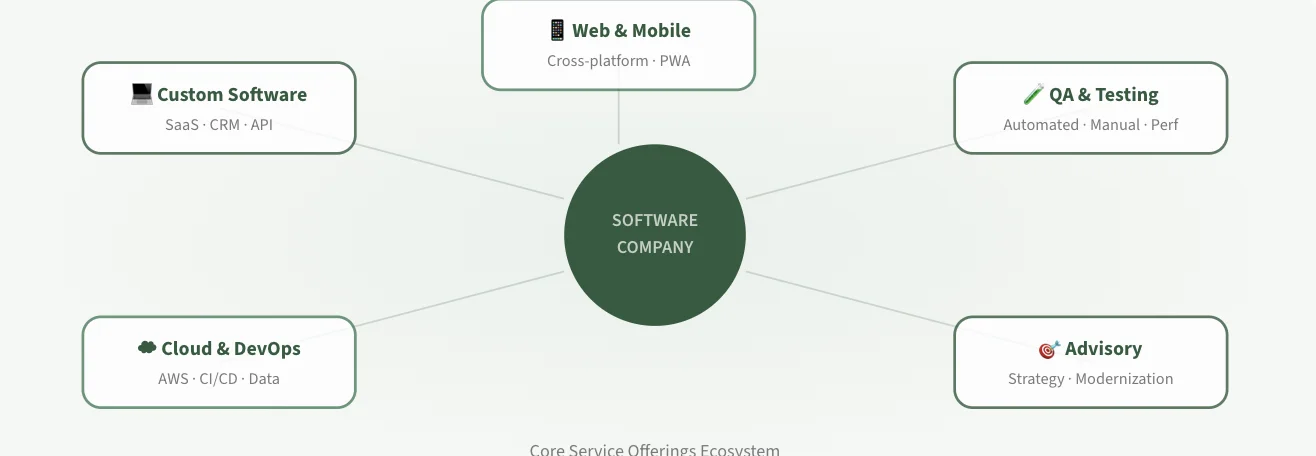
Core Service Offerings Ecosystem of a software development company
Custom Software Development
Building custom software that aligns with specific business processes using object-oriented programming, scalable architecture, and modern coding standards. This includes software product engineering for SaaS platforms, CRM solutions, business intelligence dashboards, and API integrations with third-party systems. A common example is helping organizations migrate from Excel to custom software to improve scalability and data management.
Web and Mobile Application Development
Creating web applications and mobile apps that are always available, performant, and secure. Teams use frameworks like Cordova for cross-platform mobile development, along with modern front-end and back-end technologies to deliver responsive, reliable application services.
Software Testing and Quality Assurance
A comprehensive QA & testing practice that includes manual and automated testing teams, exploratory testing, usability checks, application testing, and performance testing tools. Engineers write detailed test cases, manage flaky test suites, and use a shift-left approach to QA — catching defects early and reducing costs. Continuous testing frameworks run alongside CI/CD tools to validate every build.
Cloud, DevOps, and Data Systems
This includes cloud development and infrastructure using AWS DevOps tools, an automated DevOps lifecycle, data warehouses, OLAP systems, data analytics, and reporting pipelines. Teams build cloud-based data management platforms, custom algorithms, data analytics systems, and predictive analytics dashboards. Technologies such as machine learning, deep learning, scikit learn, and intelligent automation power advanced solutions. AI development and software robots help automate repetitive tasks at scale.
Technology Advisory and Consulting
A technology advisory practice helps companies determine the size of their MVP development project, address adoption challenges, plan for application modernization, and anticipate system changes over time. Advisory teams also guide organizations through the process of hiring software developers with the right expertise for each engagement. Advisors also assist with legacy system modernization, migrating legacy databases, and designing roadmaps for digital transformation. Cost estimation, project cost calculation, and software development costs analysis are core parts of the advisory engagement.
Real-World Software Development Examples
Software companies often deliver analytics platforms, enterprise systems, SaaS platforms, and cloud-based data management tools. Most of these projects have:
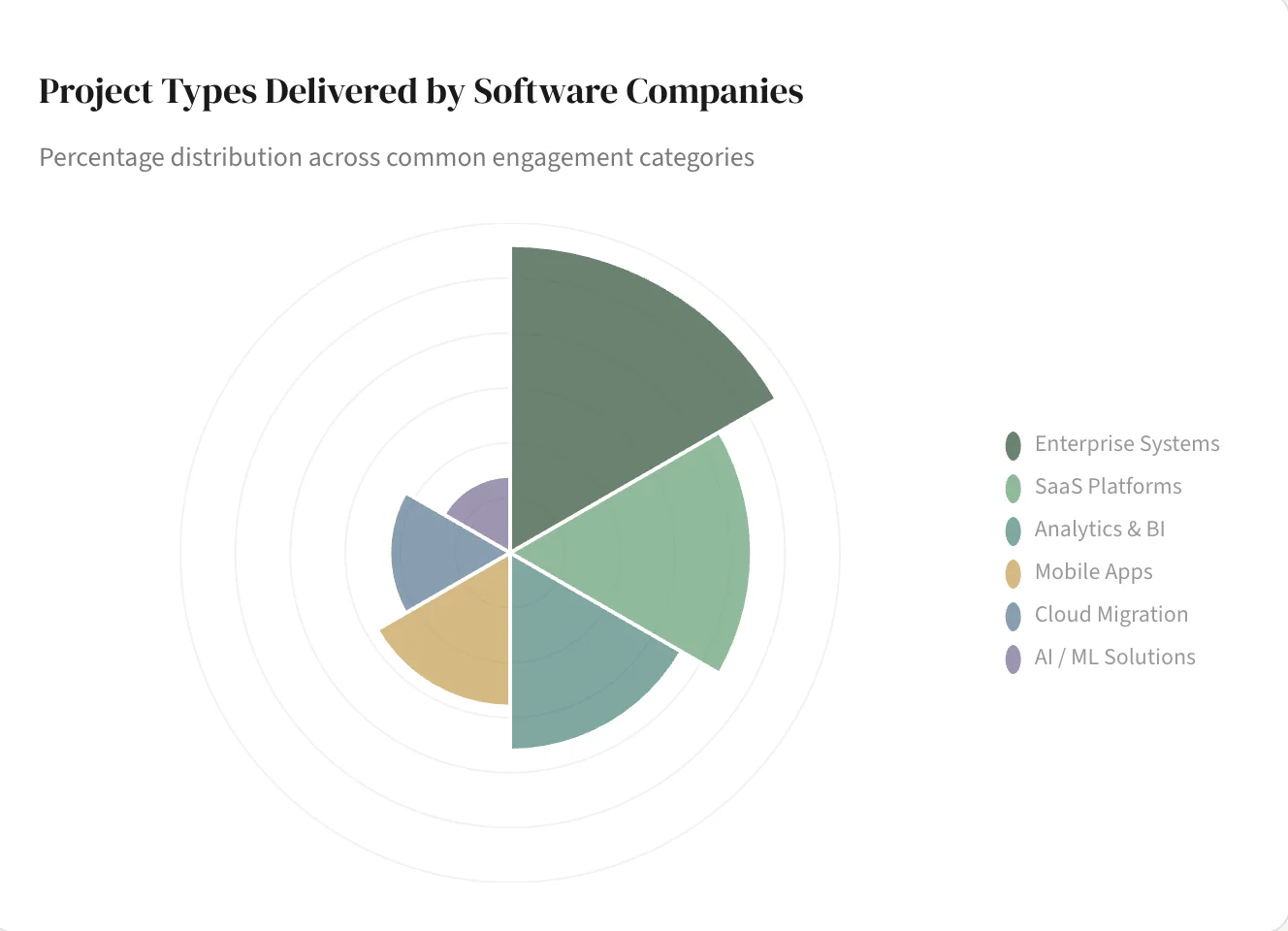
Project Types Delivered by Software Companies: percentage distribution across common engagement categories
Custom algorithms and data analytics systems that process large volumes of information.
Dashboards for reporting, predictive analytics, and business intelligence powered by OLAP, machine learning, deep learning, and scikit learn.
Investment portfolio management tools, API integrations, and CRM solutions for financial clients.
AI development solutions using intelligent automation, software robots, and API testing tools like Cordova and performance testing tools.
Cost estimation, project cost calculation, and optimization analysis.
Long-term system maintenance and improvement through the DevOps lifecycle and AWS DevOps tools.
How to Measure Software Development Success
People use key performance indicators (KPIs) such as delivery times, system stability, software development costs, performance benchmarks, and user adoption for success measurement. Companies use dashboards and progress reviews to present reports that track results, risks, and milestones throughout the lifecycle.
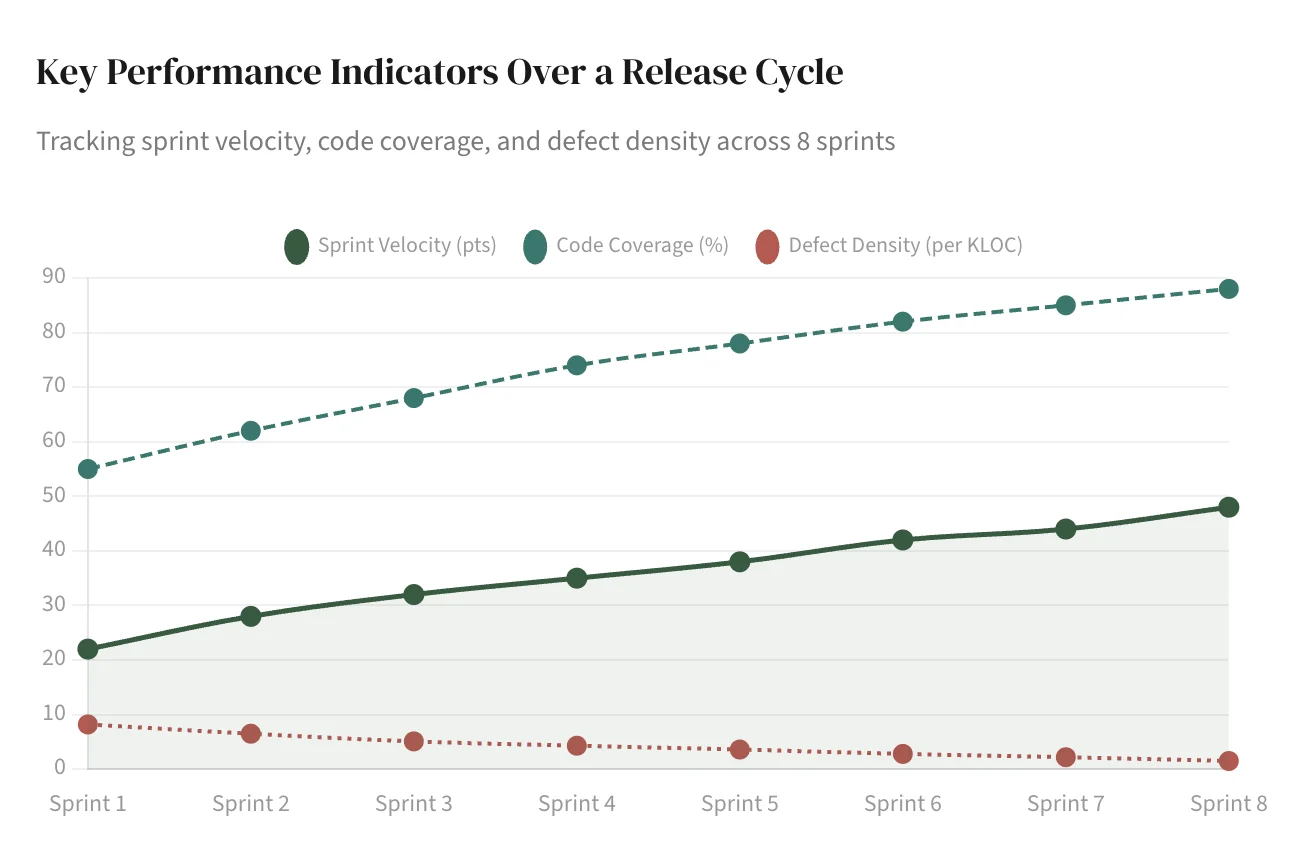
Key Performance Indicators Over a Release Cycle: tracking sprint velocity, code coverage, and defect density across 8 sprints
Report examples typically include sprint velocity, defect density, code coverage, and deployment frequency. Client testimonials, case studies, and success stories demonstrate measurable business impact — showing how the business became more efficient, how much money it saved, and how it transformed operations in quantifiable ways.
Industry Expertise
Software development companies build a wide range of software and adapt it to meet the needs of each industry. Some common areas include:
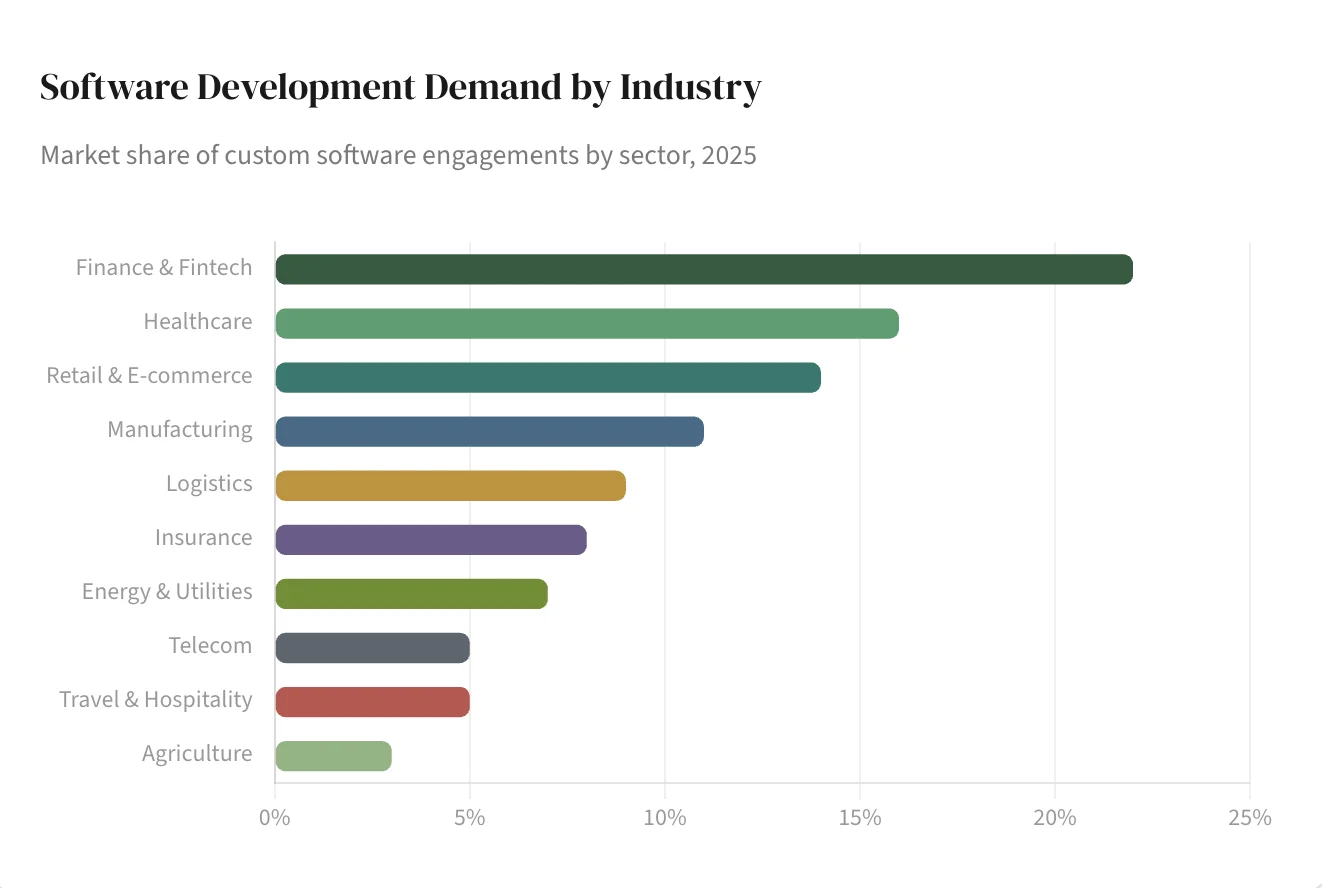
Software Development Demand by Industry: market share of custom software engagements by sector, 2025
Finance and fintechs — trading platforms, investment portfolio management tools, regulatory compliance systems.
Healthcare and medical devices & diagnostics — patient management, clinical analytics, and HIPAA-compliant platforms.
Insurance — claims processing, underwriting automation, and policy management.
Manufacturing — production optimization, IoT integration, and supply chain analytics.
Logistics and transportation — fleet management, route optimization, and real-time tracking.
Retail and e-commerce — inventory systems, personalization engines, and omnichannel platforms.
Energy and utilities — grid management, consumption analytics, and regulatory reporting.
Telecommunications — network management, subscriber analytics, and service platforms.
Travel & hospitality — booking systems, customer loyalty programs, and revenue management.
Agriculture — precision farming, crop monitoring, and supply chain traceability.
Knowing the industry ensures systems are safe, comply with the rules, and operate as intended. Teams apply domain-specific knowledge to handle regulatory requirements, security standards, and integration needs unique to each sector.
Company Credentials and Trustworthiness
People are more likely to trust a software development company that is transparent, delivers high-quality work, and meets deadlines. Knowing how to choose a software development company starts with evaluating these trust signals:

Key company credentials that build trust: ISO 9001, ISO 27001, audited systems, and client success
Ethical standards and professional codes of conduct.
A quality management system certified by ISO 9001.
Security management aligned with ISO 27001 standards.
Regular audits, tests, and application testing checkpoints.
Enterprise-grade security for business applications.
Satisfied clients shown through client testimonials, case studies, and success stories.
Responsible use of open-source software.
These steps lower the risk and ensure the delivery is ready to go.
Software Development Company vs. Freelancers
| Aspect | Software Development Company | Freelancer |
|---|---|---|
| Team | Cross-functional with dedicated developers | Individual |
| Process | Defined SDLC with project management practices | Ad hoc |
| Scalability | High — staff augmentation and resource planning | Limited |
| Security | Enterprise-grade, ISO 27001 aligned | Variable |
| Support | Post-release support and long-term maintenance | Short-term |
| Testing | Manual and automated testing teams, exploratory testing, test cases | Basic |
| Tools | CI/CD tools, performance testing tools, task management system | Variable |
When Should You Hire a Software Development Company?
Hire a software development company when you need to:
Build or extend a production system using custom software development and microservices architectures.
Plan for growth and create a minimum viable product (MVP) through structured MVP development.
Handle complex data processing with data warehouses, OLAP, data analytics systems, and cloud-based data management.
Get long-term post-release support, application testing, and continuous improvement.
Keep software development costs and risk under control through cost estimation and project cost calculation.
Modernize legacy systems, migrate legacy databases, and plan application modernization.
Integrate AI development, machine learning, deep learning, or intelligent automation into your products.
FAQ
How long does MVP development take, and what does the process look like?+
MVP development typically takes a few weeks to a few months. The process begins with scoping core features and building a lightweight system using object-oriented programming. Teams follow agile sprints to iterate fast, running QA & testing and application testing at every step to keep the MVP stable. After launch, post-release support ensures continuous improvement based on real user feedback.
What factors affect software development costs and project timelines?+
Software development costs are shaped by feature complexity, team size, technology choices, and the scope of QA & testing. Projects involving a data warehouse, OLAP analytics, or AWS DevOps tools require more specialized work and influence both the timeline and the project cost calculation. Adoption challenges — like user training or workflow changes — can also affect schedules. A detailed project cost calculation helps clients understand exactly how software development costs break down.
How does the DevOps lifecycle improve software delivery?+
The DevOps lifecycle connects development, QA & testing, deployment, and operations into one automated pipeline. Using AWS DevOps tools for continuous integration, delivery, and monitoring, teams ship faster with fewer defects. Application testing is built into every stage of the DevOps lifecycle, so issues are caught early. This automation reduces software development costs and ensures smooth post-release support with real-time monitoring and rapid incident response.
What does QA & testing include, and how is application testing handled?+
QA & testing spans the full project — from test planning during requirements to automated application testing before each release. Functional, regression, performance, and security tests are all part of the QA & testing process. Application testing continues after deployment through the DevOps lifecycle as part of post-release support, validating that updates work correctly. This approach keeps quality high and software development costs predictable.
Why do you use object-oriented programming for enterprise software?+
Object-oriented programming organizes code into modular, reusable components that are easier to maintain, test, and extend. For enterprise clients, object-oriented programming reduces long-term software development costs because the codebase is more structured and adaptable. Combined with thorough QA & testing and application testing, object-oriented programming produces reliable systems that scale well and simplify post-release support.
When do projects need a data warehouse or OLAP system?+
A data warehouse is needed when clients must consolidate large volumes of data from multiple sources for reporting and analysis. OLAP systems enable fast, multidimensional queries — for example, analyzing sales by region and time period — without slowing down transactional systems. Building a data warehouse with OLAP requires careful architecture, specialized ETL development, and rigorous application testing. The project cost calculation for data warehouse and OLAP work includes data modeling, pipeline development, and ongoing post-release support.
How do you handle adoption challenges when rolling out new software?+
Adoption challenges happen when users find new systems unfamiliar or difficult to use. Teams address adoption challenges through phased rollouts, hands-on training, and user-centered design. During MVP development, early testing surfaces adoption challenges before the full launch. After deployment, post-release support teams track user engagement, collect feedback, and make iterative improvements — reducing adoption challenges over time and lowering software development costs associated with rework.
What AWS DevOps tools do you use, and how do they help?+
AWS DevOps tools like CodePipeline, CodeBuild, CodeDeploy, and CloudWatch automate building, testing, deploying, and monitoring applications. These AWS DevOps tools integrate directly into the DevOps lifecycle, enabling continuous delivery with built-in QA & testing and application testing at every stage. Using AWS DevOps tools reduces manual effort, speeds up releases, and improves post-release support through automated monitoring — all of which help control software development costs.
How is project cost calculation done for complex projects?+
Project cost calculation starts with understanding the full scope: features, architecture, QA & testing requirements, DevOps lifecycle setup using AWS DevOps tools, and post-release support commitments. For projects with a data warehouse, OLAP analytics, or significant adoption challenges, the project cost calculation includes data migration, user training, and performance optimization. Transparent project cost calculation ensures clients see exactly how software development costs are allocated across every phase.
How are change requests handled during development?+
Each change request is assessed for impact on scope, timeline, and project cost calculation. Approved changes enter future sprints via the task management system. The DevOps lifecycle and AWS DevOps tools enable rapid deployment of changes with automated QA & testing and application testing before each release, keeping software development costs predictable.
What does post-release support cover?+
Post-release support includes monitoring, bug fixing, application testing, performance tuning, security patches, and feature enhancements — all managed through the DevOps lifecycle with AWS DevOps tools. For data warehouse and OLAP systems, post-release support extends to query optimization and pipeline maintenance. Teams continue to address adoption challenges and run QA & testing cycles to ensure the system evolves with the business. Support scope is defined in the statement of work.
Can you modernize legacy systems?+
Yes. Teams analyze legacy codebases, migrate databases, and refactor code to follow object-oriented programming standards. Data warehouse integrations are rebuilt, and thorough application testing validates every change. The DevOps lifecycle automates deployment and QA & testing for modernized systems. Teams proactively manage adoption challenges during migration so users transition smoothly, keeping software development costs and risk under control.
Who owns the intellectual property?+
The contract defines IP ownership. Clients typically retain full rights to source code, data warehouse schemas, OLAP configurations, DevOps lifecycle pipelines, and all documentation.
What does the client engagement process look like from start to finish?+
Client engagement begins with discovery — understanding goals, constraints, and adoption challenges. The team then scopes MVP development, designs architecture using object-oriented programming, and prepares a project cost calculation that outlines software development costs. Development follows the DevOps lifecycle with continuous QA & testing and application testing using AWS DevOps tools. Clients receive sprint reviews and transparent reporting throughout. After delivery, post-release support ensures long-term system health, performance, and evolution.
Conclusion
A software development company creates, builds, and maintains software solutions that help businesses run smoothly, handle complexity, and grow their digital presence over time. Through structured delivery using Scrum, Kanban, or Waterfall methodologies, workflow automation, CI/CD tools, and measurable results tracked by KPIs and success measurement, these firms provide everything from custom software development and cloud development to AI development, machine learning, and technology advisory services. Whether you need dedicated developers, staff augmentation, legacy system modernization, or end-to-end MVP development with post-release support, a professional software development company delivers expert teams, proven project management practices, and reliable risk management to bring your vision to life.