It’s always been challenging to find good software developers, but in 2026, it’s even harder. There isn’t a single way to do things. Companies that hire well are clear about what they’re building, who they need, and how they’ll judge candidates. Every step is important, from defining the role and finding candidates to conducting structured interviews and making competitive offers. This guide covers every step and helps you avoid mistakes that cost teams time, money, and momentum.
Requirements
Before you can hire the right software developer, you need to know exactly what you’re building and what skills the job really needs. Teams that set clear project goals and expectations from the start hire software developers who fit the role, stay on the same page, and help new engineers get up to speed faster. Clear direction at the beginning prevents costly changes later.
Too many businesses post job openings too quickly without fully explaining the project. What happened? This practice has resulted in hiring individuals who don’t align with the company’s culture, wasting time during onboarding, and creating issues among engineers. When expectations aren’t clear, performance becomes less consistent, and momentum slows.
Project Scope
Clearly state what your software does, what it can’t do, and what problems it solves. Think about your budget, timeline, compliance needs, current assets, infrastructure, and technical debt. Ensure the skills you need are appropriate for the size and complexity of your system. For example, don’t ask for advanced technologies like Kubernetes for projects that only need one server. When people don’t agree, they pay too much for skills they don’t need or hire someone who isn’t qualified for the job.
To hire software developers well, you need a structured hiring pipeline.

A structured hiring pipeline is essential for hiring developers effectively.
Job Description
A job description should specify the developer’s duties, the impact of their work on the business, the team structure, and what they do every day. Clearly list the skills you need, such as programming languages, frameworks, database management, and cloud experience.
Discuss the company’s culture, team dynamics, and work processes. The best job descriptions are tailored engineering briefs that make clear what the project needs, what the candidate should expect, and what the role requires.
Technical Requirements
Please ensure that the technical requirements align with the project’s objectives. We have to say what programming languages, frameworks, libraries, and database management skills are necessary for the job. Maybe the person also needs to have experience with infrastructure. If the project uses containers or orchestration, the candidate needs to understand deployment processes. It is also good if they are familiar with DevOps tools, continuous integration, and cloud services because such experience helps get things done quickly.
Separate the skills that are really necessary from the ones that can be learned. We should not list every technology because this can scare away senior candidates. We need to say what the developer will be responsible for, including things like helping when something goes wrong, making sure the system runs well, or being reliable. The developer must know the technical requirements to do their job well.
Workflows, Methods, and Culture
Make sure everyone knows what you expect from your workflow, including software development practices, code review, documentation, and collaboration. The company’s values and culture should be both said and shown in daily engineering work.
When the team fails to deliver on the promises they made during the interviews, good coders often leave. Aligning workflow, techniques, and technical execution makes it easier for people to stay with the company and do well over time.
Quality Standards
Set clear, non-negotiable quality standards. Specify expectations for automated testing, static analysis, security engineering, performance benchmarking, and documentation ownership. If test-driven development is required, state this in the job requirements. Developers should understand the standards for measuring and maintaining quality.
Clear quality standards have a measurable impact on custom software development pricing. For example, failing to communicate code coverage requirements can derail projects. State such expectations upfront.
Why It Is Important to Define Requirements
Clarify the project scope, required technical skills, and work standards before you hire software developers. This alignment makes sure that engineering work meets the needs of the business. Clear requirements attract more applicants and reduce hiring errors.
Clear role requirements accelerate onboarding, increase accountability, and improve team performance over time.

Deloitte’s research shows that when companies hire based mostly on resumes without structured evaluation processes, the failure rate of new hires in the first 18 months is much higher
Making Good Job Descriptions
Writing effective job descriptions and building a strong employer brand are essential when you want to hire software developers. Successful companies treat hiring communication as a strategic, long-term effort rather than a routine HR task. Clear messaging improves applicant quality and builds trust in competitive markets.
Based on my experience with both small and large businesses, job descriptions often receive the least attention in the hiring process.
Candidate Persona
Before writing a job description, create a candidate persona. This profile should include the candidate’s technical skills, career goals, preferred work environment, and reasons for wanting to work there. A structured persona helps you align your messaging, company culture, and hiring expectations, and it also guides your job postings and application process.
A clear candidate persona helps you reach the right people and keeps your brand consistent across all channels. When working in B2B, people often skip this step because they make assumptions about roles, which can lead to messages that don’t align. Your ideal candidate has certain expectations, and you should communicate in a way that shows you understand them.
How to Write a Clear Job Description
A good job description tells what problem the job solves, who you’re as a team what the job does day-to-day and what skills you need. Be clear on must-haves and nice-to-haves in skills so you don’t scare off people who could do the job. Be open about pay and flexible work so people trust you and are excited.
Your job description should show what your company is like and the company’s commitment to diversity, fairness and inclusion. Talk about chances to grow, like training and mentorship. Clear expectations get applications and keep people longer.
Anatomy of an Effective Job Description
Effective job descriptions focus on clarity and transparency. Include what matters to engineers and avoid vague language that drives senior developers away.
Strong job descriptions read like engineering briefs, not HR templates. Clarity on scope, structure, and compensation directly impacts the quality of applicants you attract.
Employer Brand
Having an employer brand is not just about paying a lot. People who are looking for a job think about a company’s values, whether it is stable, who is leading it, and if there are chances to grow. Putting stories from existing team members on the career page makes the company seem real and trustworthy.
To make the employer brand stronger, highlight chances to learn from others, grow professionally, and work flexibly.
Offer competitive pay, demonstrate strong values, and provide clear pathways for advancement within the company to gain a long-term edge. Small companies often draw in people by showing their real engineering culture, not just using generic corporate talk.
Career Page and Application Form
Your career page should be simple to use, organized, and in line with your brand. Keep the formatting and tone of job descriptions the same. Experienced engineers who value efficiency will prefer an application form that is easy to complete.
From writing the job description to reviewing applications, every step of the hiring process should demonstrate consistency, professionalism, and respect for candidates’ time. A smooth process leads to more conversions and a better long-term employer reputation.
Finding Candidates
Sourcing talent is about the speed and effectiveness of your hiring process. When companies struggle to hire software developers, they often rely on a single channel, making it harder to reach more people and be more effective.
A full hiring plan — whether you hire dedicated developers or use other models — includes job boards, LinkedIn Recruiter, referrals, developer communities, coding competitions, tech meetups, and a robust applicant tracking system. The goal is to build a steady pipeline of tech talent, not just fill open positions immediately.
Companies that perform well view sourcing as an ongoing process, not just something they do when needed.
When you want to hire software developers, highlight aspects that engineers value, such as challenging projects, product ownership, modern technology stacks, mentorship, learning budgets, architecture reviews, and clear career growth. Specify available work models, including remote, hybrid, or asynchronous options.
Applicant Tracking System
When hiring many software developers, an applicant tracking system is essential. Software for recruitment agencies can make candidate tracking and evaluation even easier. By connecting your tracking system to your sourcing channels, you can avoid losing candidates and speed up the hiring process.
I helped a client who was losing 30% of eligible prospects since their applicant tracking system didn’t work with their sourcing channels. Candidates applied, didn’t hear back for weeks, and then moved on. That one fix lowered their hiring time by a third.
The most important thing about hiring software developers is doing it consistently. Send all of your leads from job boards, LinkedIn Recruiter, referrals, developer groups, tech forums, coding competitions, and tech meetings to your tracking system. Companies that keep their pipeline strong find and hire software developers faster, cut down on the time it takes to hire, and get better talent.
Job Boards
People will make career decisions based on what they see on your career page. Your career page should be clear about the skills you need, team structure, the engineering culture, the benefits you offer, and flexibility options. Job boards can help you find people who want to work with you. Use the right words in your job descriptions, like “software developer,” “backend engineer,” “frontend developer,” and “full-stack engineer.” People use these words when they want to work in those fields. Look at the career pages of other companies to identify areas for improvement.
LinkedIn Recruiter
LinkedIn Recruiter is a useful way to find and hire software developers. You can use filters like the programming languages they know, the frameworks they use, their experience, the industry they work in, where they are from, and the company they work for now to find people. This tool lets you save your searches, set up alerts, and work with your team to find the people you need.
Try to make it personal when you get in touch with someone. You can talk about their GitHub project, portfolio, case studies, work on open-source projects, or any other accomplishments they have made. Don’t send the same message to everyone. Most of the time, people don’t pay attention to those messages.
Referrals
Referrals are one of the finest ways to find and hire software developers. You should ask your engineering staff to suggest developers they know. Use referrals along with job boards, LinkedIn Recruiter, developer communities, and coding competitions.

Sourcing channels mapped by candidate volume and quality of hire score. Combining multiple channels delivers the strongest pipeline.
Developer Groups
If you want to hire passionate and skilled software developers, go where they hang out. This includes programming communities on Reddit, Hacker News, Discord, Slack, and in open source. When hiring developers with specialized skills, developer communities are especially helpful. By sponsoring tech meetups, your company becomes a part of the engineering community, which makes it easier for you to hire software developers.
Coding Competitions
Coding competitions on platforms such as HackerRank, TopCoder, and CodeChef attract top developers. Running branded hackathons or coding challenges is an effective way to test technical skills, accelerate the hiring process, and identify top candidates early. To reach more people, you should advertise coding competitions on job boards, in developer communities, and on LinkedIn.

Checking Out Candidates
Screening and evaluating candidates are two of the most important steps when you hire software developers. A structured screening process ensures that candidate screening remains consistent, fair, and aligned with the set job requirements. Hiring decisions are based on personal opinions and are not consistent when there is no clear evaluation process.
You need a way to screen candidates that reduces the number of applicants from hundreds to only those who are qualified and a strong fit for the job. It’s not enough to just look at resumes to judge candidates. It needs a way to evaluate technical skills, communication, and real-world performance. When you use a framework to screen and evaluate candidates, the hiring process becomes predictable, scalable, and data-driven.

Typical screening funnel conversion rates for technical hiring. Each stage narrows the candidate pool from initial resume screening to final offer.
Screening
A screening starts the screening process. Before candidates proceed to the formal interview process, candidate screening should ensure they meet the job requirements, have the right experience, and can communicate clearly.
Resume parsers help automate candidate screening by identifying patterns in skills, certifications, and work history. Automated interview scheduling tools improve the hiring process by ensuring qualified candidates move forward quickly and without issues.
Recruiters check candidates for both technical readiness and soft skills fit during the screening process. This early evaluation process weeds out candidates and keeps the selection process fair.
Most of the time I’ve seen hiring go wrong in consulting roles, it’s at this stage. The screening was too loose, too biased, or absent altogether. The rest of the process becomes much easier if you do the screening correctly.
Portfolios
Part of the evaluation process involves reviewing portfolios and examples of real work. Hiring teams can use portfolios to identify candidates with experience in specific business cases: whether that involves migrating from Excel to custom software, scaling a high-traffic product, rebuilding a legacy system, or replacing a failed outsource software development engagement.
When reviewing a candidate’s portfolio, assess the complexity of the products they delivered, the quality of their code organization and documentation, and their ability to solve real-world problems. Portfolio analysis strengthens candidate screening by demonstrating that skills translate into real-world results. It also helps you make smart hiring decisions later in the interview process.
A portfolio can tell you more in ten minutes than a resume can in ten pages. I always tell hiring managers to look at what a developer has done, not just what they say they know.
Coding Tests
Part of the assessment process involves administering coding tests. They give you ways to evaluate candidates that go beyond what they say on their resumes. Online coding tests are a good way to assess someone’s coding quality, critical thinking, problem-solving, and real-world technical skills. When used in an evaluation process, coding tests reduce bias and ensure that qualified candidates move on based on measurable performance.
Technical Assessments
Technical tests are a major part of the candidate evaluation process. A structured interview process makes sure that all candidates are judged by the same standards. Give candidates realistic scenarios that prompt them to break down tasks. This helps test candidates in real-life situations and strengthens the evaluation process.
The ability to solve problems
One factor that can predict long-term performance is the ability to solve problems. During the evaluation process, pay attention to the way candidates handle real-life problems, ensure they understand the limits, and adjust their plans based on what they learn.
When you screen candidates, see if they can logically break down problems, explain their reasoning clearly, change their solutions when constraints change, and show that they can be coached. By testing candidates’ problem-solving skills, you can be sure they will perform well in their jobs beyond the interview room.
Technical Skills and Soft Skills
A fair selection process looks at both hard and soft skills. Technical tests assess skills, while structured behavioral questions gauge communication ability, collaboration, and adaptability. You can’t rely on coding performance alone to hire software developers well. Balancing interpersonal evaluations improves hiring decisions and reduces turnover over time.
From what I’ve seen with enterprise teams, the developers who cause the problems aren’t the ones who aren’t good at their jobs. They are the ones who can’t work together, don’t want feedback, or don’t want to document their work. Having technical skills but not being mature leads to costly problems.
Checking References
Checking references is the last step in the evaluation process. It checks whether qualified candidates performed well in their roles and whether their skills had a measurable impact. To continually improve the screening process, review the results of coding and technical tests, as well as interviews. Find patterns that link to job performance and improve the way you evaluate candidates over time.
When screening, evaluation, and management work together, the hiring process moves faster, is more reliable, and better aligns with business growth.

Screening stage pass rates comparing structured vs. unstructured hiring processes. Structured approaches consistently yield higher quality-adjusted outcomes at every stage.
Interviewing
The interview and selection process determines who receives an offer. A structured interview process ensures that everyone is treated fairly, that the same rules are followed, and that performance criteria are met. The interview process becomes subjective without structure. Makes hiring decisions less effective throughout the whole process. A good interview and selection process includes rounds of interviews with behavioral questions, coding tests, team interviews, and structured reference checks.
Automated interview scheduling improves the candidate experience by reducing friction and expediting the screening process. A well-structured, smooth interview process improves the candidate experience and increases the number of people who accept job offers.

Fig. 6 — Five-stage structured interview process with scoring rubrics at each step
Technical Interview
A structured interview process ensures that all interviewers rate candidates consistently. Each technical interview should test specific skills, problem-solving abilities, and the candidate’s fit with the job’s performance standards.
Coding tests, system design discussions, simulations of real-world problems, and work reviews may all be part of technical interview rounds. Coding tests should mirror real-life problems to accurately measure problem-solving skills. To ensure all candidates are treated equally, interviewers should use scoring rubrics aligned with the performance criteria.
A consistent technical interview framework strengthens the interview and selection process and reduces bias overall. I always tell my clients that if the people who are interviewing you can’t explain how they will score you before you walk in, you aren’t really interviewing. You are in charge of the conversation.
Questions and Fit with Culture
Behavioral questions help determine the way candidates handled problems in the past. Behavioral questions are designed to reveal communication ability under pressure, work with others, and adapt. You shouldn’t just assume that someone is a good cultural fit; you should check. Cultural fit does not mean having the same personality; it means being aligned on communication standards, accountability standards, and feedback expectations.
A team interview is a good way to see whether someone fits your culture. During the team interview, prospective colleagues evaluate collaboration style, openness, and receptiveness to feedback. A structured evaluation of fit ensures the interview process assesses both technical strengths and collaboration.
The selection process becomes more objective when behavioral questions and team interview feedback align with established performance standards.
Team Interview
A team interview provides a clearer view of team collaboration dynamics. Watching candidates explain their ideas, answer questions, and handle real-time challenges helps assess problem-solving skills beyond scripted responses. Not just during the technical interview, but also throughout the structured interview process, you should test your problem-solving skills. Provide practical scenarios and assess answers against clear performance standards.
When team interview feedback is documented within the structured interview process, the interviewing and selection process becomes more reliable, defensible, and repeatable.
Candidate Experience
Candidate experience directly impacts the success of the interviewing and selection process. To maintain a strong candidate experience, clearly communicate interview stages, provide timely feedback after each technical interview, set transparent expectations for the selection process, and explain performance criteria and next steps.
Every time you talk to someone who wants to work for you, they see you in a different light. They will be more likely to stay with the job if they have a good experience. When a lot of businesses are hiring, especially for important jobs, the people who want to work for them are just as interested in you as you are in them. If you don’t respond quickly or if the interviews aren’t well planned, your company will look bad. People who work hard will leave for another company.
Reference Checking and Certifications
It’s a good idea to look at what past employers say about someone to make sure they can do the job and get along with your business. You should check to see their trustworthiness, reliability, and teamwork skills. Certifications are also important because they show that you know what you’re doing, especially when they are used with tests and interviews.
When you’re almost done with the interviews, look over all the feedback, test results, and reference checks before making a choice. This makes the process of hiring fair and useful.
Trial Period
A trial period can improve the hiring process. You can see actual performance on job tasks, works with others, and fits into the company’s culture during this time.
At the end of the trial, review the results. This ensures the hiring decision is based on results and makes the hiring process more consistent.
The hiring process becomes more efficient, consistent, and effective when all its parts, such as reference checks and trials, are conducted with goals in mind.
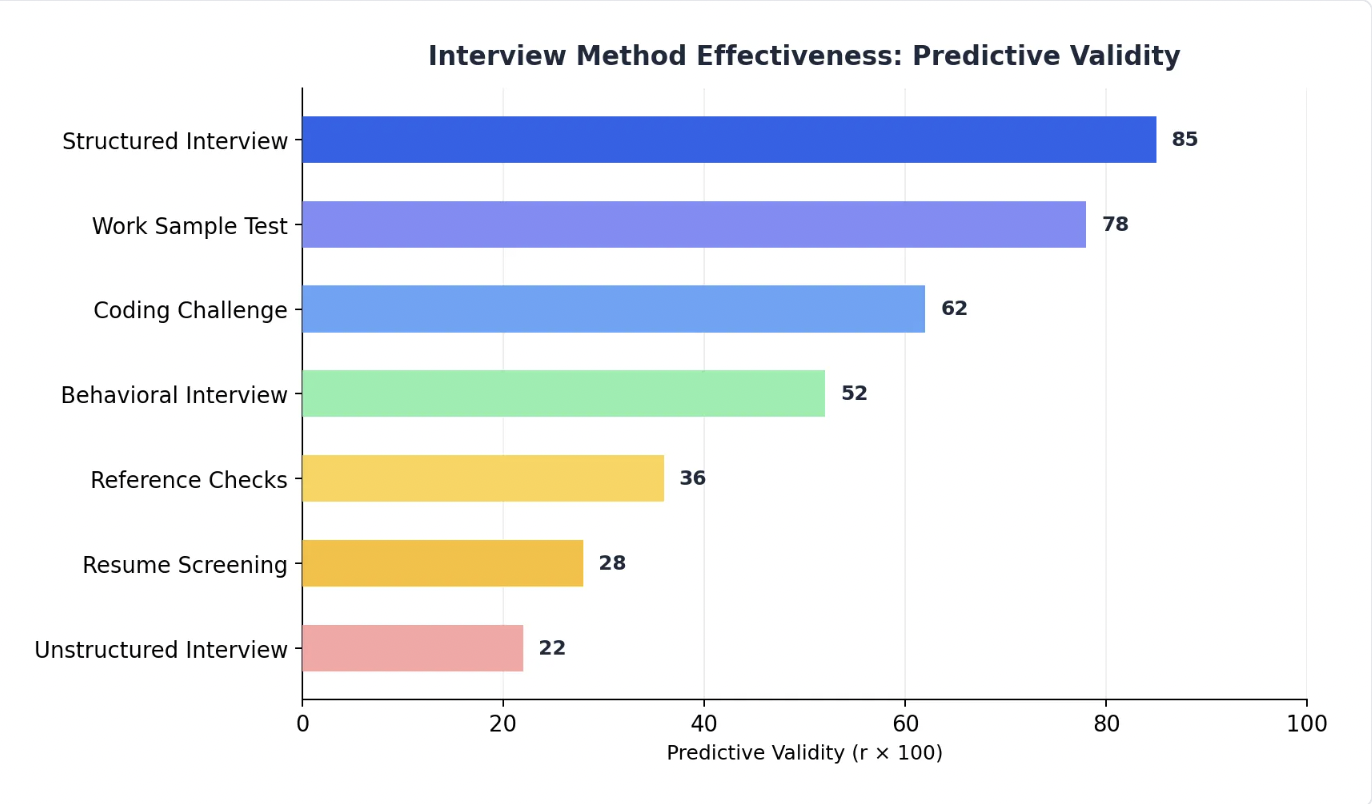
Interview method effectiveness: correlation with 12-month job performance rating (r-value scaled to 100). Structured interviews and work sample tests show the highest predictive validity.
Making Offers of Work
You need to ensure your job offer is competitive and includes key details such as salary, bonuses, and benefits. Good workers will consider job offers from different companies, so your offer needs to be strong.
Your offer needs to be clear, based on real numbers, and aligned with a budget that makes sense for the hiring process. Don’t just talk about the pay; talk about the value of the offer. I’ve seen companies lose employees because their offer wasn’t clear or took too long to make.
A good offer doesn’t just include money; it also includes things like flexible hours, the option to work from home, health benefits, and paid time off.
Making a Budget That Works
Research competitor compensation levels and build a budget that makes sense before you make an offer. Benchmarking software development cost per hour by region helps calibrate realistic compensation ranges. Everything should be in this budget, including pay, bonuses, benefits, and time off. A well-structured budget will ensure your offer is both competitive and sustainable.
Pay
The pay package should be competitive and include both compensation and benefits. A salary comparable to other companies’ pay, performance-based bonuses, health benefits, time off, flexible hours, and the option to work from home are all important to include.
If you can’t pay a salary, give other benefits instead. Make the package clear so the worker can make an easy choice. How you present the offer is important.
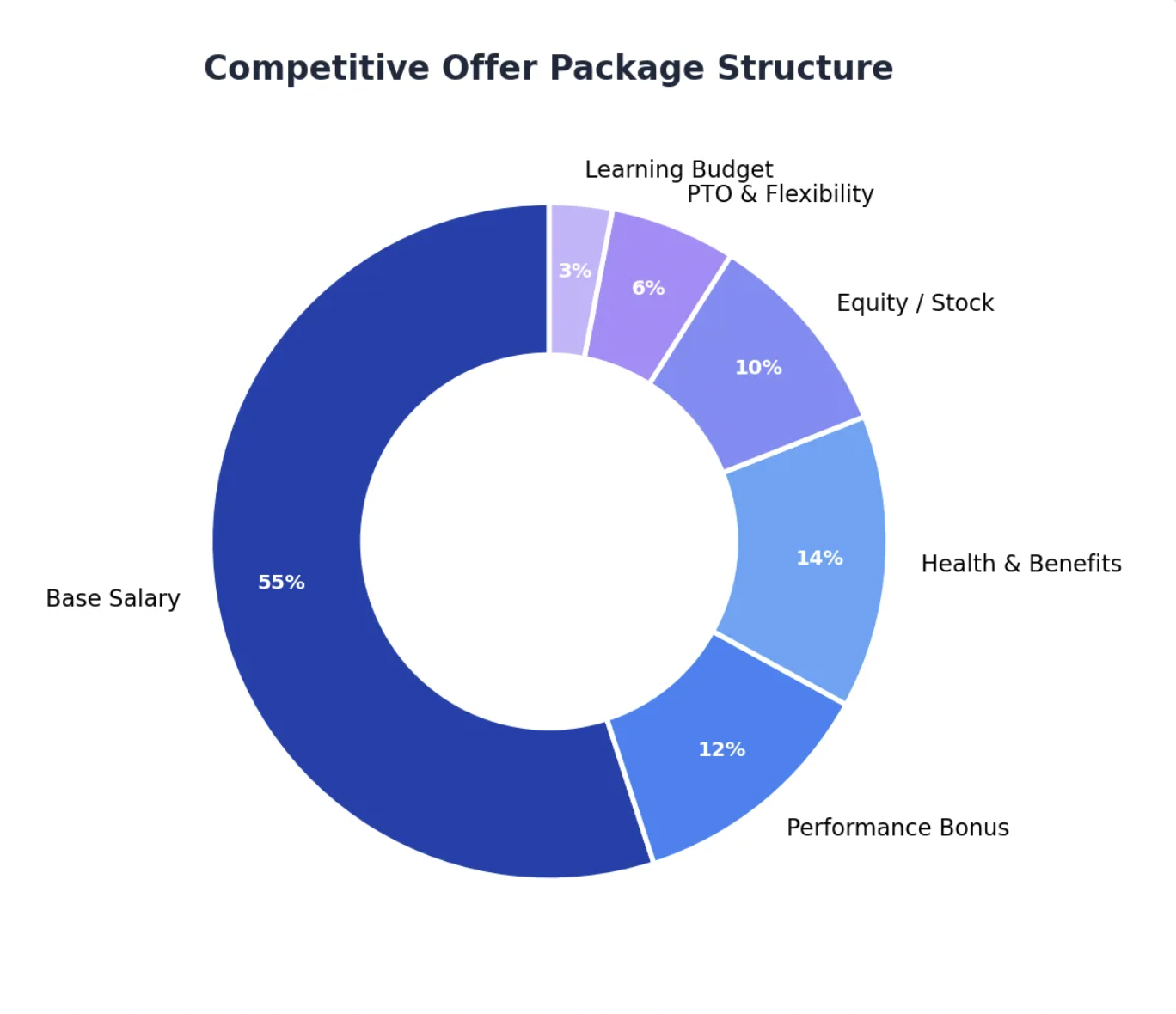
Competitive offer package structure: base salary is only part of total compensation
Talking About Pay Early
Talk about salary to avoid misunderstandings. Find out what the worker wants to be paid and their preferred payment structure. Review all components of the salary package. It’s easier to make a decision when everyone agrees on the pay. Less back and forth.
Negotiation
There should be negotiation. Based on competitor pay rates. The goal is to find a middle ground between what you can afford and what the worker wants. You can get the best workers by making a deal that includes bonuses, benefits, and other perks.
Onboarding and Getting Started
Onboarding is the process of getting a new employee up to speed on the team. It is very important to ensure the worker performs well and stays with the company. A good onboarding process keeps employees longer. Helps the worker get more done faster.
Before the workday starts, onboarding begins. It starts with ensuring everyone on the hiring team is aligned. Integration is easier when recruiters, managers, and leaders all have the same expectations. A good hiring process ensures that what is discussed in interviews aligns with expectations after hire.
Even the best software developers have trouble when the onboarding process isn’t working well.
Common onboarding mistakes include delaying new hires’ access to repositories and environments, providing insufficient documentation, obscuring roles, offering inadequate mentorship, and failing to integrate sprints effectively.
Without structured onboarding, it takes new hires too long to catch up. Productivity goes down, frustration rises, and the risk of quitting early increases.
An effective onboarding process should include a written overview of the architecture, clear code standards, an explanation of the sprint process, communication rules, and performance expectations for the first week. Strong onboarding speeds up time-to-productivity and helps retain employees.

Structured 30-60-90 day onboarding timeline aligned with Service Delivery Approach
Onboarding Framework
A good onboarding process helps new employees fit into the team and learn about the company’s culture, engineering standards, and performance goals. It’s more than just letting them use tools and systems. It needs goals, mentors, and checkpoints to track progress milestones.
Before the onboarding day, it should start. Allowing the worker to use tools, documents, and systems in advance demonstrates readiness and helps ensure a smoother process.
Having clear goals for the first 30, 60, and 90 days helps the manager and the employee stay aligned. Regular feedback clarifies expectations and demonstrates progress.
Technical Onboarding
Getting the worker up to speed on technical onboarding is critical. They need help getting to code, documentation, and tools. Mentorship helps them get to work faster and prevents confusion about the architecture.
Technical integration should teach the worker about quality standards, code conventions, and system design principles. They need to know why the building decisions were made, not how the system works.
Good documentation is very important for remote teams. It helps people work together, accelerates information sharing, and simplifies onboarding.
Place of Work
From the first day on the job, the worker should have access to all the tools. This includes things like development environments, infrastructure, communication platforms, and documentation.
It should be clear what the work environment is like, whether it’s remote, hybrid, or in the office. The company’s approach should align with your expectations for working together, communicating, and getting things done.
Clear standards, organized tools, and easy-to-find documentation reduce confusion and streamline integration.
Company Culture
Behavior shows the company’s culture during onboarding. The employee learns communication norms, accountability expectations, and collaboration practices. Cultural integration depends on leadership behavior and the clarity of decisions made.
Show the worker communication standards, team rituals, and use processes. Ensure expectations align with operational standards.
Mentoring is an important part of integration. A dedicated mentor provides advice, feedback, and performance clarification. Regular mentoring helps people learn faster and keeps them from getting too busy.
Feedback and Expectations
Structured feedback should be provided during onboarding. Managers should assess performance against milestones, and workers should provide feedback on the onboarding structure, documentation, and resources.
Common onboarding failures include unclear objectives, lack of documentation, inconsistent mentorship, delayed access to systems, and weak alignment with company culture. If you address these problems early, you can retain your new employees longer and help them do their best work over time.
When structured correctly, onboarding connects hiring alignment, technical immersion, resource readiness, mentorship, feedback systems, and cultural integration into one coherent framework. This way, you can reduce risk, accelerate their onboarding, and integrate them into your engineering team.

Onboarding Quality vs. 12-Month Retention Rate — retention tracked monthly by onboarding structure maturity level
Alternatives to In-House Hiring
When you hire software developers full-time, it isn’t always the best approach. You might want to hire dedicated developers, hire a freelance developer, add to your staff, outsource software development to an external team, or even hire developers from other countries, depending on the project, the timeline, and the budget. These will help you save money and give you more choices.
Each option gives you a different level of control over developer fit and ease of scaling up or down. You should think about the level of control you need, speed to market, and duration of engagement. I have worked with both big and small businesses, and I can tell you that the quality of your model execution matters more than which one you choose. A team that is well-managed will do better than a team that is not.
You can pick the best way to finish your project and make sure it fits with your business goals by knowing these options.

Comparison of engagement models: control, scalability, cost-effectiveness, and best use case
Remote developers
You can hire dedicated developers on a full-time or contract basis. Remote developers can join your team, unlike freelance developers who work alone.
Hiring developers can help you find the best people, no matter where they are in the world. It can also save you money because you don’t have to pay as much to hire someone in a big city. You can hire dedicated developers or remote developers to work for you. You can hire them with a contract. You can save money with them and scale your business easily. You must take care of them and ensure they have the correct paperwork.
Contract Workers
You can hire external developers to work with your team if you expand your staff. You are still in charge of the project. You still need to make key decisions and remain in charge of the project, even if you delegate.
You can hire dedicated developers and contract workers to work for you by using companies that specialize in finding IT workers. When you hire developers, they become part of your team, unlike hiring a team from outside the company. This works well when you have leaders and a clear plan. If you don’t, though, the developers you hire might not know what to do, and you’ll end up paying more for the confusion.
Outsourcing Partner
If you outsource software development, a group of external developers will do the work for you. The team usually includes developers, testers, and a project manager, who all work together to finish the project.
The right approach for launching a new product, build a mobile app, a custom web application, or add a big new feature. Instead of hiring more people, you hire a team to handle the whole project. They take care of everything. You don’t have to worry about the details because they take care of their own work. It’s important to choose a good team.
When you choose a team, evaluate communication quality, documentation practices, and knowledge sharing. I always tell my clients to give a team a small project to work on before they agree to a big one. This lets you observe their actual work style. If they fit well together. A structured approach to choosing a software development company reduces the risk of a costly mismatch.
Hiring Developers from Other Countries
It can be cheaper to hire developers from other countries because labor costs are lower in some places. But you should consider the time difference, ease of communication, and the project’s complexity.
If you need to work closely with developers and have daily meetings, you should hire them from nearby countries. You can hire developers from other parts of the world if you’re okay with a bigger time difference.

Average Total Cost per Hire by Engagement Model — recruitment + onboarding + 6-month management overhead (USD)
Picking the Best Option
Your requirements and the speed at which you need delivery will determine the best option.
You can hire a freelance developer if you only need someone to do a job. You can hire dedicated developers if you need a stable long-term team. You can hire contract workers if you need additional staff. You can outsource software development to an external team if needed. You can hire developers from nearby countries to save money and build a balanced team.
If you have a plan and pick the right option, you can stay flexible without sacrificing quality.
Common Problems When Hiring Software Developers
It’s not always easy to find and hire software developers. There are risks involved whether you hire dedicated developers, a freelance developer, or a team from outside the company. If you don’t carefully screen developers, onboard them correctly, ensure they fit your company’s culture, and hold them accountable, you could miss deadlines, deliver low-quality work, and experience high turnover.
You can strengthen your team and reduce risk when you hire software developers with these problems in mind. I’ve noticed that the same issues recur across large and small businesses. You can stop the mistakes from happening because you know they will.
Interviews that aren’t very Good
One of the most common mistakes is not having a reliable process for interviewing technical job candidates. Many hiring managers look at programming trivia related to real-world problems.
A good technical interview should test coding skills, provide structured coding tests, review real code from past projects, and assess architecture thinking, debugging skills, and scalability awareness.
Coding tests that only look at syntax don’t reveal actual on-the-job performance. The best coding challenges are like real-life problems. Assess the way a developer handles unclear situations, makes decisions, and improves performance.
When evaluating candidates, focus on their problem-solving approach. Are they asking questions to clarify things? Do they explain their choices clearly? Can they make code better?
You might discover performance problems too late if you don’t have a screening process and rely only on resumes or guarantees from external teams. Hiring becomes subjective and inconsistent without a way to evaluate candidates.
Standardized technical interviews, paired programming sessions, and code reviews of repository samples can help reduce hiring risk.
Not paying attention to problem-solving skills
Another big mistake is focusing on current technical skills rather than broader problem-solving ability.
Things change quickly in technology. Tools, libraries, and frameworks change. Developers who succeed in the long run are those who think analytically, reason at the system level, are flexible, troubleshoot in a structured way, are curious, and learn on their own.
You should provide candidates with real-life examples rather than abstract puzzles during the hiring process. It gives you a better idea of a candidate’s skills if you ask them to design an API, optimize a database query, or fix a broken deployment.
Being good at solving problems is often a better indicator of long-term performance than knowing a specific framework. I hired developers who had never worked with our technology, but they were better than other candidates because they could think through systems.
If you don’t assess a developer’s adaptability, you might hire someone who has trouble when product requirements change or when technical debt builds up.
Not paying attention to soft skills
To work well with others, you need more than just technical skills. Companies often overlook soft skills and cultural fit, leading to many failed deliveries.
Important things to look for in an evaluation include communication clarity, handling of criticism, responsiveness in distributed teams, collaboration style, accountability, and coachability.
Developers working on remote teams or in offshore development environments need to communicate effectively. When teams work across time zones, documentation discipline, asynchronous updates, and openness become very important.
Hiring people who fit your culture doesn’t mean hiring people who are like you. It means getting everyone on the same page about quality standards, feedback loops, sprint velocity, ownership, and a growth mindset.
When you don’t pay attention to cultural alignment, it makes things harder, slows collaboration, and hurts morale. Even strong engineers may struggle if they dislike feedback or avoid cross-team communication.
Behavioral interview questions, structured soft skills assessment, and reference checks help prevent these issues.

Hiring pitfalls mapped by likelihood and business impact: poor onboarding and weak interviews are highest risk
Time Zone Issues
Companies that work with offshore coders, nearshore software development companies, or teams that outsource software development — instead of choosing to hire dedicated developers — often don’t realize the complexity that arises.
Time zone differences can slow down work. A simple question about a bug can take 24 hours instead of one sprint hour. When there are no overlapping work hours and clear communication windows, the project slows down.
Other common challenges include unclear task ownership, inconsistent documentation standards, fragmented sprint integration, lack of performance metrics, and dependency bottlenecks.
Outsourced development models require structured governance. Clear SLAs, defined sprint rituals, shared dashboards, and technical leadership oversight are essential.
Organizations that outsource software development and treat those teams as external vendors rather than integrated engineering units often experience accountability gaps and quality inconsistencies. I have consulted on projects where the offshore team delivered code for six months without a single architecture review from the client side. The technical debt they accumulated costs more to fix than the entire engagement.
Bad Onboarding
Even very skilled software developers struggle when the onboarding process isn’t effective.
Common onboarding mistakes include delayed access to repositories and environments, incomplete documentation, unclear role definitions, insufficient mentorship, and limited sprint integration.
Without structured onboarding, new hires require excessive ramp-up time. Productivity declines, frustration rises, and the risk of early turnover increases.
Effective onboarding should include a documented architecture overview, defined code standards, an explanation of the sprint process, communication guidelines, and first-week performance expectations. Strong onboarding reduces time-to-productivity and strengthens long-term retention.
Hiring Model Doesn’t Match the Project
Picking the wrong hiring model for the stage of the project is another common problem.
Some examples of misalignment are hiring senior enterprise architects to work on the early stages of an MVP, choosing to hire dedicated developers for short-term projects that need ongoing commitment, using freelance developers to build complicated systems over several years, relying on staff augmentation without having internal technical leadership, and choosing to outsource software development of core intellectual property without governance rules.
There are trade-offs in control, scalability, and cost for each type of engagement model, such as freelance, staff augmentation, hire dedicated developers as dedicated teams, or pursue full outsource software development. When I’m consulting, I have a rule: if you can’t tell who is in charge of architecture and who is in charge of delivery, you chose the wrong model.
Companies that align hiring strategy with product complexity, timeline, and internal capabilities significantly reduce technical debt and operational friction.

Hiring pitfall frequency vs. cost impact: how often each pitfall occurs and its relative cost to the organization
FAQ
What do you do first when you want to hire a software developer?+
The first step is to determine what the project will cover, not to write a job description. Before you can define the role, you need to understand the business problem, the technical architecture, the non-functional requirements, and the delivery constraints. If you don’t do this, you might hire a developer whose skills aren’t up to the task of working on the system.
What should you include in a job description to get developers interested?+
You should begin by outlining what the developer will do and the way their role affects the business. List the skills and the preferred experience separately, along with the salary range and a true description of the engineering culture. The best job descriptions are like engineering briefs, not HR templates.
What are the best ways to find software developers to hire?+
There isn’t just one channel that works. The best way to find a job is to use a mix of job boards, LinkedIn Recruiter, referrals, developer communities, coding competitions, and tech meetups, all tracked in a single system. You shouldn’t think of sourcing only as something you do when you need to fill a role.
How do you do a good job of screening software developers?+
You should use a screening process that includes looking over resumes, portfolios, coding tests, and technical interviews. You should judge someone based on the ability to solve real-world problems, not the volume of book knowledge. Coding challenges should reflect the constraints of real-world production. Every interviewer should have a scoring system based on specific performance standards.
What is the difference between outsourcing and staff augmentation?+
Adding staff means hiring developers to work alongside your current team while you still retain control over the project and architecture. When you outsource software development, you give a partner the responsibility for delivery, and they are in charge of their own team, coordination, and milestones. Adding staff requires strong internal leadership, while outsourcing requires strong governance.
Why do new developers fail during their first few weeks?+
Some of the most common reasons for onboarding failures include not gaining access to systems on time, missing required documents, unclear goals, a lack of a mentor, and misalignment with the company’s culture. These gaps make it harder to get up to speed and increase the likelihood that people will leave. Most of these problems can be avoided by implementing an onboarding process with 30-, 60-, and 90-day goals, assigned mentors, and documented workflows.
How long does it typically take to hire a software developer?+
The average hiring process for a software developer takes 4–8 weeks from job posting to accepted offer, depending on role seniority and market conditions. Senior and specialized roles often take longer — 8–12 weeks — due to a smaller talent pool and more rigorous evaluation. Companies that maintain an active talent pipeline, use structured interviews, and move decisively on strong candidates consistently reduce time-to-hire by 30–50% compared to those that start sourcing only when a position opens.
Conclusion
Hiring software developers is about more than judging their technical skills. A project can fail if there are too many problems, such as poor technical interviews, poor coding tests, missed soft skills, time zone issues, poor onboarding practices, and hiring models that don’t fit.
Companies that screen applicants, test their ability to solve real-world problems, and assess their cultural fit early on can build stronger engineering teams.
Companies can greatly improve developer performance by improving technical interviews, refining coding challenge design, strengthening onboarding processes, and ensuring hiring strategies align with business goals. Lower turnover and ensure deliveries remain stable over time.