This analysis examines software development cost per hour by country across 40+ markets, offering technology leaders and procurement executives a data-driven framework for making informed outsourcing decisions in 2026. The report covers current market trends and future rate projections, regional and country-specific hourly benchmarks, the key factors that shape rate formation, and pricing structures by role and seniority level. It also looks at how costs change for offshore, nearshore, and onshore delivery models; points out the hidden costs that increase the total cost of ownership; and discusses the balance between quality and cost using a clear evaluation method. The final sections provide vendor selection methodology and practical budgeting strategies. All findings are grounded in cross-industry benchmarking data and proprietary salary research.

The global outsourcing ecosystem: offshore, nearshore, onshore, and blended delivery models with cost savings and market metrics
Trends for Software Development Rates
The global IT outsourcing market is projected to reach $812 billion by 2029, expanding at a CAGR of 8.28% from 2025 to 2029. As the economic situation in mature markets tightens and the global demand for custom solutions accelerates, outsourcing offers the most viable path to scaling engineering capacity. Digital transformation driven by AI automation, cloud computing, cybersecurity, data science, fintech, and low-code adoption has made software development outsourcing a strategic necessity. Salary changes in the software development market, combined with shifting supply and demand across regions, are fueling the growth of offshore development centers worldwide.
Market Size and Growth Projections
Between 2025 and 2029, the IT outsourcing market is expected to grow at a CAGR of 8.28% from 2025 to 2029, driven by increasing demand for custom software solutions, the rise of platform engineering, fintech innovation, and the normalization of distributed delivery models. For a breakdown of what drives these costs, see our analysis of custom software development pricing. The economic situation in traditional outsourcing hubs is evolving: salary changes in the software development market are running above inflation in many top-performing countries, reshaping the economic landscape of the industry. The global software development outsourcing landscape is entering a period of profound transformation, and the rules governing success in this market are changing rapidly. AI automation is reshaping productivity expectations, salary changes in the software development market are eroding traditional cost advantages, and geopolitical risks are forcing organizations to rethink single-geography dependency.

Exhibit A: Global IT Outsourcing Market Growth Projection 2025–2029, from $591B to $812B
Specialized Demand and Emerging Destinations
The fastest growth is in specialized domains. AI/ML engineering, DevSecOps, data science, and cybersecurity teams see demand growth of 15–20% annually, outpacing general application development. Supply and demand in the region for AI automation tools, cloud computing, fintech, and cybersecurity skills continues to create acute imbalances across the IT outsourcing market. Low-code adoption trends are further reshaping which skills command premiums.

Exhibit B: Annual Demand Growth by Specialization 2025–2026 — AI/ML Engineering leads at 22%
India is the world’s largest outsourcing destination by volume, and South Asia includes India, Bangladesh, and Sri Lanka, which are new players that offer average offshore developer rates that are 20–30% lower than the Indian average. However, these countries have a smaller pool of local talent and more infrastructure problems. Geopolitical risks and regional economic shifts shape destination planning, and salary changes in the software development market drive continuous rebalancing of supply and demand in the region.

The Global IT Outsourcing Market overview: $812B projected by 2029, CAGR 8.28%, driven by AI, Cloud, Cybersecurity, Fintech, Data Science, and Low-Code
AI Automation and AI Automation Tools
AI automation tools will compress demand for junior and mid-level generalist developers across the IT outsourcing market while increasing demand for senior engineers who can effectively leverage these tools. As the supply and demand in the region for AI-capable talent tightens, salary changes in the software development market for senior AI specialists will accelerate. Organizations should monitor the impact of AI automation tools on their outsourcing portfolio and adjust their economic situation assumptions accordingly.
Low-Code Adoption and Cloud Computing
Low-code adoption will shift some application development from custom engineering to configuration and orchestration, altering the skill mix and rate profiles across the IT outsourcing market. Simultaneously, cloud computing continues to reshape the technology stack landscape, creating sustained demand for DevOps engineers, cloud architects, and infrastructure specialists. Cloud computing skills carry a growing premium globally. The economic situation for cloud computing specialists reflects acute supply and demand imbalances in the region, and salary changes in the software development market for cloud roles are outpacing general development.
Cybersecurity, Data Science, and Regulatory Evolution
Cybersecurity and data sovereignty requirements are tightening globally across the IT outsourcing market, increasing compliance costs and favoring providers with strong regulatory certifications and data residency capabilities. Data science remains one of the fastest-growing specializations in the IT outsourcing market, fueled by the explosion of data-driven decision-making across industries and by fintech platforms that require advanced analytics capabilities. Contracts and governance frameworks must be reviewed and updated as regulations evolve. Salary changes in the software development market for data science and cybersecurity roles continue to outpace general development.
Salary Changes in the Software Development Market
Salary changes in the software development market are accelerating in traditional outsourcing hubs across the IT outsourcing market. The economic situation and supply and demand in the region vary significantly as infrastructure challenges are resolved, geopolitical risks shift, and new top performing countries emerge. The global demand for custom solutions in cloud computing, AI automation, data science, and fintech is driving salary changes in the software development market even in emerging destinations.
Fintech, Geopolitical Risks, and the Global Demand for Custom Solutions
The fintech sector remains one of the fastest-growing consumers of outsourced development in the IT outsourcing market, driving global demand for custom solutions in blockchain, cybersecurity, data science, and compliance-focused engineering. The global demand for custom solutions shows no sign of slowing, sustained by AI automation, cloud computing, low-code adoption, fintech innovation, and the proliferation of customer-facing digital platforms. Organizations looking to replace legacy tools with tailored solutions can explore our guide on how to migrate from Excel to custom software. The IT outsourcing market will continue expanding, with the CAGR of 8.28% from 2025 to 2029 reflecting robust structural demand driven by salary changes in the software development market and tightening supply and demand in the region across all major specializations.
The Dual Forces Shaping Offshore Software Development Rates
The future of offshore software development rates will be shaped by the tension between cost-saving forces and cost-increasing pressures across the IT outsourcing market. The economic situation in each geography determines which force dominates. In well-developed IT outsourcing markets like India and Poland, salary changes in the software development market reflect the net effect of both pressures simultaneously. The global demand for custom solutions in AI automation, fintech, and enterprise software remains the primary structural driver of rate growth across the IT outsourcing market.
The Global Talent Pool and the Scale of the IT Outsourcing Market
The global IT outsourcing market gives organizations access to a worldwide talent pool spanning cloud computing, cybersecurity, data science, AI automation, fintech, and every major technology stack. This market reached $591.24 billion in 2025 and continues to expand at a CAGR of 8.28% from 2025 to 2029. Cybersecurity spending keeps rising as cyberattacks intensify and regulations tighten, and cybersecurity specialists face persistent supply and demand in the region shortages. Rates are growing especially for fintech, custom web application, mobile, and cloud computing skills. Monitoring salary changes in the software development market gives organizations a structural advantage in vendor negotiations across the IT outsourcing market. Progressive regulations and maturing IT outsourcing markets in Eastern Europe, South Asia, and Latin America are expanding the talent pool while raising the compliance floor.
Strategic Outlook and Rate Benchmarking Cadence
Refresh your cost estimation framework, cost calculation scorecard, and rate benchmarks at least semi-annually using custom salary and market research to detect salary changes in the software development market and shifts in supply and demand in the region. Track the economic situation in each target geography, monitor geopolitical risks, and recalibrate for the impact of AI automation, cloud computing, low-code adoption, fintech, data science, and cybersecurity on the IT outsourcing market.
As low-code adoption and AI automation reshape the market, the global demand for custom solutions will increasingly favor senior talent, and salary changes in the software development market demand continuous portfolio rebalancing.
Country-Specific Hourly Rates
Our analysis draws on cross-industry benchmarking data and industry benchmarks, supplemented by custom salary and market research across 40+ countries. We present actionable guidance on regional average hourly rates, country-specific hourly rates, role-based hourly rates, and seniority-based hourly rates. We examine the economic landscape of top performing countries, assess the cost-to-quality ratio across destinations, and quantify the cost of living impact on average offshore developer rates.
Country-Specific Hourly Rates and Role-Based Hourly Rates
Country-specific hourly rates differ dramatically: a senior developer in a top performing country like Poland may cost triple the average offshore developer rates for the same role in South Asia. Eastern Europe spans from cost-competitive destinations such as Ukraine and Romania to premium markets like Poland and the Czech Republic, where EU membership commands a nearshore outsourcing premium of 15–25%.

Exhibit C: Senior Developer Hourly Rates by Region (USD) — from North America $140–$200/hr to Africa $45–$75/hr
The cost-to-quality ratio in South Asia remains compelling for well-managed engagements. Regional average hourly rates and country-specific hourly rates correlate directly with local talent pool depth, and destinations with shallow pools see faster rate inflation.

Software development hourly rates by region and seniority level (USD) — Junior, Mid-Level, Senior, and Architect roles compared across 7 global regions
Time Zone Alignment and Its Impact on Regional Average Hourly Rates
Time zone alignment is an increasingly decisive factor in destination selection and directly affects regional average hourly rates. Destinations with strong time zone alignment command a premium in their country-specific hourly rates, often 10–15% above regional peers, because the reduction in communication friction and project delays justifies the incremental cost.

Software development rates by region: senior developer hourly rates across 7 global regions in USD
Economic Landscape and Cost of Living Impact
In top performing countries like Poland, Romania, and Vietnam, the favorable cost of living impact enables developers to accept country-specific hourly rates well below Western norms while maintaining a high standard of living. However, rapid economic growth is driving salary inflation that is gradually narrowing the gap between regional average hourly rates and onshore equivalents. Regional average hourly rates in top performing countries are converging upward, narrowing the gap with onshore markets.
Top performing countries combine competitive rates with deep local talent pools, strong IT infrastructure, and favorable time zone alignment, but these advantages are not static and must be reassessed annually. Cybersecurity costs now represent a material line item in any outsourcing budget, and the economic situation for cybersecurity specialists reflects persistent supply and demand in the region shortages.
Rate Benchmarking and Comparison Methodology
The cost-to-quality ratio for your specific technology stack and project type should be the primary comparison metric, not raw country-specific hourly rates or regional average hourly rates in isolation. Resist the temptation to staff entirely with junior developers to minimize rates. Move beyond hourly rate comparison: regional average hourly rates and country-specific hourly rates tell only a fraction of the story, as hidden and additional costs routinely add 15–35% to the contracted rate.
Top performing countries should be benchmarked against emerging alternatives using regional average hourly rates, country-specific hourly rates, seniority-based hourly rates, role-based hourly rates, and average offshore developer rates. Custom salary and market research should be refreshed semi-annually to ensure vendor evaluations reflect current country-specific hourly rates and the evolving cost-to-quality ratio across top performing countries.
The True Cost of Attrition on Rate Economics
Replacement costs average 1.5–2x the monthly rate per departing team member when accounting for recruitment & onboarding of the replacement, knowledge re-transfer, and temporary productivity loss. This attrition premium effectively inflates the realized regional average hourly rates and country-specific hourly rates well above the contracted rate, particularly in offshore settings where attrition rates are highest.
Role-Based Rate Differences
Rates vary substantially based on role, seniority, and developer specialization. Understanding role-based hourly rates and seniority-based hourly rates is critical for building accurate cost models and optimizing team size and skill mix. These rates reveal substantial cost-to-quality ratio differences across the globe and can differ by vendor by 20–30% within the same top performing country. The local talent pool varies enormously: some top performing countries offer depth across all seniority levels, while others have strong junior pipelines but limited senior and architect availability. English proficiency levels vary significantly even within regions; verify through interviews and pilot engagements.
Junior, Mid-Level, and Senior Developers
Mid-level developers (3–5 years) offer a balance of competence and cost. Senior developers (6+ years) bring architectural judgment, mentorship capability, and the ability to work with minimal supervision. Their premium, typically 2–3x junior rates, reflects significantly higher productivity and lower defect rates. Early architecture and design phases benefit from heavier investment in solution architects and senior developers, while implementation phases can absorb a higher ratio of mid-level developers. Early-stage projects or MVPs may deliberately lean junior-heavy to conserve budget, accepting higher rework risk.
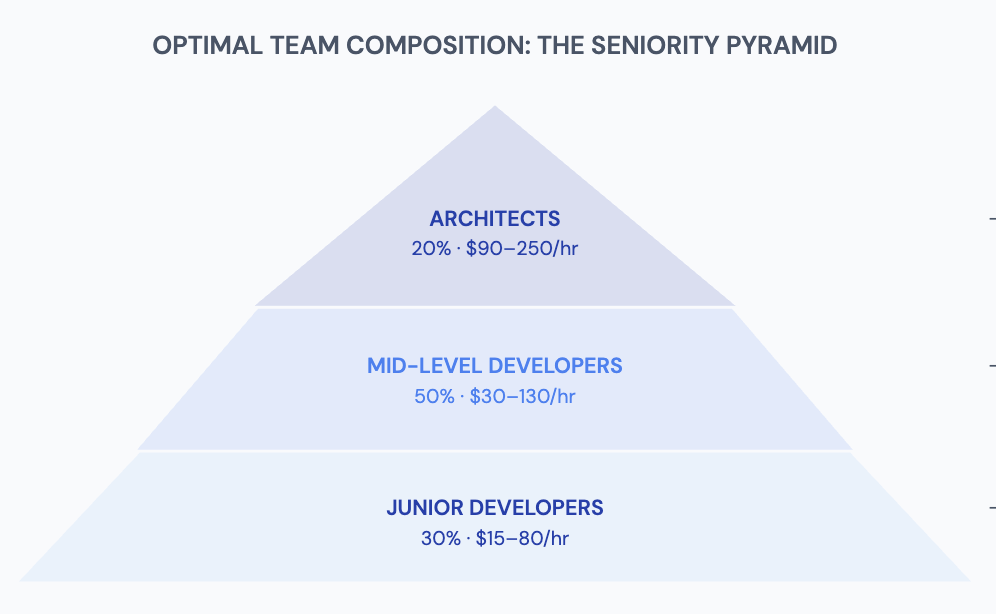
Optimal team composition: the seniority pyramid — Architects 20%, Mid-Level Developers 50%, Junior Developers 30%
Specialized Roles and Premium Rates
Specialized roles carry additional premiums reflecting acute market scarcity:
AI/ML engineers: 25–40% premium; demand driven by the explosion of AI automation across industries
Cybersecurity specialists: 20–35% premium; regulatory tightening and threat landscape expansion fuel persistent demand
DevOps engineers: 15–25% premium; essential for cloud computing infrastructure and CI/CD pipeline management
Blockchain specialists: 20–40% premium; concentrated demand in fintech and supply chain sectors
QA automation engineers: 10–20% premium; growing as organizations invest in testing environments and shift-left quality strategies
Full-stack developers: modest premium for versatility; especially valued in smaller dedicated teams
Data science professionals: 20–35% premium; critical for analytics-driven organizations
Business analysts: rates vary widely by domain expertise; essential for requirements translation
Project managers: rates reflect delivery methodology expertise; critical for coordination across distributed teams

Exhibit D: Specialization Rate Premiums Over Base Developer Rates — AI/ML 25–40%, Blockchain 20–40%, Cybersecurity 20–35%
A team size and skill mix of approximately 20% senior/architect, 50% mid-level, and 30% junior typically delivers the optimal price-to-quality ratio and cost-to-quality ratio across all top performing countries. The most reliable estimates decompose the project into discrete workstreams, assign role-based effort estimates to each, and apply location-specific rate cards.

Optimal team composition pyramid for maximum cost-to-quality ratio: Architects and Seniors 20%, Mid-Level 50%, Junior 30%
AI Automation and the Future of Seniority-Based Hourly Rates
As AI automation tools mature, the effective rate per delivered feature will decline for AI-augmentable workstreams, but the premium for senior developers and solution architects who supervise AI-generated output will increase. This dynamic is reshaping the relationship between seniority-based hourly rates and delivered value, and must be factored into any forward-looking cost estimation framework.
Factors Influencing Rates
This section explores the key elements that affect hourly rates for software development, including location, developer experience, technical expertise, project complexity, company type, and market demand for IT professionals. Regional average hourly rates, country-specific hourly rates, role-based hourly rates, and seniority-based hourly rates are all shaped by cost of living impact, local talent pool depth, IT infrastructure maturity, and supply and demand in the region. A realistic budget should factor not just hourly rates but also vendor reliability, communication overhead, and long-term maintainability.

Key factors influencing development rates: Geography, Seniority, Tech Stack, Compliance, Company Type, and AI/Low-Code adoption
Geographic Location and Economic Landscape
The single biggest factor influencing cost is geographic location. A developer’s rate is tied directly to the local cost of living and the regional tech market. Wages are tied to local economic conditions, cost of living, and market demand for IT professionals. The economic landscape of each region, including the cost of living impact, taxation system, and legal systems, directly shapes the rate floor and ceiling for each geography. Evaluate the cost of living impact on rate sustainability: rates that are too low relative to local living costs signal high attrition risk.
Developer Specialization and Seniority
Developer specialization is one of the key factors influencing rates. Seniority-based hourly rates reflect the productivity differential between junior, mid-level, and senior developers. Senior developers and solution architects command 2–3x junior rates because they deliver higher code quality, lower defect rates, and the architectural judgment that prevents costly rework. AI/ML engineers, cybersecurity specialists, blockchain developers, and data science professionals carry additional premiums of 20–40% above generalist rates at the same seniority level.
Project Complexity and Technology Stack
Project complexity directly affects hourly rates and total project cost. It depends on the architecture type (monolithic or microservices), the feature set, the amount of industry-specific problems, and the broadness of the technology stack. Integration with payment systems, third-party APIs, and analytics increases complexity and thus hourly rates. Enterprise integrations, compliance-heavy systems, and multi-platform deployments carry disproportionately higher coordination and quality assurance overhead.
Company Type: Freelancers, Boutique Agencies, Enterprise Vendors
Company type significantly affects rate structures and the cost-to-quality ratio. Freelancers offer the lowest headline rates but carry higher project risk due to limited scalability, no backup resources, and variable code quality standards. Boutique agencies provide deeper specialization and tighter team cohesion at mid-range country-specific hourly rates, making them well-suited for projects requiring niche tech stack and specialization expertise. Enterprise vendors and large systems integrators charge the highest rates but offer established processes, risk mitigation frameworks, and the ability to scale teams rapidly. To understand the full scope of services these providers offer, read our overview of what a software development company does.
Compliance Complexity as a Cost Multiplier
Strict regulatory frameworks and data sensitivity increase the need for experienced engineers and compliance consultants, raising effective hourly costs. Compliance complexity compounds the impact of every other cost factor: it increases the required seniority mix, extends testing environments and QA cycles, and mandates additional contract analysis and compliance audits. For compliance-heavy systems such as financial platforms, healthcare applications, and government solutions, the compliance overhead can add 20–40% to the base development cost.
Hidden Influences: Time-Zone Overlap, Communication, and Culture
No single cost factor operates in isolation. Geographic location interacts with the economic landscape, infrastructure challenges compound with time zone alignment to create communication overhead, and developer specialization premiums are modulated by local talent pool depth. Cultural compatibility goes beyond language. Business culture norms around hierarchy, feedback, initiative, and conflict resolution directly affect collaboration quality and are especially critical in compliance-heavy and customer-facing projects.
AI Automation as a Rate Formation Factor
AI coding assistants, including large language model-based code generation, automated testing, and AI-assisted code review, are already improving developer productivity by 20–40% for routine coding tasks, which directly affects team size and skill mix requirements and blended hourly rates. Organizations using AI automation tools for code generation, automated testing, and deployment should model the net budget impact: lower developer hours offset by higher per-hour rates for the senior talent required to supervise AI-generated output.
Cost Comparison
The choice between offshore, nearshore outsourcing, and onshore outsourcing delivery models involves cost–quality trade-offs across cost, communication efficiency, time-zone overlap, cultural compatibility, and regulatory compliance. Understanding the models of cooperation is essential for managing cost–quality trade-offs and selecting the right engagement model.

Exhibit E: Total Cost of Engagement by Delivery Model — Base Rate, Hidden Costs, Management Overhead, and Compliance for Offshore, Nearshore, and Onshore
Offshore Development Centers
Offshore development (typically South Asia, Southeast Asia, or Africa) delivers the greatest cost savings, often 40–70% below onshore outsourcing rates. Offshore software development rates are the lowest across all models of cooperation. Onboarding and training cycles are longer in offshore settings than in nearshore or onshore outsourcing arrangements, due to greater language and cultural barriers and time-zone gaps. Hidden & additional costs should be modeled separately for each offshore development center engagement.
Nearshore Outsourcing
Nearshore outsourcing models offer a compelling middle ground. Nearshore outsourcing is particularly effective for agile dedicated teams that require real-time collaboration. Nearshore outsourcing contracts should specify collaboration SLAs and time zone alignment commitments. The cost–quality trade-offs are easier to manage in nearshore outsourcing than in pure offshore arrangements, and project complexity can be handled more effectively because the models of cooperation allow for tighter feedback loops.
Onshore Outsourcing
The role-based flexibility is highest in onshore outsourcing engagements due to the depth and breadth of the local talent pool, and the cost–quality trade-offs favor onshore outsourcing when project complexity is high and the cost of failure is severe.
The Blended Delivery Model
The recommended approach for most enterprise engagements is a blended delivery model: onshore outsourcing architects and product owners (10–15% of team), nearshore outsourcing senior developers and tech leads (25–35%), and offshore mid-level and junior developers for volume delivery in an offshore development center (50–65%).
The blended model addresses project complexity by allocating the right engagement models and models of cooperation to each workstream: high-complexity architecture work stays onshore, while standard development flows through the offshore development center. Industry benchmarks show that blended models achieve 20–30% lower total cost than pure onshore outsourcing while avoiding the quality risks of purely offshore software development rates.

Delivery Model Comparison: Offshore vs Nearshore vs Onshore — cost savings, hidden costs, communication overhead, and recommended team blend
Cost Drivers Across Delivery Models
When comparing offshore, nearshore outsourcing, and onshore outsourcing models, organizations must account for the full range of cost drivers that shape the effective rate. The table below presents 2025 benchmark ranges, including average offshore developer rates and onshore equivalents, for key roles by region, alongside the primary cost factors that create variance within and between models.
Engagement Models and Cooperation Models
The cooperation model, whether a fixed-price model, time & material (T&M), or dedicated teams, should be matched to project characteristics and the chosen delivery model (offshore, nearshore outsourcing, or onshore outsourcing):
Fixed-price model: Suits well-scoped, predictable workstreams but embeds a risk premium of 10–25%. Requires thorough contract analysis and scope definition upfront to prevent scope creep.
Time & material (T&M): Offers flexibility for evolving requirements. Ideal for nearshore outsourcing engagements where real-time collaboration and agile iteration are priorities.
Dedicated teams: Deepest integration and lowest long-term unit cost, but require significant upfront investment in recruitment & onboarding and cultural alignment. Best suited for long-term engagement across all models of cooperation.
Organizations should blend nearshore outsourcing and offshore development center models based on workstream characteristics, project complexity, and time zone alignment requirements. Select the appropriate engagement models and models of cooperation for each geography, and model hidden & additional costs separately for each onshore outsourcing, nearshore outsourcing, and offshore development center component. The engagement models and models of cooperation should be tailored to each project phase.
Contract Analysis for Model Selection
Contract analysis is especially critical when comparing offshore, nearshore outsourcing, and onshore outsourcing models, because each model carries distinct contractual risks. Before committing to any engagement model, organizations should perform detailed contract analysis to identify contract lock-ins, compliance audits requirements, cross-border taxation implications, insurance and liability coverage obligations, scope creep protections, and surprise fees clauses.
Hidden and Additional Costs
This section addresses the less obvious expenses associated with offshore software development, including management overhead, onboarding, legal compliance, communication challenges, and potential quality issues. Some providers advertise low hourly rates but don’t mention the recruitment fees, office space costs, administrative overhead, or project management charges that get tacked on later. Infrastructure, onboarding, communication overhead, compliance, and delays all add layers to the real cost of delivery. Analysis of 200+ outsourcing engagements reveals that hidden and additional costs routinely add 15–35% to the contracted rate. Industry benchmarks show that hidden & additional costs in offshore development centers run 25–35% above the base rate, while onshore outsourcing delivers the lowest hidden & additional costs as a percentage of total spend but at the highest absolute cost point across engagement models. Hidden costs like contract lock-ins, surprise fees, and high turnover can blow up your budget. The categories below represent the most significant sources of cost overrun.

The Hidden Cost Iceberg: contracted rate above the waterline, with onboarding, communication, attrition, compliance, infrastructure, and scope creep below — adding 15–35% above contracted rate
Onboarding and Training
Recruitment & onboarding costs are frequently underestimated. They typically concern recruiting, onboarding, managing, and retaining remote developers. For a detailed walkthrough of the hiring process, see our guide on how to hire software developers. Knowledge transfer, codebase familiarization, and integration into development workflows represent real cost, especially when employee turnover and retention costs force repeated onboarding and training cycles due to attrition. We take care of the admin overhead like HR, infrastructure, team setup, and retention, so you can focus on building your product.
Project Management and Communication Overhead
Communication overhead, time zone differences, project management tools, training, and integration with in-house systems all add to the final bill. Managerial effort and admin overhead scale with team distribution. Managing an offshore development team requires strong project managers to ensure the project stays on track. Communication overhead is particularly acute for offshore teams requiring asynchronous workflows, additional project management tools, and structured escalation protocols.
Attrition and the Real Cost of Turnover
One of the biggest hidden costs tech leaders face when building offshore teams is attrition. Attrition is one of the costliest challenges in offshore development, as it leads to disrupted workflows, delays, and unexpected expenses for rehiring and onboarding. Employee turnover and retention costs are compounded by the need for repeated recruitment & onboarding cycles. Replacement costs average 1.5–2x the monthly rate per departing team member when accounting for knowledge re-transfer, temporary productivity loss, and recruitment & onboarding of replacements.
Language and Cultural Barriers
Language and cultural barriers are a distinct cost category that compounds communication overhead and managerial effort. While offshore developers with higher rates rarely lack fluency in English, they may lack familiarity with your culture and misinterpret feedback, leading to errors and rework. Greater cultural distance demands more structured protocols, frequent check-ins, and detailed documentation. All of these add to admin overhead and project management and communication overhead costs.
Legal and Compliance Overhead
While legal and compliance overhead may only represent a small portion of the total, the consequences of neglecting them are severe. Legal and compliance overhead includes costs related to contracts and governance, cross-border taxation, compliance audits, and regulatory alignment. Contracts and governance: drafting international contracts, ensuring intellectual property rights, and setting up non-disclosure agreements require legal consultation. Cross-border taxation: depending on the jurisdiction, there may be additional tax obligations or withholding requirements. Compliance audits: especially for industries like finance, healthcare, or government. Insurance and liability coverage: professional indemnity and cybersecurity insurance add to the cost floor.
Infrastructure, Tools, and Licenses
Infrastructure, tools, and licenses represent recurring expenses that are often excluded from vendor rate cards. Development tools and licenses: tools like Jira, GitHub, code editors, and testing platforms must be provisioned for every team member. Cloud services, including platforms like AWS, Azure, and Google Cloud, are particularly variable, often exceeding initial estimates by 20–40% as environments scale, a factor that disproportionately affects offshore development centers where infrastructure may not be bundled into the rate. Cybersecurity costs are growing as threats intensify and regulatory requirements expand.
Project Delays, Scope Creep, and Surprise Fees
Project delays and scope creep are persistent threats to budget predictability across all engagement models. Scope creep: when requirements are added without adjusting budgets, developers spend extra hours not accounted for in the initial estimate. Project delays compound costs across all categories. Every week of delay increases admin overhead, cloud services consumption, development tools and licenses costs, and managerial effort. When building your offshore software development budget, allocate a contingency of 15–25% for project delays, scope creep, and surprise fees.
Hidden Costs by Delivery Model
Hidden & additional costs differ substantially by delivery model:

Exhibit F: Hidden Cost Composition as percentage of Base Rate by Delivery Model — Offshore 25–35%, Nearshore 15–25%, Onshore 8–15%
Offshore development centers carry the highest hidden costs as a proportion of base rate (25–35%), driven by communication overhead due to time-zone differences, language and cultural barriers affecting requirements interpretation, higher managerial effort, elevated admin overhead, longer onboarding and training cycles, higher attrition rates, and the need to provision cloud services, development tools and licenses, and cybersecurity costs explicitly.
Nearshore outsourcing destinations carry moderate hidden costs (15–25% above base), with lower communication overhead and managerial effort than offshore but higher than onshore outsourcing.
Onshore outsourcing is most appropriate for compliance-heavy systems involving classified data, complex stakeholder management, or regulatory frameworks that restrict data movement across borders.
Constructing the Total Cost of Ownership Model
The Total Cost of Ownership model should incorporate onboarding and training, attrition, employee turnover and retention costs, admin overhead, managerial effort, communication overhead, language and cultural barriers, legal and compliance overhead, contracts and governance, cross-border taxation, compliance audits, contract lock-ins, insurance and liability coverage, infrastructure, tools, and licenses, cloud services, cybersecurity costs, development tools and licenses, project delays, scope creep, and surprise fees.
Quality vs. Cost Considerations
This section explores the balance between cost and quality in software development outsourcing, providing guidance on how to ensure value without sacrificing project outcomes. Experienced companies evaluate vendors on productivity, code quality, and long-term maintainability, not just the headline hourly cost. The price-to-quality ratio varies dramatically across the IT outsourcing market: the lowest-cost providers frequently deliver the highest total cost over a full project lifecycle due to quality issues and rework, technical debt, and elevated project risk. Benchmarking data shows that the lowest-cost providers exhibit quality issues and rework rates 30–50% higher than mid-tier providers, higher attrition, greater project risk, and faster accumulation of technical debt that imposes severe long-term maintainability burdens. The cost-to-quality ratio varies significantly even within a single top performing country based on vendor maturity, local talent pool specialization, and the economic landscape.

Exhibit G: Cost-Quality Scoring Matrix for 7 regions — quality score versus cost index across North America, Western Europe, Eastern Europe, Latin America, South Asia, Southeast Asia, and Africa
Finding the Optimal Price-to-Quality Ratio
The optimal price-to-quality ratio is typically found in the second quartile of regional average hourly rates. These are vendors whose country-specific hourly rates reflect mature processes, strong retention, genuine technical depth, and vendor reliability without the overhead premiums of the largest global systems integrators. Compare several options and choose based on the price-to-quality ratio, experience, communication transparency, and a track record of delivering successful projects.
Quality Issues, Rework, and Technical Debt
Poor code quality and inadequate coding practices create technical debt that requires expensive refactoring later. This is one of the most persistent sources of cost overrun in outsourced engagements. Quality issues and rework resulting from insufficient senior oversight, poor code quality, or inadequate testing environments inflate total costs by 10–25% in poorly managed engagements. Quality issues and rework are most acute in engagements with high attrition, weak contracts and governance, and insufficient investment in testing environments.
The Structured Evaluation Framework
When selecting an offshore partner, organizations should use a structured evaluation framework to balance three key factors: the price-to-quality ratio, vendor reliability, and project risk profile. We advocate for a structured evaluation framework that weights quality indicators, including code quality metrics, automated test coverage, developer retention rates, reference architecture quality, and vendor reliability track record, alongside cost. The tech talent shortage means that vendor reliability and retention are as important as rate competitiveness in achieving a favorable cost-to-quality ratio.
Vendor Evaluation: Balancing Cost, Quality, and Reliability
Experienced companies evaluate vendors on productivity, code quality, and long-term maintainability, not just the headline hourly cost. The trade-offs are significant: wide variance in vendor quality means that effective project management is critical, and vendor reliability varies. Careful due diligence is required. Larger vendors may charge more, but they often provide project management, quality assurance, and structured processes that can reduce hidden costs and project risk.
Pilot Projects and Senior Oversight as Quality Safeguards
Use pilot projects: start with a small engagement of 2–4 weeks to evaluate quality, communication, and delivery speed before committing to a long-term contract. Pilot projects serve as a structured evaluation framework in practice. They reveal code quality standards, communication dynamics, project management maturity, vendor reliability under real-world conditions, and the true price-to-quality ratio before the organization is locked into a multi-year commitment. Invest in senior oversight: ensure at least 15–20% of the team consists of senior developers and solution architects who can maintain code quality standards across the engagement.
The Outsourcing Quality Opportunity
The organizations that thrive in this landscape will be those that invest in the analytical infrastructure to make quality-conscious decisions well: centralized sourcing intelligence, data-driven vendor evaluation, pilot projects as a validation mechanism, and contract analysis that anticipates the full range of hidden and additional costs before they materialize. Weight quality indicators alongside cost and mandate pilot projects before committing to long-term engagements. When evaluated holistically, the price-to-quality ratio often favors mid-tier providers in top performing countries over both the cheapest offshore options and the most expensive onshore alternatives.
Choosing the Right Outsourcing Vendor
Selecting the right vendor and outsourcing destination is a multidimensional decision that extends well beyond rate comparison. For a step-by-step evaluation process, see our guide on how to choose a software development company. Vendor quality and reputation, combined with destination characteristics, determine long-term partnership success.
Talent Pool and Specialization Alignment
Align your technology stack requirements with the local talent pool depth in each candidate destination. Destinations with deep talent pools in your core stack reduce recruitment timelines and lower attrition risk, while shallow markets may force reliance on generalists who lack the specialization your project demands. Evaluate vendor specialization depth through technical assessments and reference checks. Prioritize vendors who can demonstrate proven delivery in your specific domain and technology stack.
Vendor Quality and Reputation
Due diligence on vendor quality and reputation should include reference checks, case study validation, financial stability assessment, and ideally site visits. Look beyond marketing materials and ask for direct contact with previous clients who worked on projects similar in scope and complexity to yours. Evaluate the vendor’s cooperation model flexibility and willingness to adapt engagement structures. Vendors who insist on rigid terms often lack the operational maturity to handle evolving project requirements.

Exhibit H: Vendor Evaluation Scorecard — weighted scoring: Technical Capability 30%, Quality and Delivery 25%, Cost Competitiveness 20%, Communication 15%, Cultural Fit 10%
Risk Diversification
Risk diversification is increasingly important. Organizations that concentrate delivery in a single country are exposed to geopolitical risks, regulatory changes, and talent market overheating. A multi-hub strategy provides resilience. Custom salary and market research for each target destination should inform the diversification strategy. When selecting destinations, compare the economic landscape, local talent pool depth, infrastructure challenges, time zone alignment, cost of living impact, and cost-to-quality ratio.
Building a Multi-Geography Portfolio
The most effective outsourcing portfolios are multi-geography, blending a nearshore hub for high-collaboration work with an offshore development center for volume delivery and a domestic team for stakeholder management and architecture.
Organizations should distribute outsourcing across two to three complementary destinations to mitigate geopolitical risks, access diverse talent pools, and maintain negotiating leverage. When constructing a multi-geography portfolio, evaluate the economic landscape, local talent pool depth, infrastructure challenges, time zone alignment, cost of living impact, and cost-to-quality ratio of each candidate destination.
Assessing Language and Cultural Barriers in Vendor Selection
Organizations should assess language and cultural barriers during vendor selection and budget for the additional managerial effort required to bridge them. Factor the cost of bridging language and cultural barriers into the total cost model for each vendor and destination.
Centralized Sourcing Intelligence
For organizations managing multiple outsourcing relationships, centralizing vendor performance data and rate benchmarking within a dedicated sourcing function is strongly advisable. This function should track delivery metrics, attrition trends, and cost overruns across all vendor relationships to identify patterns that individual project teams would miss. A centralized sourcing intelligence capability turns scattered vendor data into a strategic asset that strengthens negotiation positioning and improves vendor selection accuracy.
Budgeting and Cost Estimation
This section discusses practical approaches for estimating, planning, and managing software development budgets, including the cost estimation framework and cost calculation scorecard for accurate cost calculation across engagement models. The cost estimation framework should be systematic, repeatable, and calibrated to organizational context, integrating team size and skill mix, tech stack and specialization, testing environments, and the full spectrum of hidden and additional costs into a unified budget model. To save costs, leverage AI automation tools for specific tasks and hire experts to supervise their execution and provide valuable insights.

Cost Estimation Framework: 5-step approach — Define Scope, Determine Delivery Model, Map Team Composition, Apply Rate Cards, Add Hidden Cost Buffer 15–25%
Starting with Scope Definition
Accurate cost estimation begins with rigorous scope definition. Without a clearly bounded scope, any budget is a guess. The scope definition process should produce a decomposed work breakdown structure that maps each deliverable to specific roles, effort estimates, and acceptance criteria. A key part of this is clear scope definition for the estimate. The cost estimation framework should be populated with preliminary estimates for team size and skill mix, tech stack and specialization requirements, and testing environments from the earliest stages of planning.
The Cost Estimation Framework
A cost estimation framework provides a structured way to forecast expenses across the full project lifecycle. The framework should be applied iteratively, populated with preliminary estimates during scoping, refined as requirements mature, and recalibrated at each major milestone. An effective cost estimation framework integrates five layers: direct labor costs (role-based hourly rates × estimated effort), tech stack and specialization premiums (adjustments for niche technologies and scarce skills), hidden and additional costs (modeled separately using the categories from the previous section), infrastructure and tooling (cloud services, development tools and licenses, cybersecurity costs), and contingency reserves (calibrated to project risk profile and engagement model).
The Cost Calculation Scorecard
A cost calculation scorecard is a checklist that ensures you account for all potential expenses, including development hours, project management, QA, and even hidden costs. We recommend maintaining a scorecard that tracks the following for each workstream:
Team size and skill mix: number and seniority of resources, mapped to role-based hourly rates by geography
Tech stack and specialization: technology-specific rate adjustments reflecting specialization premiums
Blended hourly rate: weighted average across roles, seniority levels, and geographies
Estimated effort: hours per workstream, validated by historical benchmarks or analogous project data
Testing environments: for complex applications, businesses must budget for staging servers, device farms, or third-party testing services; typically 25–35% of development effort
Project management and coordination: 10–20% of total effort, covering resources spent on communication and project management tools
Contingency reserve: 10–15% for agile projects, 15–25% for fixed-scope engagements under a fixed-price model
Infrastructure, tools, and licenses: CI/CD pipelines, monitoring platforms, cloud services provisioning, and cybersecurity costs aligned to the project’s risk profile
Contract and compliance costs: legal review, compliance audit requirements, insurance, and cross-border taxation provisions
The scorecard should be a living document, updated at each sprint boundary or milestone review, and shared transparently between client and vendor teams to maintain budget alignment throughout the engagement.
Selecting the Right Engagement Model
Understanding the different engagement models is key to managing your budget effectively. Select the right engagement model by matching project characteristics to the budget structure each model imposes:
A fixed-price model is suitable for projects with a well-defined scope and budget. A clear scope definition for the estimate is essential before locking in a fixed-price contract, and the cost calculation scorecard should capture the risk premium embedded in the vendor’s pricing. The risk premium typically ranges from 10–25% above equivalent T&M pricing. Thorough contract analysis ensures that the selected engagement models and models of cooperation align with the organization’s risk tolerance.
Time & material (T&M) is a model where you pay based on actual time spent and resources used on your project. The cost estimation framework must account for resources spent on communication and project management tools, which can represent 10–20% of total T&M spend. T&M aligns naturally with agile delivery and engagements where requirements evolve. The cost calculation scorecard should track blended hourly rates, velocity-to-spend ratios, and coordination overhead to maintain budget discipline.
For dedicated teams, the cost calculation scorecard should cover onboarding, tech stack and specialization needs, and testing environments, including staging servers, device farms, or third-party services for complex applications. Use the cost estimation framework to break the work into smaller tasks, assign each task to the appropriate engagement model, and validate that the cost calculation scorecard captures all potential expenses including development hours, project management, QA, and hidden costs.
Leveraging AI Automation in Budgeting
AI coding assistants, automated testing frameworks, and AI-driven project management tools enable engineers to produce more output in less time. The cost estimation framework should reflect this productivity gain by adjusting effort estimates downward for AI-augmentable workstreams while budgeting for the senior oversight required to validate AI-generated output. To save costs, leverage AI automation tools for specific tasks and hire experts to supervise their execution and provide valuable insights.
Budgeting for Compliance-Heavy Systems
For compliance-heavy systems such as financial platforms, healthcare applications, and government solutions, the cost estimation framework must account for the elevated cost of quality failure. Budget allocations for compliance-heavy systems should include enhanced testing environments (including security and compliance testing), additional senior oversight and solution architect involvement, dedicated compliance audits throughout the development lifecycle, and contingency reserves of 20–30% above the base estimate.
FAQ
What is the average software development cost per hour in 2026?+
Software development cost per hour varies dramatically by country and region. Offshore development centers in South Asia offer rates 40–70% below onshore prices, while Eastern European destinations like Poland and Romania provide a compelling cost-to-quality ratio. Country-specific hourly rates depend on local talent pool depth, cost of living impact, economic landscape, and supply and demand in the region.
What hidden costs should I expect when outsourcing software development?+
Hidden and additional costs routinely add 15–35% to the contracted hourly rate. These include onboarding and training, project management and communication overhead, attrition and turnover costs, language and cultural barriers, legal and compliance overhead, cross-border taxation, infrastructure and tools, cloud services, cybersecurity costs, and development tools and licenses. Offshore development centers carry the highest hidden costs (25–35% above base rate), while nearshore outsourcing adds 15–25%.
How do I choose between offshore, nearshore, and onshore outsourcing?+
The choice depends on cost–quality trade-offs across cost, communication efficiency, time-zone overlap, cultural compatibility, and regulatory compliance. Offshore development delivers 40–70% cost savings but carries higher hidden costs and communication overhead. Nearshore outsourcing offers a compelling middle ground with better time zone alignment. Onshore outsourcing is most appropriate for compliance-heavy systems. Many organizations use a blended delivery model combining all three.
What factors influence software development hourly rates?+
Key factors include geographic location and economic landscape, developer specialization and seniority, project complexity and technology stack, company type (freelancers, boutique agencies, or enterprise vendors), compliance requirements, time-zone alignment, and AI automation adoption. Senior developers command 2–3x junior rates, while specialized roles like AI/ML engineers carry 25–40% premiums above generalist rates.
How do I estimate the total cost of a software development project?+
Use a cost estimation framework that integrates five layers: direct labor costs (role-based hourly rates × estimated effort), tech stack and specialization premiums, hidden and additional costs, infrastructure and tooling, and contingency reserves. Maintain a cost calculation scorecard tracking team size and skill mix, blended hourly rate, estimated effort, testing environments (25–35% of development effort), project management (10–20% of total effort), and contingency reserve (10–25% depending on engagement model).
How does AI automation affect software development costs?+
AI coding assistants and automated testing tools improve developer productivity by 20–40% for routine tasks, reducing the total hours needed. However, they increase demand for senior engineers who can supervise AI-generated output. AI automation will compress demand for junior and mid-level generalist developers while increasing premiums for senior talent. Organizations should adjust effort estimates downward for AI-augmentable workstreams while budgeting for senior oversight.
What is the best way to select an outsourcing vendor?+
Use a structured evaluation framework that weights quality indicators—code quality metrics, automated test coverage, developer retention rates, and vendor reliability track record—alongside cost. Start with pilot projects of 2–4 weeks to evaluate quality, communication, and delivery speed. Conduct due diligence including reference checks, case study validation, and financial stability assessment. Diversify across two to three complementary destinations to mitigate geopolitical risks and maintain negotiating leverage.
Conclusion
Organizations that treat outsourcing as a purely cost-driven exercise will consistently underperform those that adopt a holistic, quality-conscious approach.
To achieve this, organizations need two things. First, a robust cost estimation framework anchored in a detailed cost calculation scorecard that captures team size and skill mix, tech stack and specialization, testing environments, engagement models, and the full spectrum of hidden and additional costs. Second, a multi-geography delivery strategy that balances nearshore outsourcing, offshore development centers, and onshore outsourcing through the appropriate models of cooperation.
The organizations that thrive in this landscape will be those that invest in the analytical infrastructure to make these decisions well, treating their outsourcing portfolio as a strategic asset to be actively managed rather than a one-time procurement decision.