Every growing company eventually reaches a crossroads: build a custom software solution tailored to your exact needs, or buy an existing product and adapt your processes around it? The answer is rarely obvious — and the stakes are high. The wrong choice can drain budgets, stall product launches, and lock organizations into years of costly workarounds. The right choice can accelerate growth, sharpen competitive positioning, and free up resources for the work that truly differentiates the business.
The goal is not to prescribe a universal answer, but to equip SD Company with the analytical tools and decision-making discipline needed to make the right call, case by case, with confidence.
Overview of Build vs. Buy Decision
The build vs. buy question is a foundational technology strategy decision that affects cost structures, competitive positioning, and organizational agility. This section establishes the context for the decision, explains why it warrants executive-level attention, and defines the scope of the analysis that follows.
Context and Relevance
In an era of accelerating digital transformation, enterprises across every industry face a recurring strategic question: should we develop proprietary software in-house, or procure an existing commercial solution? This decision, commonly referred to as the “build vs. buy” dilemma, sits at the intersection of technology strategy, financial planning, and organizational capability. Getting it right can unlock competitive advantage; getting it wrong can erode margins, slow execution, and generate years of technical debt that limits future optionality.
According to our advisory experience across Fortune 500 engagements, the build vs. buy decision is not merely an IT procurement question. It is a strategic investment decision that should be evaluated with the same rigor applied to capital expenditures, M&A activity, or market entry strategies. The implications extend beyond initial deployment costs into organizational agility, talent retention, security posture, and long-term scalability.
When Companies Typically Face This Decision
Organizations encounter the build vs. buy question at several critical junctures in their lifecycle. Understanding when this decision arises helps ensure it receives the appropriate level of executive attention and analytical discipline.
- Digital transformation programs: enterprises migrating legacy systems to modern architectures must decide which capabilities to develop internally and which to source from vendors.
- Scaling inflection points: as companies grow beyond the startup stage, manual processes and spreadsheet-based workflows become unsustainable and require purpose-built systems.
- Competitive response: market disruption may demand rapid capability development, forcing a time-sensitive build-vs.-buy evaluation.
- Regulatory and compliance changes: new mandates (e.g., data privacy, financial reporting standards) may necessitate specialized tooling not available off-the-shelf.
- M&A integration: post-acquisition technology rationalization routinely surfaces redundant systems and triggers consolidation decisions.
Scope of This Paper
This paper provides SD Company with a structured advisory perspective on the build-versus-buy decision. We examine the key evaluation dimensions, articulate the benefits and risks of each approach, present proven decision-making frameworks, and conclude with actionable guidance tailored to enterprise environments. Our analysis draws on industry benchmarks, client case studies, and established best practices from the technology advisory practice. For organizations evaluating which specific services a development partner can provide, our overview of what a software development company does offers a useful reference.
Key Factors to Consider When Choosing
No single criterion determines whether to build or buy. The decision requires a multi-dimensional evaluation spanning financial, operational, technical, and strategic considerations. This section introduces the seven primary dimensions that should inform every build-vs.-buy assessment.
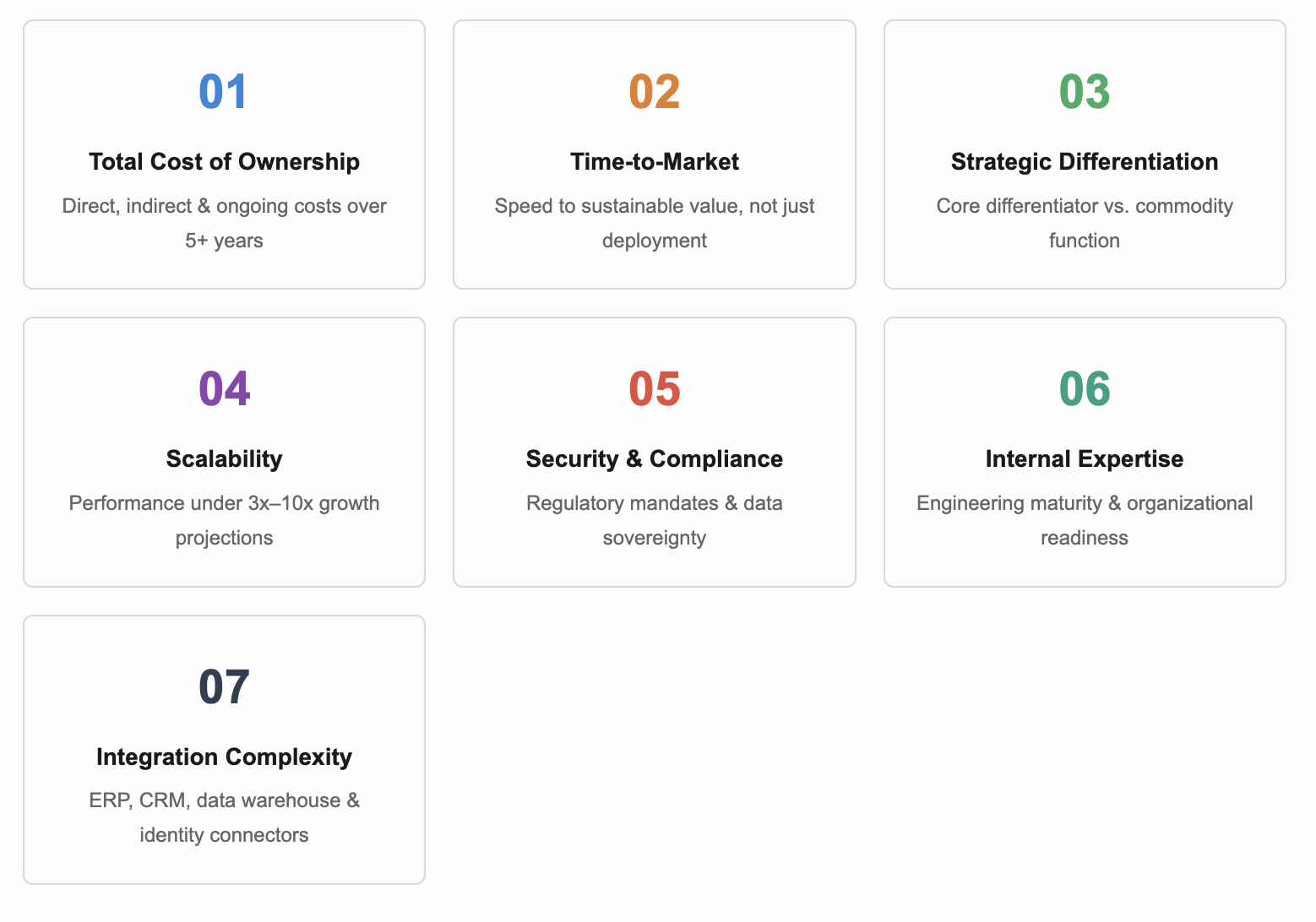
The seven primary dimensions of every build vs. buy evaluation
Total Cost of Ownership (TCO)
Cost analysis must extend well beyond initial licensing or development expenses. A robust TCO model captures direct costs (licenses, infrastructure, development labor), indirect costs (training, change management, opportunity cost of delayed delivery), and ongoing costs (maintenance, upgrades, support staff). In our experience, organizations that evaluate only upfront costs systematically underestimate the true investment by 40–60% over a five-year horizon. For a detailed breakdown of what these costs look like in practice, our guide to custom software development pricing provides useful benchmarks.
Time-to-Market
The urgency of deployment is a critical differentiator. Off-the-shelf solutions can typically be configured and deployed within weeks to months, while custom development cycles frequently span 12–24 months for enterprise-grade systems. However, rapid deployment of a misaligned product can generate technical debt that ultimately slows the organization more than a measured custom build. The right question is not simply “how fast?” but “how fast to sustainable value?”
Strategic Importance and Differentiation
Perhaps the single most important criterion is whether the capability in question constitutes a source of competitive differentiation. Processes that are core to the business model — pricing engines, proprietary analytics platforms, customer-facing experiences — often justify custom development. By contrast, commodity functions such as HR management, basic accounting, or email infrastructure rarely warrant bespoke solutions.
Advisory Insight: We recommend applying the “differentiation test” early in the evaluation. If a capability would be equally effective whether built or bought, the default should be to buy. Reserve custom development resources for the 15–20% of capabilities that genuinely differentiate your business.
Scalability and Performance Requirements
Growth projections matter. A solution that performs well at current volumes may fail under 3x or 10x load. Custom-built systems offer architectural control to design for anticipated scale, while commercial products may impose throughput constraints or require premium tier upgrades. Conversely, leading SaaS vendors invest heavily in elastic infrastructure that can be difficult and expensive to replicate in-house.
Security, Compliance, and Data Sovereignty
Regulatory requirements and data sensitivity can strongly favor one approach over the other. Highly regulated industries (financial services, healthcare, defense) may require the granular control of custom development to meet audit and compliance obligations. Conversely, reputable SaaS vendors often maintain security certifications (SOC 2, ISO 27001, HIPAA) that would be prohibitively expensive for individual organizations to achieve independently.
Internal Expertise and Organizational Readiness
Building software demands sustained access to skilled engineering talent, mature development practices (CI/CD, automated testing, DevOps), and organizational patience for iterative delivery. Organizations lacking these capabilities face elevated execution risk. Buying, while requiring less technical depth, demands strong vendor management, systems integration skills, and change management discipline.
Integration Complexity
No software system operates in isolation. The ease with which a solution integrates with existing enterprise systems (ERP, CRM, data warehouses, identity providers) significantly influences both cost and risk. Custom systems offer API-first design possibilities but require integration to be explicitly engineered. Commercial products typically provide standard connectors but may impose constraints on data models and workflows.
Benefits and Drawbacks of Building Custom Software
Building custom software offers maximum control and differentiation potential, but at the cost of higher investment, longer timelines, and elevated execution risk. This section provides a balanced analysis of both sides to help decision-makers weigh the trade-offs realistically.
Benefits of Building
Full Control Over Features and Architecture. Custom development affords complete control over the technology stack, feature set, user experience, web application architecture, and system architecture. This enables organizations to optimize for their specific workflows, data models, and performance requirements without compromise. For businesses where software is the product or a primary competitive lever, this control is invaluable.
Competitive Differentiation. Proprietary software can become a durable competitive moat. When core business logic is embedded in custom code, competitors cannot simply purchase the same capability. This is particularly relevant in industries where algorithmic advantage, unique data processing, or differentiated user experience drive market share.
Long-Term Return on Investment. While initial investment is higher, custom software eliminates recurring license fees and vendor dependency. Over a 5–10 year horizon, the total cost of a well-maintained custom system can be lower than cumulative SaaS subscription costs, particularly at enterprise scale where per-seat or per-transaction pricing becomes significant.
Intellectual Property Ownership. Building creates an asset on the balance sheet. The resulting intellectual property can be leveraged, licensed, or monetized independently. This is especially attractive for technology-forward companies seeking to diversify revenue streams or increase enterprise valuation.
Drawbacks of Building
Higher Upfront Cost and Longer Time-to-Value. Custom development requires substantial upfront investment in talent, infrastructure, and project management. Enterprise software projects commonly exceed initial budget estimates by 30–80%, and timelines frequently overrun by 50% or more. Organizations must be prepared for sustained investment before realizing returns. For a granular view of engineering labor costs across different engagement models, our analysis of software development cost per hour provides useful benchmarks for budget planning.
Execution Risk and Complexity. Software development at scale is inherently complex. Requirements evolve, technical challenges emerge, and market conditions shift. Without mature engineering practices — such as agile sprint-based delivery — and experienced leadership, custom projects face significant risk of scope creep, quality deficiencies, and outright failure. Industry data suggests that approximately 20% of large-scale custom IT projects fail to deliver their intended objectives.
Ongoing Maintenance Burden. The initial build represents only a fraction of total lifecycle cost. Custom systems require continuous investment in bug fixes, security patches, feature enhancements, infrastructure management, and technical debt remediation. Organizations must commit to perpetual engineering capacity, typically 15–20% of the original development team size.
Talent Dependency. Custom systems create knowledge concentration risk. When key engineers depart, institutional knowledge of complex codebases can be lost, increasing maintenance costs and slowing future development. This risk is amplified in competitive labor markets for software engineering talent.
Benefits and Drawbacks of Buying Software
Purchasing commercial or SaaS software prioritizes speed and operational simplicity, but introduces trade-offs around vendor dependency, customization limits, and long-term cost accumulation. This section examines the advantages and risks of the buy path with equal rigor.
Benefits of Buying
Faster Time-to-Market. Commercial software, whether on-premise or SaaS, can be deployed in a fraction of the time required for custom development. For organizations under competitive pressure or regulatory deadlines, this speed advantage can be decisive. Leading enterprise SaaS platforms can be configured and operational within 4–12 weeks for standard use cases.
Lower Initial Investment. The subscription or licensing model distributes cost over time, reducing the capital outlay required at project inception. This is particularly advantageous for mid-market organizations or business units operating under constrained budgets. OpEx-based pricing also simplifies financial planning and reduces risk of sunk-cost scenarios.
Access to Vendor R&D and Best Practices. Established software vendors invest heavily in research, development, and industry-specific expertise. By purchasing, organizations benefit from continuous product innovation, security updates, and evolving best practices without bearing the full R&D cost. This is especially valuable in rapidly changing domains such as cybersecurity, data analytics, and regulatory compliance.
Reduced Operational Overhead. SaaS and managed solutions transfer infrastructure management, uptime responsibility, and routine maintenance to the vendor. This frees internal IT teams to focus on higher-value activities such as strategic architecture, data governance, and digital innovation rather than operational firefighting.
Drawbacks of Buying
Vendor Lock-In. Dependency on a single vendor creates strategic risk. Migration costs can be prohibitive, and vendors may leverage lock-in to increase pricing, alter terms, or deprecate features. Organizations should evaluate exit costs and data portability provisions before committing to any commercial platform.
Limited Customization. Off-the-shelf products are designed for broad market appeal, which inevitably means compromises for individual buyers. Customization options may be insufficient for complex or unique business processes. Over-customizing a commercial platform (a common anti-pattern) can create a hybrid system that combines the worst attributes of both approaches: high cost, fragility, and upgrade complexity.
Cumulative Licensing Costs. While initial costs are lower, subscription-based pricing accumulates over time. For large organizations with thousands of users, annual SaaS costs can rival or exceed the amortized cost of custom development within 3–5 years. Price escalation clauses in vendor contracts compound this effect.
Data and Security Considerations. Entrusting sensitive data to third-party platforms introduces supply chain risk. While leading vendors maintain strong security postures, organizations must conduct rigorous due diligence on data handling practices, breach notification procedures, data residency, and subprocessor management. Regulatory frameworks increasingly place accountability on the data controller, regardless of where processing occurs.
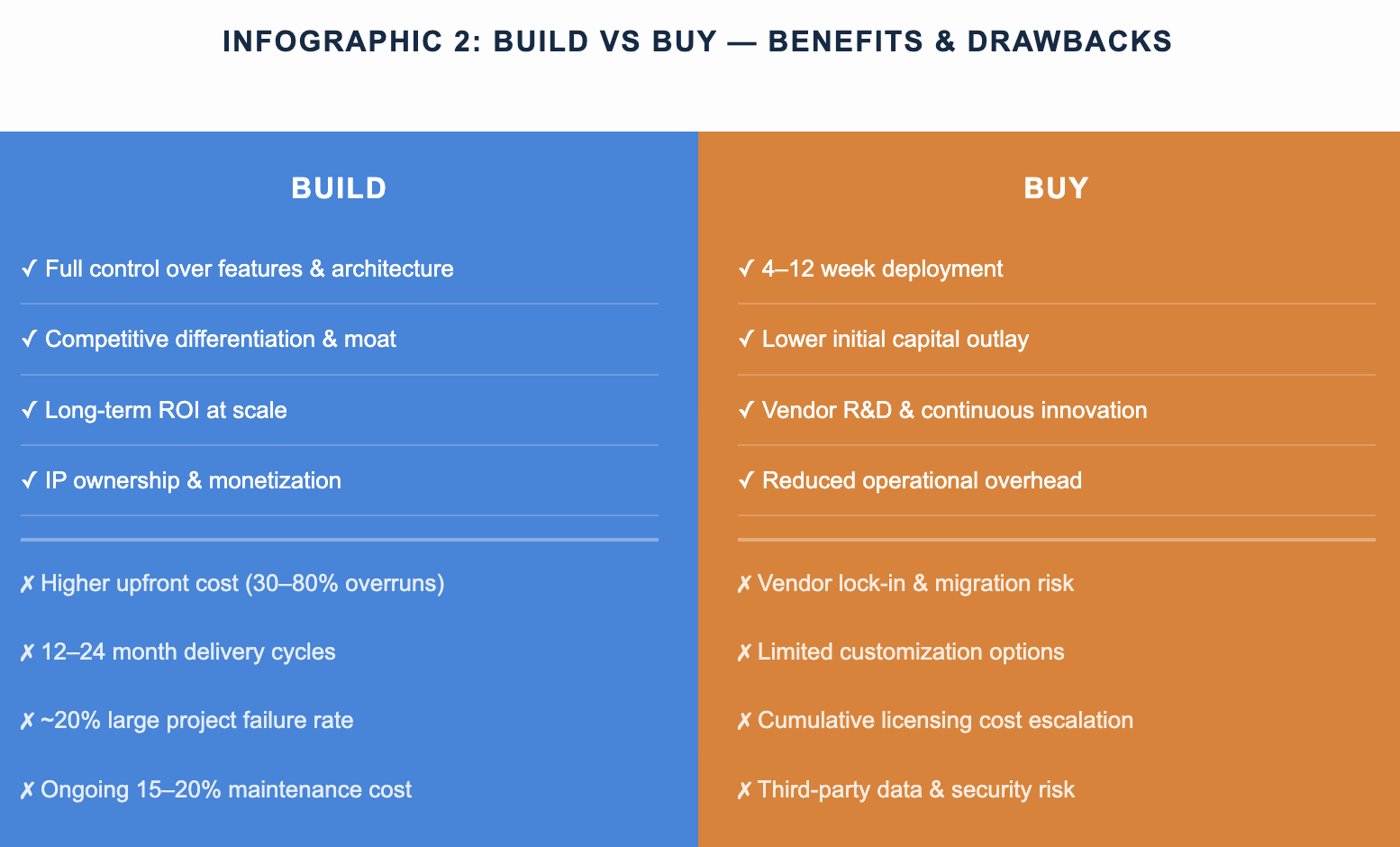
Build vs Buy — comparative benefits and drawbacks at a glance
Decision-Making Frameworks and Processes
Understanding the factors and trade-offs is necessary but not sufficient — organizations need structured methods to translate analysis into a defensible recommendation. This section presents five proven frameworks and introduces the hybrid approach as a practical alternative to a binary choice.
Cost-Benefit Analysis (CBA)
A structured CBA quantifies the financial impact of each option over the investment horizon (typically 5–7 years). The analysis should encompass all direct costs (development, licensing, infrastructure), indirect costs (training, productivity loss during transition, opportunity cost), and expected benefits (revenue uplift, cost avoidance, efficiency gains). We recommend using net present value (NPV) to account for the time value of money and to enable apples-to-apples comparison across options with different cost and benefit timing profiles. Sensitivity analysis should be applied to key assumptions — particularly development timeline, user adoption rates, and vendor pricing trajectories — to understand how conclusions shift under alternative scenarios.
Total Cost of Ownership (TCO) Model
TCO extends beyond CBA by capturing the full lifecycle cost of each option. A rigorous TCO model includes the following cost categories:
| Cost Category | Build | Buy |
|---|---|---|
| Initial Development / Licensing | High (engineering labor, tooling) | Moderate (license + implementation) |
| Implementation & Configuration | Included in development | Moderate (SI partner, configuration) |
| Infrastructure | Ongoing (cloud or on-premise) | Typically included in SaaS |
| Maintenance & Updates | 15–20% of build cost annually | Included in subscription |
| Training & Change Management | Moderate | Moderate |
| Opportunity Cost | High (diverted engineering capacity) | Low |
| Exit / Migration | Low (owned code) | High (data migration, retraining) |
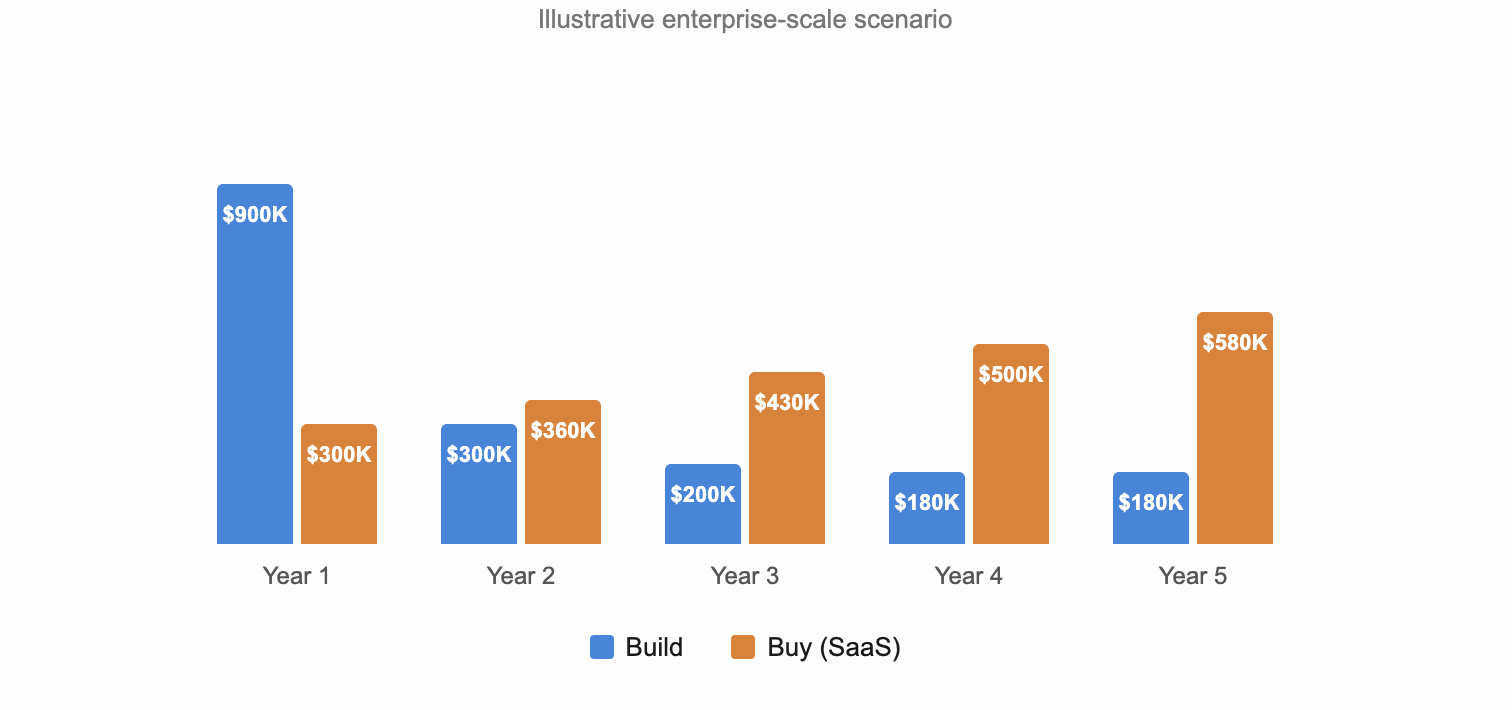
Illustrative enterprise-scale scenario: annual costs by year (Build vs Buy)
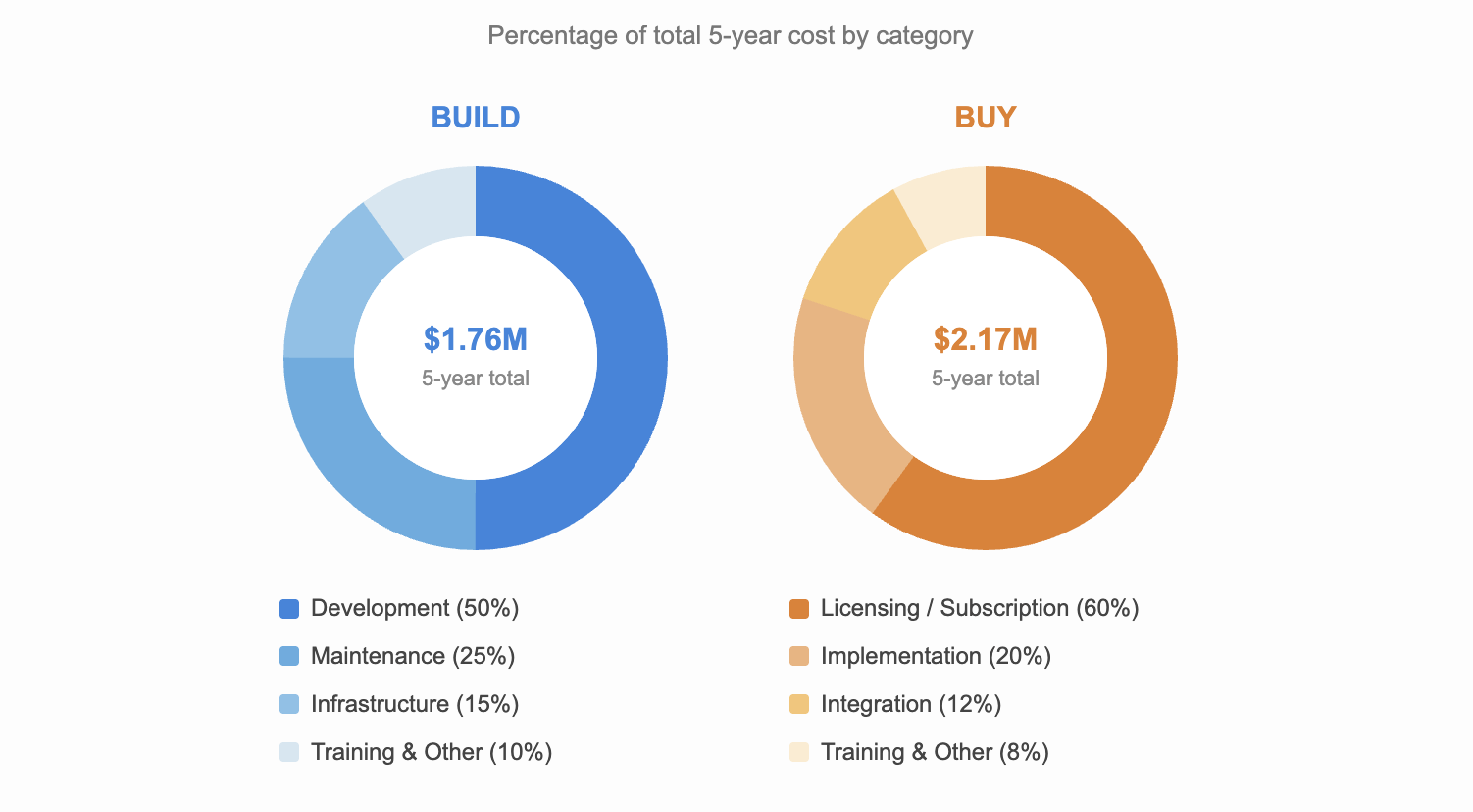
Percentage of total 5-year cost by category: $1.76M (Build) vs $2.17M (Buy)
Strategic Value Assessment
Not all software decisions are primarily financial. The strategic value assessment evaluates each option against the organization’s competitive positioning, digital maturity ambitions, and long-term technology roadmap. We recommend plotting capabilities on a 2×2 matrix of Strategic Importance (vertical axis) versus Market Availability (horizontal axis):
- High Strategic Importance, Low Market Availability → Build. This is your core differentiator; custom development is typically justified.
- High Strategic Importance, High Market Availability → Evaluate carefully. Consider building if differentiation is at stake, or buying a best-in-class platform and customizing selectively.
- Low Strategic Importance, High Market Availability → Buy. Commodity capability — adopt the market standard and focus resources elsewhere.
- Low Strategic Importance, Low Market Availability → Simplify. Question whether the capability is truly needed, or if the process can be redesigned to use available tools.
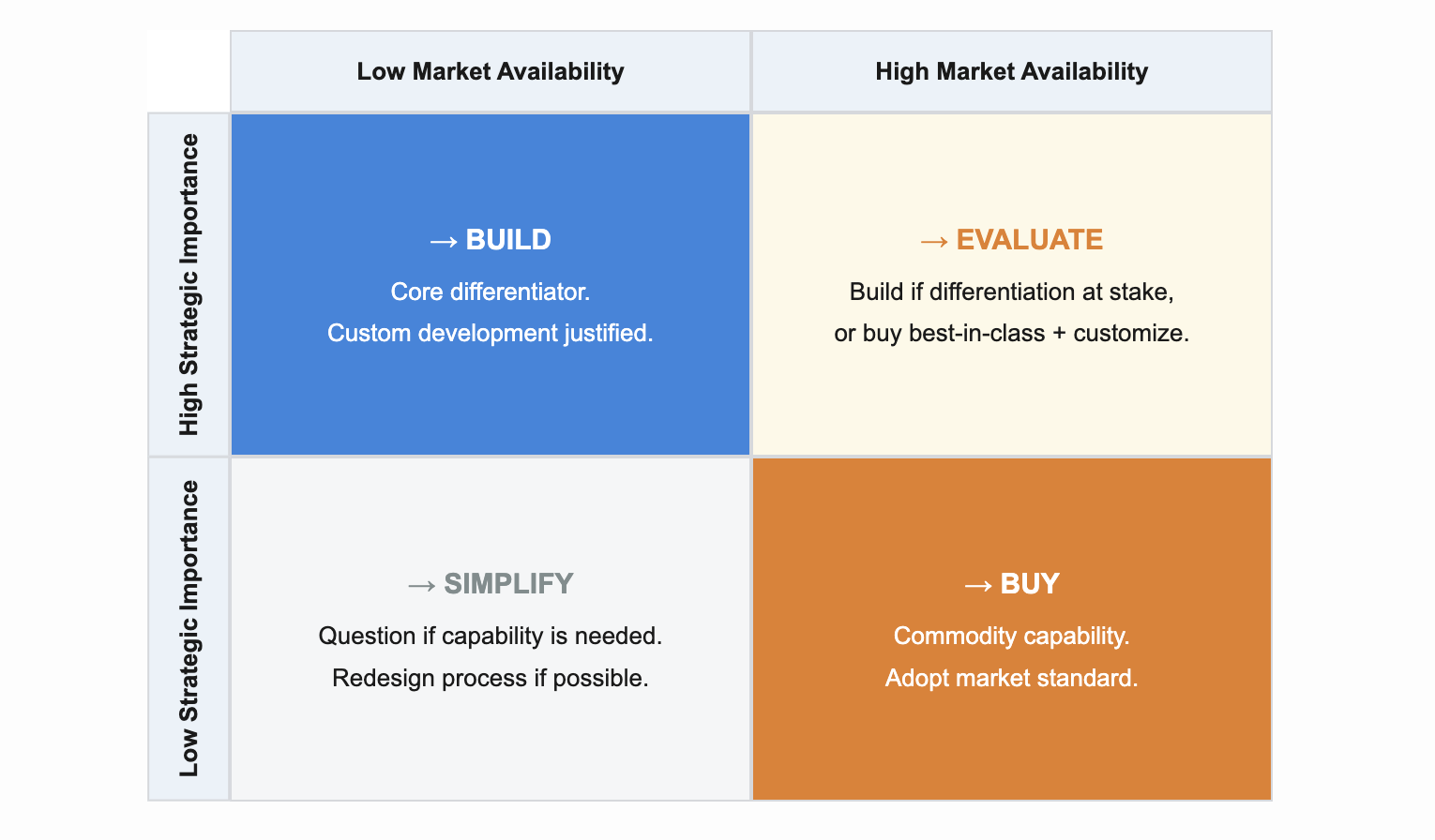
Strategic Value Assessment: 2×2 matrix of Strategic Importance vs. Market Availability
Risk Matrix
Every technology decision carries risk. A formal risk assessment should evaluate the following dimensions for both the build and buy options:
| Risk Dimension | Build Risk | Buy Risk |
|---|---|---|
| Execution / Delivery | High — project overruns, scope creep | Low — proven product |
| Vendor / Partner | Low — internal control | High — vendor viability, lock-in |
| Technology Obsolescence | Medium — architectural choices | Medium — vendor roadmap alignment |
| Security | Variable — depends on internal maturity | Variable — depends on vendor posture |
| Talent | High — recruitment, retention | Low — less specialized need |
| Scalability | Medium — requires deliberate architecture | Low–Medium — vendor-managed |
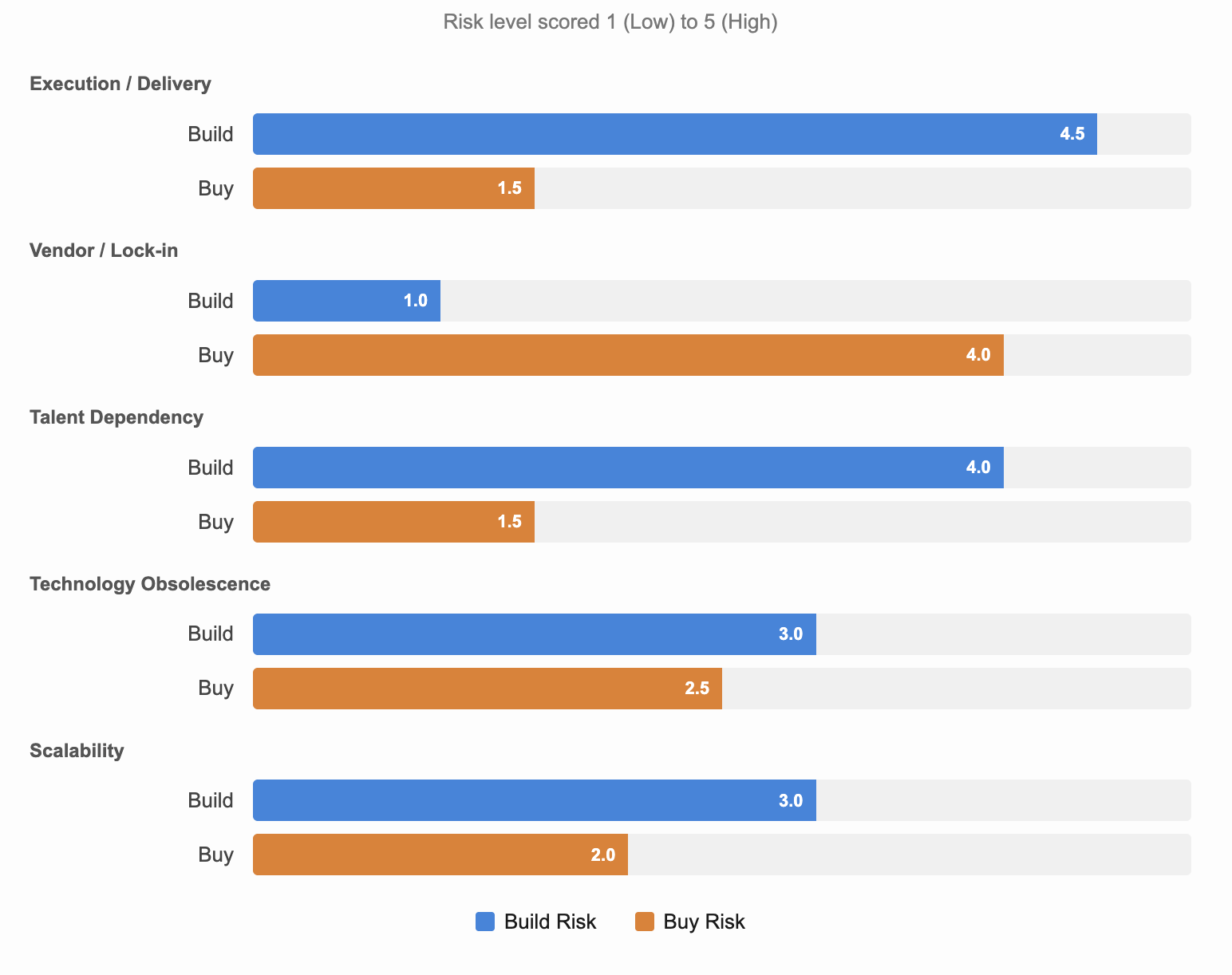
Risk level by dimension scored 1 (Low) to 5 (High): Build vs Buy
Weighted Scoring Model
For decisions involving multiple stakeholders with competing priorities, a weighted scoring model provides a transparent and defensible evaluation process. The approach involves defining evaluation criteria (cost, time, risk, strategic fit, scalability, security, integration), assigning weights reflecting organizational priorities, scoring each option against each criterion on a standardized scale (e.g., 1–5), and calculating weighted totals. This model is particularly effective in governance-heavy environments where investment committees require a structured justification for technology spending. It also surfaces implicit disagreements among stakeholders about organizational priorities, making it a useful facilitation tool beyond its analytical value.
Hybrid and Phased Approaches
The build vs. buy decision need not be binary. In many cases, the optimal strategy combines elements of both. Common hybrid patterns include:
- Buy and extend: purchasing a commercial platform for the foundation and building custom modules or integrations on top of it.
- Buy now, build later: starting with a purchased solution to address immediate needs and migrating to a custom-built platform over time as requirements stabilize.
- API-first composability: using an API-first architecture that allows specific components to be swapped between vendor and custom implementations based on evolving needs.
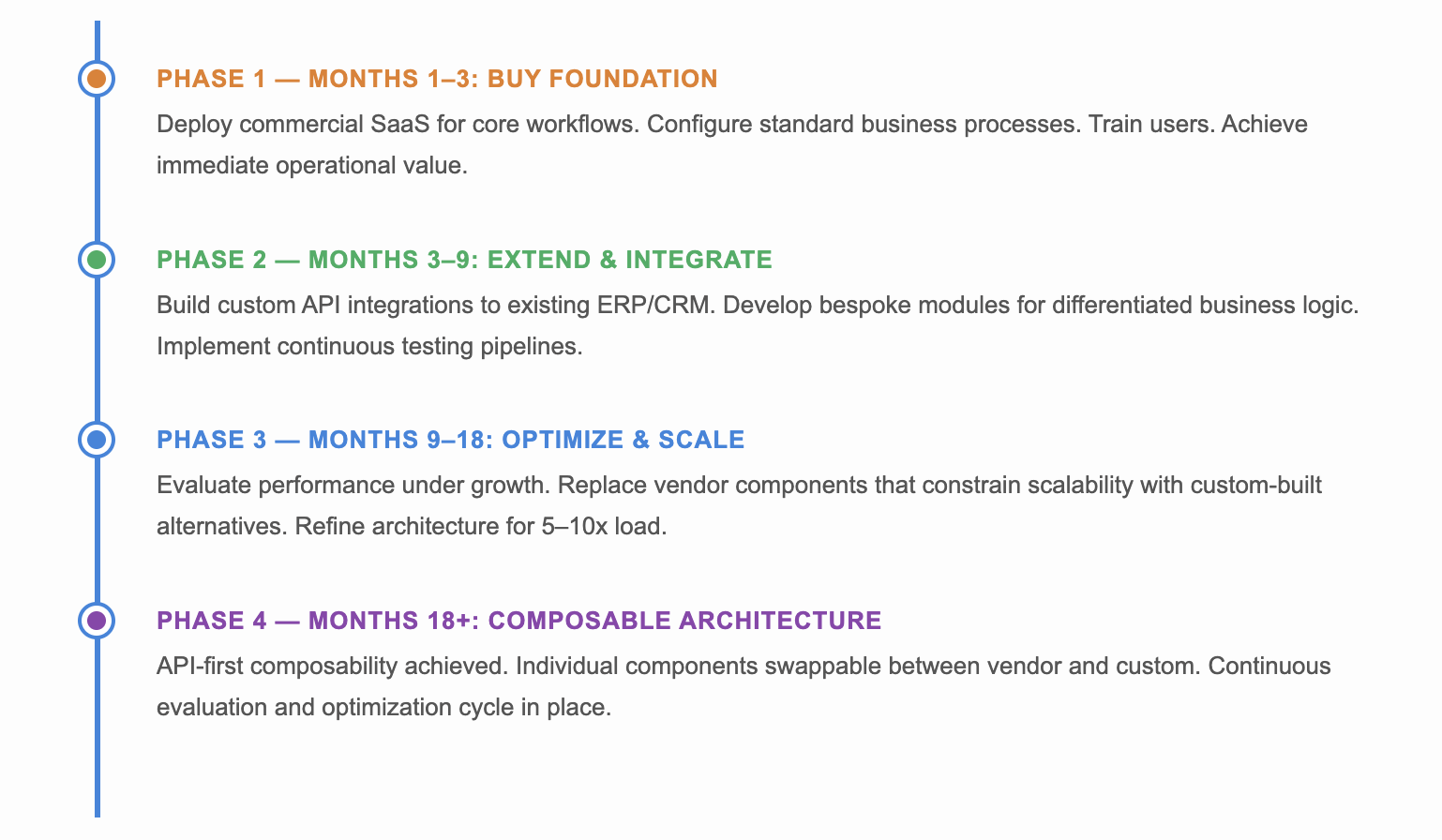
Hybrid build vs. buy roadmap: four phases from foundation to composable architecture
Summary and Final Considerations
This section synthesizes the analysis into actionable guidance for SD Company. It covers strategic alignment, requirements discipline, budget and ROI planning, solution comparison methodology, testing and resource readiness, and concrete next steps to operationalize the decision-making process.
Aligning the Decision with Business Objectives
The build vs. buy decision is one of the most consequential technology investment choices an enterprise faces. To deliver lasting value, the decision must be anchored in the organization’s business objectives — not in technology preferences, vendor relationships, or engineering ambitions alone. Every element of the evaluation — from budget allocation to solution comparison — should trace directly back to what the business is trying to achieve.
SD Company’s business objectives should serve as the primary filter at every stage of the decision-making process. Whether the objective is accelerating revenue growth, improving operational efficiency, entering new markets, or strengthening regulatory compliance, the chosen software path must demonstrably advance those goals. When business objectives are ambiguous or undocumented, the risk of misalignment between technology investments and strategic outcomes increases substantially.
We strongly advise formalizing business objectives into measurable targets before initiating any build vs. buy evaluation. This ensures that every subsequent analysis — cost modeling, solution comparison, resource planning — has a clear reference point against which options can be scored.
Understanding Business Requirements Before Deciding
A rigorous decision-making process begins with comprehensive requirements gathering. Business requirements define what the software must accomplish in the context of the organization’s operations, while functional requirements specify the discrete features and capabilities the system must provide. Non-functional requirements — performance benchmarks, uptime guarantees, scalability thresholds, security standards, and compliance mandates — are equally critical and are frequently underweighted in early-stage evaluations.
Functional Requirements. Functional requirements describe the specific behaviors, features, and interactions the system must support. Examples include transaction processing rules, reporting outputs, user role hierarchies, workflow automation logic, and data import/export formats. When evaluating a buy option, functional requirements serve as the acceptance checklist against vendor feature matrices. When evaluating a build option, functional requirements form the product backlog that drives development estimation and sprint planning. Organizations that skip formal functional requirements documentation frequently discover gaps only after implementation has begun — resulting in scope creep, budget overruns, and delayed return on investment.
Non-Functional Requirements. Non-functional requirements define the quality attributes that determine whether a system is fit for purpose under real-world conditions. These include response time and latency targets, concurrent user capacity, disaster recovery and failover expectations, data encryption and access control standards, and regulatory audit trail requirements. Non-functional requirements have a direct impact on budget: a system designed for 99.99% uptime costs significantly more than one targeting 99.5%. They also influence the solution comparison, as commercial products and custom-built systems often differ dramatically in their ability to meet stringent non-functional requirements without extensive customization or premium licensing tiers.
Mapping Requirements to Business Processes. Both functional requirements and non-functional requirements must be validated against existing business processes. A system that meets every technical specification but disrupts established business processes will face adoption resistance and require costly change management. Conversely, a system that mirrors current business processes but fails to support process improvement or growth will become a constraint rather than an enabler. We recommend conducting business process mapping workshops to document current-state workflows, identify pain points, and define target-state business processes before finalizing requirements. This ensures the solution — whether built or bought — is designed to support how the business actually operates and how it intends to evolve.
Budget Planning and Return on Investment
Setting a Realistic Budget. Budget is often treated as a fixed constraint when it should be treated as a strategic variable. The appropriate budget depends on the strategic importance of the capability, the complexity of business requirements, and the expected return on investment. Organizations that set an arbitrary budget ceiling before understanding requirements risk either underfunding a critical initiative or overspending on a commodity solution. A well-structured budget should include initial costs (development labor or licensing fees), implementation costs (configuration, integration, data migration, training), ongoing costs (maintenance, subscription renewals, infrastructure, support staff), hidden costs (opportunity cost of diverted resources, productivity loss during transition), and contingency (typically 15–25% of total estimated budget for unforeseen complexities).
Calculating Return on Investment. Return on investment is the ultimate measure of whether a technology decision delivered value. However, return on investment calculations for software investments must go beyond simple cost savings to capture revenue enablement, risk reduction, speed-to-market gains, and operational efficiency improvements. For build options, return on investment typically materializes over a longer horizon (3–7 years) due to higher upfront investment, but can be substantial when the software becomes a competitive differentiator or eliminates recurring licensing costs at scale. For buy options, return on investment often appears faster due to lower initial outlay and rapid deployment, but cumulative subscription costs and limited customization may reduce long-term return on investment. We recommend modeling return on investment under three scenarios — conservative, baseline, and optimistic — to provide decision-makers with a range of expected outcomes rather than a single-point estimate.
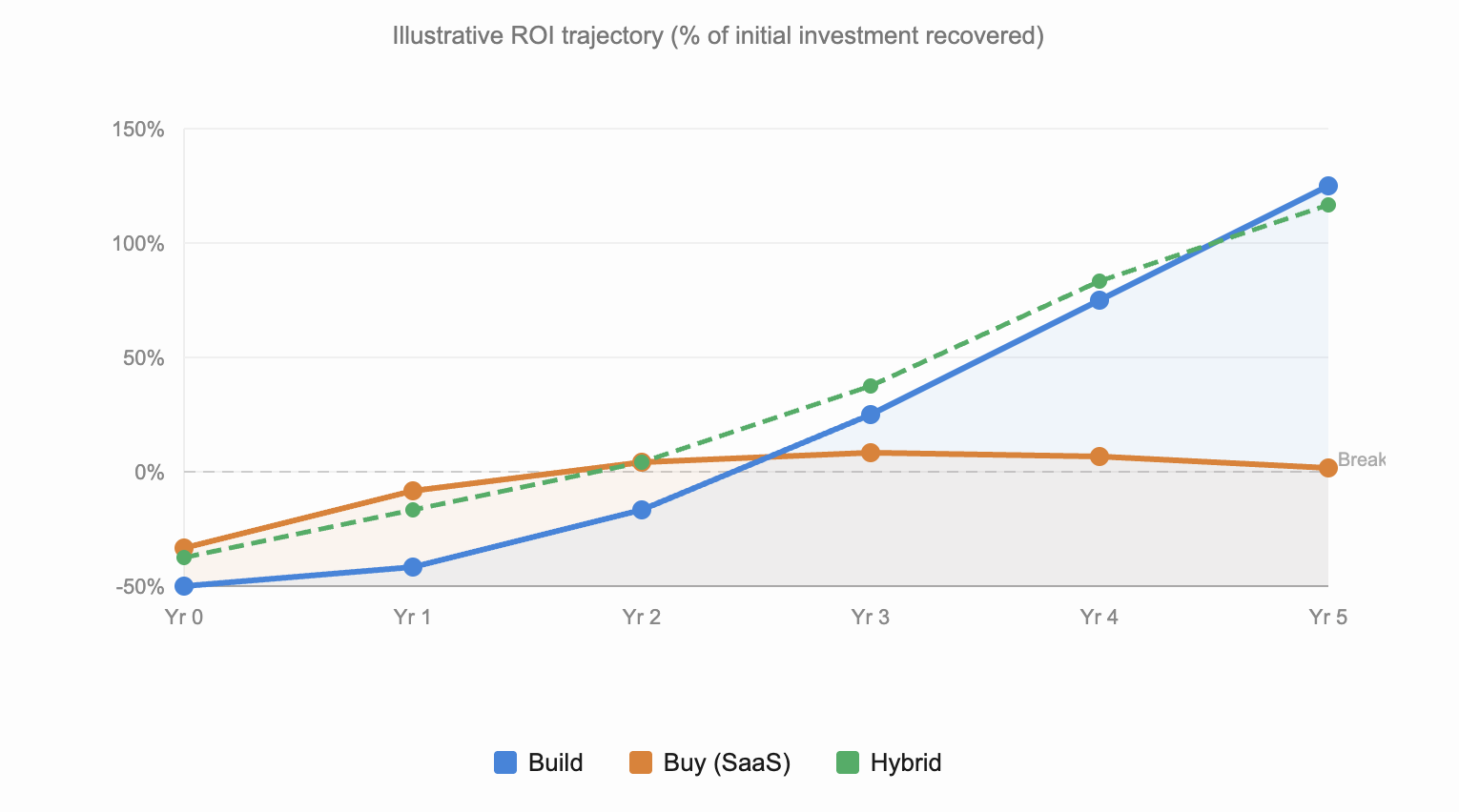
Illustrative ROI trajectory (% of initial investment recovered): Build vs Buy vs Hybrid
Structuring the Solution Comparison
A robust solution comparison is the backbone of any defensible build vs. buy recommendation. The solution comparison must be systematic, multi-dimensional, and directly tied to documented business requirements and business objectives.
Solution Comparison Framework. We advise SD Company to structure the solution comparison across the following dimensions, with weights reflecting the relative priority of each dimension to business objectives:
| Comparison Dimension | Build Evaluation | Buy Evaluation |
|---|---|---|
| Functional requirements | Can engineering deliver all required features within timeline and budget? | Does the product cover functional requirements out of the box or via configuration? |
| Non-functional requirements | Can the architecture be designed to meet performance, security, and scalability targets? | Does the vendor guarantee non-functional requirements in SLAs? |
Scoring the Solution Comparison. Each option should be scored on a standardized scale (1–5) against every dimension, with scores weighted by the strategic priority derived from business objectives. The resulting weighted totals provide a quantitative basis for the recommendation while making trade-offs explicit and auditable. A well-executed solution comparison also surfaces hidden risks: a buy option may score highly on speed and budget but poorly on business process fit, signaling future change management challenges. A build option may score well on functional requirements coverage but poorly on resources and timeline, indicating execution risk.
The Role of Continuous Testing
Continuous testing is a critical success factor regardless of whether the organization builds or buys. In a build scenario, continuous testing — encompassing automated unit tests, integration tests, regression suites, performance tests, and security scans — must be embedded in the development lifecycle from inception. Without continuous testing, custom software projects accumulate defects that erode quality, inflate maintenance costs, and delay return on investment.
In a buy scenario, continuous testing remains essential for validating vendor releases, custom integrations, data migration accuracy, and business process workflows after each update. Organizations that omit continuous testing for purchased software frequently encounter regression issues following vendor updates that disrupt business processes and erode user trust. We recommend that SD Company establish continuous testing as a non-negotiable requirement in both build and buy evaluation criteria. The resources allocated to continuous testing should be explicitly included in the budget, whether as engineering headcount (build) or as QA tooling and integration testing effort (buy).
Resource Planning and Growth Readiness
Assessing Available Resources. The feasibility of each option depends critically on available resources — encompassing engineering talent, project management capacity, QA expertise, infrastructure, vendor management skills, and executive sponsorship. A build decision made without adequate resources leads to project failure; a buy decision made without integration and change management resources leads to shelfware. Resource assessment should be conducted early in the decision-making process and should account for current availability, competing priorities, hiring timelines, and the organization’s ability to retain critical talent over the project lifecycle. If the required resources are not available internally and cannot be acquired within the timeline, this factor alone may determine whether building is viable.
Planning for Growth. Growth is the variable most often underestimated in software investment decisions. A solution selected for current needs may become a bottleneck within 18–24 months if growth projections are not factored into the evaluation. The solution comparison should explicitly model how each option behaves under projected growth scenarios — including user growth, data volume growth, transaction throughput growth, and geographic expansion. For build options, growth readiness requires deliberate architectural decisions (horizontal scalability, microservices, database sharding) and sustained investment in resources to maintain and evolve the platform. For buy options, growth readiness depends on the vendor’s infrastructure elasticity and pricing model — some vendors scale seamlessly while others impose steep per-unit cost increases that erode return on investment at scale. Organizations experiencing rapid growth should weight growth readiness heavily in the solution comparison and ensure that the selected option’s budget model remains sustainable at 3x and 10x current volumes.
Decision Signals
To further guide SD Company’s decision-making process, we offer the following heuristic signals derived from the evaluation framework:
| Signal Favoring Build | Signal Favoring Buy |
|---|---|
| Capability is a core business differentiator tied to business objectives | Capability is a commodity or support function outside core business processes |
| No adequate product satisfies functional requirements | Mature products meet both functional requirements and non-functional requirements |
| Organization has strong engineering resources and continuous testing maturity | Internal engineering resources are limited or better allocated elsewhere |
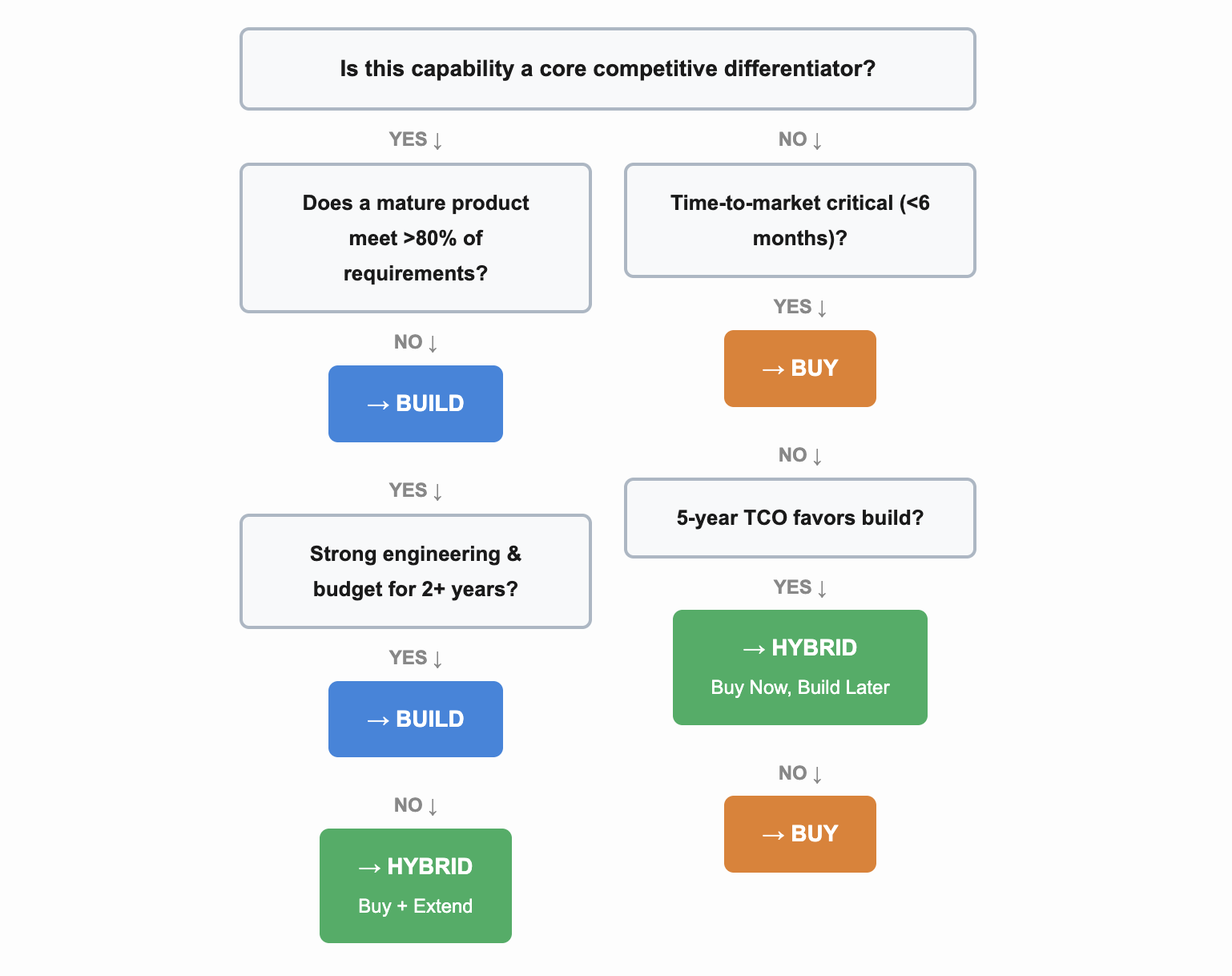
Build vs. Buy decision flowchart: a structured path to the right recommendation
Recommended Next Steps
We recommend SD Company pursue the following actions to operationalize the decision-making process described in this paper:
- Business Objectives Alignment Workshop: Convene business and technology leadership to formally document the business objectives that each software investment must support. Establish measurable KPIs for each objective.
- Requirements Gathering: For each capability under evaluation, conduct structured requirements workshops to document functional requirements, non-functional requirements, and current-state business processes. Ensure traceability from every requirement to a stated business objective.
- Budget and Return on Investment Modeling: Develop detailed 5-year budget models for the top 3–5 capabilities, calculating projected return on investment under conservative, baseline, and optimistic scenarios. Include all direct, indirect, and hidden costs.
- Solution Comparison Execution: Conduct a formal solution comparison for each capability using the weighted scoring framework outlined in Section 6.4. Evaluate at minimum three vendor options per buy-candidate against documented business requirements.
- Resource and Readiness Assessment: Audit available engineering, QA, and vendor management resources. Assess continuous testing maturity and DevOps capabilities. Identify resource gaps and develop hiring or contracting plans to close them within the project timeline.
- Growth Scenario Planning: Model how each solution performs under 2x, 5x, and 10x growth scenarios. Validate that the budget model remains sustainable and that both functional requirements and non-functional requirements are met at projected scale.
- Governance Framework: Establish a standing technology investment review committee to own the decision-making process. The committee should include representation from business (to validate business objectives and business processes), technology (to evaluate functional requirements, non-functional requirements, and continuous testing readiness), finance (to oversee budget and return on investment), and risk (to assess vendor, execution, and growth risks). Apply these frameworks consistently to all future build vs. buy decisions.
Closing Perspective
The build vs. buy question will recur throughout SD Company’s growth trajectory. The goal is not to arrive at a single universal answer, but to develop institutional capability for making these decisions well — rapidly, rigorously, and with a clear connection to business objectives.
Organizations that embed a disciplined decision-making process — anchored in clearly documented business requirements (both functional requirements and non-functional requirements), realistic budget planning, structured solution comparison, robust continuous testing practices, honest resource assessment, and forward-looking growth modeling — consistently outperform those that treat technology decisions as ad hoc procurement exercises. They achieve stronger return on investment, build more resilient business processes, and allocate resources more effectively toward the capabilities that truly drive competitive differentiation.
The frameworks and methodologies presented in this paper are designed to be repeatable and scalable. We welcome the opportunity to support SD Company in applying them to specific investment decisions through facilitated workshops, detailed business case development, and ongoing advisory engagement.
FAQ
What is the build vs. buy software decision?+
The build vs. buy software decision is a strategic technology choice between developing a custom software solution in-house or purchasing an existing commercial product. It sits at the intersection of financial planning, competitive positioning, and organizational capability. The decision affects cost structures, time-to-market, long-term scalability, and the degree of control an organization has over its technology assets. Most enterprises face this decision during digital transformation programs, scaling inflection points, competitive disruptions, or post-merger technology rationalization.
What are the main factors to consider when choosing to build or buy software?+
The seven primary factors in any build vs. buy evaluation are: total cost of ownership (TCO) over a 5–7 year horizon, time-to-market requirements, strategic importance and competitive differentiation, scalability and performance targets, security and compliance obligations, internal engineering talent and organizational readiness, and integration complexity with existing enterprise systems. No single factor determines the outcome — a robust decision requires a multi-dimensional assessment that weights each criterion according to organizational priorities.
What are the main advantages of building custom software?+
The primary advantages of building custom software are full control over the technology stack and feature set, competitive differentiation through proprietary business logic, intellectual property ownership that creates a balance sheet asset, and lower long-term costs compared to cumulative SaaS subscriptions at enterprise scale. Custom software is particularly justified when the capability is a core differentiator, when no off-the-shelf product satisfies functional requirements, and when the organization has mature engineering resources and continuous testing practices.
When should a company buy software instead of building it?+
Buying commercial or SaaS software is typically the right choice when the capability is a commodity function not tied to competitive differentiation (such as HR management, basic accounting, or email infrastructure), when time-to-market pressure is high and deployment within weeks is required, when internal engineering resources are limited or better directed toward core product development, and when mature products already satisfy both functional and non-functional requirements. A practical heuristic: if a capability would be equally effective whether built or bought, the default should be to buy.
How do you calculate total cost of ownership for build vs. buy?+
A rigorous TCO model must capture all cost categories over a 5–7 year horizon: initial development or licensing costs, implementation and configuration expenses, infrastructure (cloud or on-premise), ongoing maintenance (typically 15–20% of build cost annually for custom systems), training and change management, opportunity cost of diverted engineering resources, and exit or migration costs. Organizations that evaluate only upfront costs systematically underestimate the true investment by 40–60%. For buy options, price escalation clauses in vendor contracts and per-seat pricing at scale must also be factored in.
What is a hybrid build vs. buy approach?+
A hybrid approach combines elements of both building and buying to optimize for cost, speed, and differentiation. Common hybrid patterns include: buy and extend (purchasing a commercial platform and building custom modules or integrations on top), buy now build later (deploying a purchased solution immediately while planning a custom migration as requirements stabilize), and API-first composability (using an API-first architecture that allows individual components to be swapped between vendor and custom implementations as needs evolve). In many enterprise contexts, the optimal answer is neither purely build nor purely buy.
How does the build vs. buy decision affect long-term ROI?+
The impact on long-term ROI differs significantly between options. Custom-built software typically requires a longer payback period (3–7 years) due to higher upfront investment, but can generate substantial returns when the system becomes a competitive differentiator or eliminates recurring licensing costs at enterprise scale. Bought software delivers faster initial ROI due to lower upfront cost and rapid deployment, but cumulative subscription fees, limited customization, and vendor lock-in risk may reduce long-term returns. ROI should be modeled under conservative, baseline, and optimistic scenarios to account for uncertainty in development timelines, user adoption rates, and vendor pricing trajectories.
Conclusion
The build vs. buy decision is not a one-time event — it is a recurring strategic discipline that shapes the trajectory of any technology-driven organization. Throughout this paper, we have examined the question from multiple angles: cost structure, time-to-market, competitive differentiation, scalability, security, organizational readiness, and integration complexity. Several conclusions emerge clearly from this analysis.
First, there is no universally correct answer. The right choice depends entirely on the specific capability in question, the organization’s strategic context, and the maturity of available alternatives. A company that builds everything wastes resources on commodity problems; a company that buys everything surrenders control over the capabilities that matter most.
Second, the quality of the decision depends on the quality of the process. Organizations that invest in structured evaluation — formal requirements gathering, total cost of ownership modeling, weighted solution comparison, and risk assessment — consistently make better technology investment decisions than those relying on intuition, vendor pitches, or engineering preference. The frameworks presented in Sections 5 and 6 of this paper are designed to bring that structure to SD Company’s decision-making.
Third, the cost of getting it wrong is asymmetric. A poor build decision typically manifests as years of mounting technical debt, budget overruns, and opportunity cost. A poor buy decision typically manifests as vendor lock-in, workflow compromises, and escalating subscription costs that erode long-term return on investment. Both failure modes are expensive, but they are expensive in different ways — and understanding which risk profile is more acceptable to the organization is itself a strategic input.
Fourth, hybrid approaches deserve serious consideration. The binary framing of “build or buy” often obscures the most practical path: buy the foundation, build the differentiation. API-first architectures, composable platforms, and phased migration strategies allow organizations to combine the speed of purchasing with the control of custom development — reducing risk on both sides.
Finally, the decision is only as good as its execution. Choosing to build without adequate engineering talent, continuous testing discipline, and sustained executive commitment will fail. Choosing to buy without strong vendor management, integration planning, and change management will underdeliver. Whichever path SD Company selects, the commitment to execution must match the ambition of the strategy.
The build vs. buy question will return — with the next product launch, the next market expansion, the next regulatory shift. SD Company’s competitive advantage lies not in always choosing one path over the other, but in developing the institutional muscle to evaluate each decision rigorously and act on it decisively. When the build path is chosen, selecting the right development partner is equally critical — our guide on how to choose a software development company provides a structured evaluation framework.